Hawk
a bird of prey belonging to the falcon family. There are 300 or 400 species of falcons, hawks, and eagles in the world; thirty or more are found in North America. They usually migrate in flocks but, in hunting and nesting, they are solitary birds. The hawk lives chiefly on insects and small mammals, such as field mice and ground squirrels. Bird students insist that few birds are caught by hawks and that their service in keeping fields free from destructive animals is so valuable that, aside from the sparrow hawk, their occasional theft in a poultry yard is not worth mention. They nest usually in trees, though in a prairie country they build in bushes or even on the ground. Eggs, two to six, according to the species. The female is larger, stronger, and bolder than the male. The hawk is swift and silent on the wing, so that its approach is not heard by its prey. The claws are formed for seizing and holding. The hawk strikes with the hinder claw in pouncing and grips with the other so as to hold firmly. When the leg is bent a cord or tendon closes the talons so that they cannot be opened without straightening the leg. When a hawk strikes an animal its settling weight, by bending the legs at the knees, serves to close the talons and clutch the prey. This gives a hawk and all birds of prey a grip such as a person would have if his hand could not be opened or shaken off so long as his arm were bent at the elbow. The bill is also strong and well adapted to tear flesh apart.
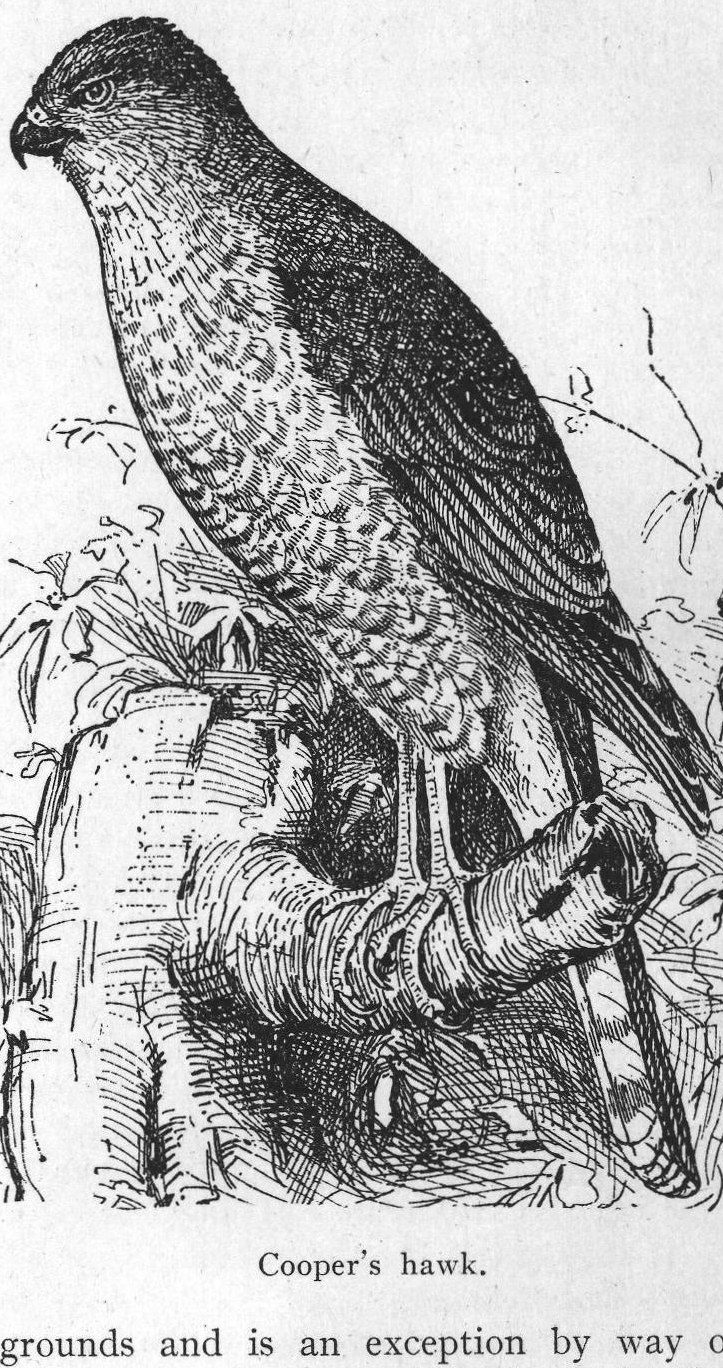
Among the hawks most often seen several deserve mention. The fish hawk or American osprey lives almost wholly on fish which it catches by darting from the wing. It nests usually in a tree in a swamp. The swallow-tailed hawk or kite, black above and white beneath, with long pinions and a forked tail, is ever on the wing. The snail hawk of Florida dives into shallow water for a snail, then flies to a low perch to enjoy it, picking out the flesh without injuring the shell. The marsh hawk, a gray, ashy bird above, white beneath, with a white patch on its rump, is about twenty inches long. It courses ceaselessly over low grounds and is an exception by way of nesting on the ground. The red-tailed hawk and the red-shouldered hawk are not infrequently called chicken hawks. Of 782 stomachs of chicken hawks examined by Dr. Fisher, of the United States Department of Agriculture, 120 contained poultry or birds; 390, mice; 171, other small mammals; 27, snakes; 69, frogs; 141, insects; 16, spiders; 15, crawfish; 3, fish; 1, centipedes; and 103 were empty. Of the duck hawk, the falcon of history, a less favorable report is made. The falcon lives almost entirely on ducks, teal, snipes, and other birds caught near the shore. The pigeon hawk, named from its appearance, lives chiefly on small birds. Other names are the rough-legged, the sharp-shinned, the short-tailed, the broad-winged, Cooper's, and Swainson's. Reviewing Dr. Fisher's examination of over 2,700 stomachs of hawks and owls, Dr. C. Hart Merriam, Chief of the Division of Ornithology, makes a strong plea for discrimination. He says:
Only six of the seventy-three species and subspecies of hawks and owls of the United States are injurious. Omitting the six species that feed largely on poultry and game, 2,212 stomachs were examined, of which fifty-six per cent contained mice and other small mammals, twenty-seven per cent insects, and only three and one-half per cent poultry and game birds.
The investigation seems to have been made with care. If the conclusions are correct, the farmer should shoot only the few species that prey on game and poultry. The other species should be encouraged to nest, and to assist the domestic cat in keeping down the number of squirrels and mice that are injurious to crops.