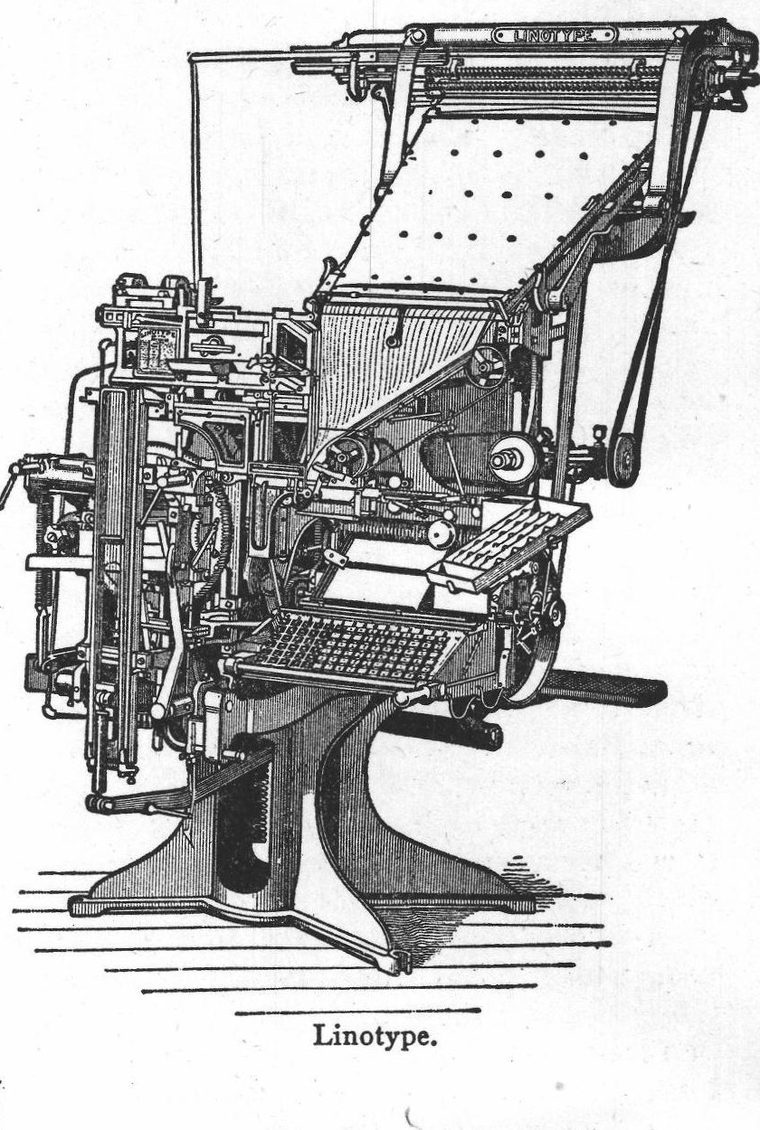
Linotype
lin'o-tip, a machine invented to do the work of a compositor or typesetter. It is not a typesetting machine, but produces a metal bar or slug having in relief on its edge the letters or characters from which to print a line of a newspaper or book. The machine is much too complicated for description, but its principal features are a magazine for storing the matrices from which the letters on the slug are cast; a keyboard like that of a typewriter which releases the matrices in the order they are required; a pot or vessel heated by gas which contains the molten metal used in casting the slug; and the machinery and devices necessary-to assemble the matrices in their order and convey them to the caster and back again to the magazine. Each letter on the keyboard has a corresponding groove or channel in the magazine, and when the key is depressed the matrix is released and conveyed by a traveling belt to the assembling point. Spaces between the words are provided for by spacebands, which fall into place when the spacebar of the keyboard is depressed. The matrices are assembled one by one, spaces being inserted as required. After enough matrices to make a line are assembled, they are automatically conveyed, on depressing a lever, to the casting mechanism where the line is justified or spaced out. This is done by means of the space-bands, which, as they are thrust upward, widen the spaces between the words forming the line of matrices uniformly from top to bottom until the line is of the required length. The heated metal is then forced by the stroke of a pump through small holes into a mold, the front of which is formed by the assembled line of matrices. After the cast is made the matrices and spacebands are separated, the spacebands deposited in a channel provided for their reception, and the matrices carried to the rear of the magazine and distributed, each letter in its own groove, by means of conveyor screws. Each slug as it is cast is shaved off and the superfluous metal removed. The slugs are deposited consecutively in a galley in the order in which they will appear on the printed page. The linotype is operated by a single person, who will ordinarily produce slugs equivalent to the type set by five hand compositors. The average rate is between 4,000 and 5,000 ems per hour, although this is exceeded, one operator having made a record of 13,287 ems per hour for eight hours.
The linotype is run by steam, electricity, or other power, a minimum of one-quarter horsepower being required for each machine. Lines of any sized type from five to thirty-six point can be produced, and of any length from five to thirty-six ems of pica, or from one to six inches. Each matrix has two dies cut in its face, one above the other, and the mechanism is such that the operator can produce at will Roman and italic or Roman and boldface letters, or the line may be part Roman and part italic or part Roman and part boldface. By setting in by hand matrices of other kinds as small caps, German, Greek, mathematical signs, etc., other characters may be introduced. The magazine can be removed readily from the machine and others containing different sized or different faced letters substituted therefore. Some machines have two magazines, one above the other, from either of which lines may be assembled. Matrices are now cut of all styles of faces in general use for newspaper and bookwork.
The linotype was invented by Ottmar Mergenthaler (1854-1899), a German-American clockmaker of Baltimore, Maryland, and on his account is frequently called a mergenthaler. The invention was perfected in 1886. The first newspaper to use it was the New York Tribune. There are now over 14,000 American-built linotypes in daily use throughout the world. The composition of all daily papers published and of nearly 1,500 high grade periodicals and trade journals is now done with a linotype, and it is in use in practically all the large book offices in America. A less complicated and cheaper machine constructed on the same principle, and known as the Junior Linotype, is manufactured for use in country newspaper offices and other small establishments.