Longfellow, Henry Wadsworth
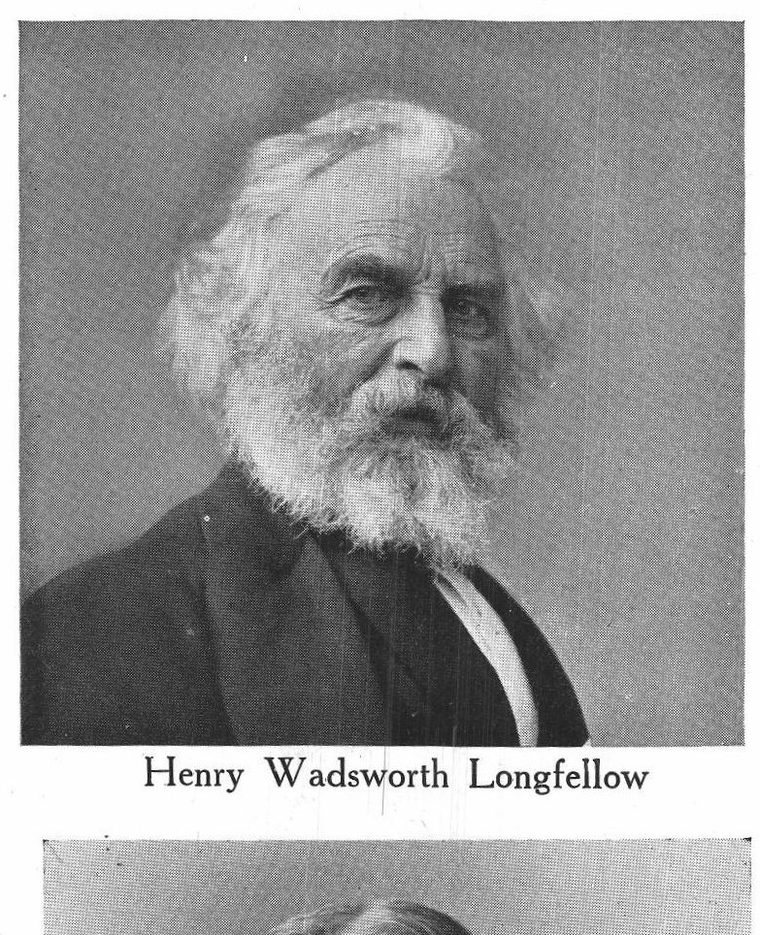
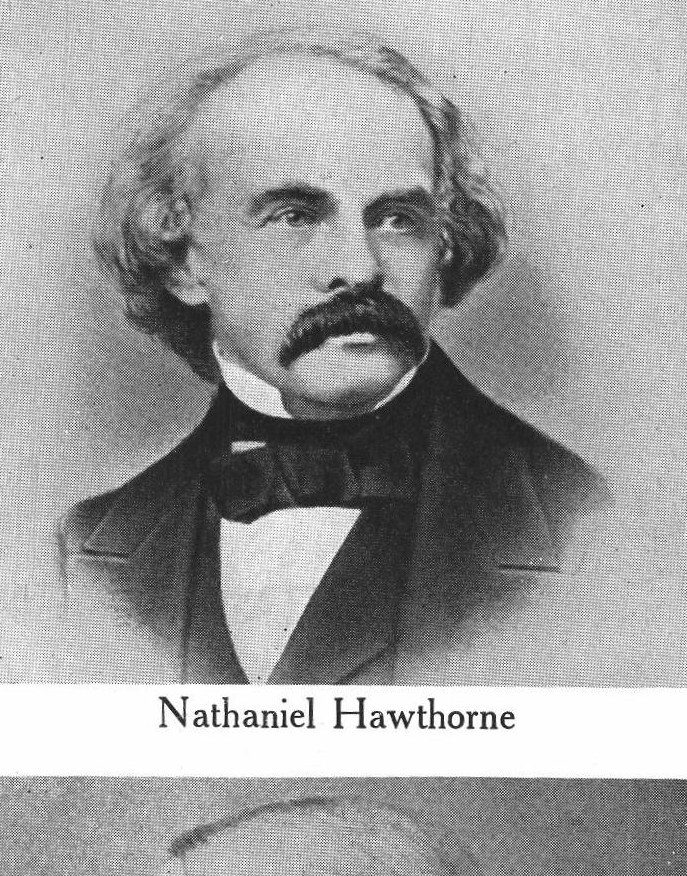
Henry Wadsworth (1807-1882), an eminent American poet. He was born at Portland, Maine, February 27, 1807. His father was the leading lawyer of the city. The Longfellow house in which the poet was born is a square three-storied house with a hip roof. It was then one of the aristocratic dwellings of the city but it is now in a tenement district. Longfellow entered Bowdoin College when only fourteen and was graduated in due course. Hawthorne was a classmate.
At graduation, Bowdoin offered Longfellow a professorship of modern languages, with permission to go abroad and prepare for the position. He spent four years traveling and studying in Italy, Spain, and France. A volume of travels entitled Outre-Mer, meaning Over Sea, gives a delightful account of his rambles and student experience. It reminds the reader of Irving's Sketch Book, by which it was very possibly suggested. Like Irving, Longfellow did much to interest Americans in the castles, cathedrals, old towns, and culture of Europe. In addition to modern languages he took an interest in early English. Hitherto Anglo-Saxon had been regarded as a curiosity, ranking with the Icelandic possibly, but Longfellow showed that our own literature has grown out of the rude poems of our Anglo-Saxon ancestors. When he took up his college duties in 1829, Longfellow was, without doubt, the most proficient American scholar in his particular line. In 1834 he was called to a similar professorship at Harvard University. After a second trip abroad, lasting a year and a half, he assumed the duties of his new position. He took up his abode in the house at Cambridge used by Washington as headquarters. Still
Stands the old-fashioned country seat.
Across its antique portico
Tall poplar-trees their shadows throw.
Here he continued to reside for the rest of his life. It is now known as the Longfellow House. In 1839 he wrote Hyperion, a novel into which he weaves much of his own life. Longfellow was twice married. He resigned his professorship in 1854 and gave himself entirely to literature.
Longfellow began to write poetry when only thirteen years of age. A little volume of miscellaneous poems selected from the United States Literary Gazette, published when he was eighteen years of age, contains fourteen poems bearing his name.
Longfellow goes by many names. He is called "The Children's Poet." His poems best adapted to children are, first of all, The Children's Hour, and The Village Blacksmith. One of the pleasant events of the poet's life was the presentation of a richly carved chair by the children of Cambridge on the anniversary of his seventy-second birthday. It was made of the wood of the "spreading chestnut tree" under which the village smithy stood. The Old Clock on the Stairs, The Arrow and the Song, The Skeleton in Armor, and The Wreck of the Hesperus are favorite selections found in school readers. The Rainy Day was written at a time of sorrow. The Bridge, referring to the bridge across the Charles River between Boston and Cambridge, has been set to music. The Psalm of Life is probably quoted more frequently than any other of his poems. It has been called a "cheap jingle," something that cannot be said of The Day is Done.
Falls from the wings of Night,
As a feather is wafted downward
From an eagle in his flight.
Very many of Longfellow's poems are European in subject and treatment. Some of them are mere translations. Poe, who was very bitter against everything coming from New England, called Mr. Longfellow a "plagiarist," claiming that he simply stole from European sources. For all that, Longfellow is to the European mind a distinctive, and a great, if not the greatest, American poet. Evangeline, Hiawatha, and Miles Standish are cornerstones of this reputation.
Hawthorne gave him the anecdote of two Acadian lovers, parted on their marriage morn when the inhabitants were shipped away by the British authorities. "If you don't want this incident for a tale, let me have it for a poem," said Longfellow. This was the germ of Evangeline.
Still stands the forest primeval; but under the shade of its branches Dwells another race, with other customs and language. Only along the shore of the mournful and misty Atlantic Linger a few Acadian peasants, whose fathers from exile Wandered back to their native land to die in its bosom. In the fisherman's cot the wheel and the loom are still busy; Maidens still wear their Norman caps and their kirtles of homespun, And by the evening fire repeat Evangeline's story, While from its rocky caverns the deep-voiced, neighboring ocean Speaks, and in accents disconsolate answers the wail of the forest.
No wonder the poet Holmes wrote him, "The story is beautiful in conception as in execution. I read it as I should have listened to some exquisite symphony, and closed the last leaf, leaving a little mark which showed a great deal more than all the ink I could have wasted upon the note you have just finished."
Hiawatha was published in 1855. It would seem that the subject of a great race occupying an entire continent, fading away before the whites like hoar frost before the sun, would be a grand theme for the poet's pen; and, indeed, many have attempted it; but Longfellow is the only writer who has succeeded in idealizing the American Indians in a poem of any length. The legends he obtained largely from the writings of Schoolcraft; the word painting of costumes, peace pipes, and the like, from the pictures of Catlin. The meter is that of an old heroic Finnish poem. The Land of the Ojibways is the northern peninsula of Michigan; Hiawatha is the legendary chief of the Ojibways; Minnehaha Falls is on the western bank of the Mississippi, a few miles below the Falls of St. Anthony; the pipestone quarry is located in extreme south-western Minnesota, near the present town of Pipestone. Hiawatha is considered Longfellow's greatest poem. We cannot foretell for all time the fate even of what are now regarded as masterpieces. If a time should ever come, say a million years hence, when the writings of the nineteenth century lie buried beneath the accumulated productions of pen and press so that the fame of Lincoln, for instance, may be but a breath associated with the last flickering flame of dying slavery, it is reasonable to suppose that Longfellow will have a lingering reputation as the author of a quaint, melodious poem, setting forth the legends of an ancient, aboriginal race said to have inhabited the forests and plains of central North America.
The success of these two poems encouraged Longfellow to write a third, The Courtship of Miles Standish, the scene of which is laid in Plymouth. The subject matter is drawn from the early settlement of Plymouth colony. Five thousand copies of this poem were sold by noon on the first day of its appearance. In 1863 the Tales of a Wayside Inn were published,--a number of stories told in verse, grouped together after the fashion of Chaucer's Canterbury Tales, except that they are represented as told in an old weather-beaten inn at Sudbury, where Longfellow and a few friends were wont to meet occasionally. Some of the more noted of these tales are Paul Revere's Ride, a well known story of the Revolution; The Birds of Killingworth, teaching the desirability of shielding our native birds; The Bell of Atri, a plea for the old horse when he has done his work.
Longfellow has been called a "comforting poet," one who has the right words to say to those who are sorrowing. In this respect he is certainly preeminent. Sometimes he is a little "preachy," sometimes he moralizes openly, as in The Psalm of Life, more like an essayist than like a poet, but in the hour of bereavement his poems will breathe a tender sympathy
As long as the heart has passions,
As long as life has woes.
At a class reunion held on the fiftieth anniversary of the graduation of its members, Longfellow read a noble poem entitled Morituri Salutamus, the Latin for "about to die, we bring greeting." This is distinctively the poem of an old man addressed to old men. We quote twelve lines:
At sixty wrote the Canterbury Tales;
Goethe at Weimar, toiling to the last,
Completed Faust when eighty years were past.
These are indeed exceptions; but they show
How far the gulf-stream of our youth may flow
Into the Arctic regions of our lives,
Where little else than life itself survives. . . .
For age is opportunity no less
Than youth itself, though in another dress,
And as the evening twilight fades away
The sky is filled with stars, invisible by day.
March 24, 1882, Longfellow passed away. He was buried in Mount Auburn Cemetery "under the gently falling snow."
SAYINGS FROM LONGFELLOW'S POEMS.
The rapture of pursuing.
This is the forest primeval.
The silent homage of thoughts unspoken.
A boy's will is the wind's will.
"Why don't you speak for yourself, John?"
Somewhere the birds are singing evermore.
Thou, too, sail on, Oh Ship of State!
Sail on, O Union, strong and great!
Oh, what would the world be to us
If the children were no more?
Buy with gold the old associations.
TRIBUTES.
His ballads have more of the old-time magic, more of the early simplicity, than those of any other modern English author.--Brander Matthews.
His poems are apples of gold in pictures of silver.--Curtis.
His nature was consecrated ground, into which no unclean spirit could ever enter.--Lowell.
He did not have Emerson's spiritual breadth and insight, nor Whittier's trenchant strength, nor Lowell's versatile gifts; but, as a maker of artistic verse, as a poet of the beautiful and of the human affections, his position of superiority is secure.--Abernethy.
When the American who is in London steps into Westminster Abbey--that splendid mausoleum of the worthy dead of a dominant race--nothing in the Poet's Corner thrills him more, if I may here express my own experience, than to behold the marble bust of Longfellow, the only memorial to a maker of American literature in that historic place. By general consent and the acclaim of two sister peoples, he was selected as the bard to represent us there.--Richard Burton.
There is no blot on the crystal purity of his writings.--Whittier.
Longfellow has taught more people to love poetry than any other English writer, however great.--Meiklejohn.
The white Mr. Longfellow.--Bjornson.