Lumbering
an American term for the industry of cutting trees in the forest and preparing the trunks for market. The products of lumbering are logs, shingles, bolts, stave bolts, rails, fence posts, telephone and telegraph poles, cordwood, spruce, and poplar cut to lengths for the pulp mills, masts and spars, ship knees, railroad ties, shakes, cooperage, hop poles, hoop poles, handle stock, and other rough forms of timber. By way of distinction, the term lumber is applied to the boards and dimension stuff produced by a sawmill, while the term lumber products includes the foregoing as well as sash, doors, and other articles turned out by the planing mill and the factory. The term lumberman is applied indiscriminately to one who logs in the forest or who operates a sawmill, for a firm of lumbermen is likely to engage not only in lumbering, but in sawing, and very possibly in the establishment of retail lumber yards in which the product of the sawmill is offered for sale.
Lumbering is a world-wide industry. The lumber yards of China and Japan are occupied largely by piles of bamboos assorted to length and size. The Filipinos cut not only bamboos but valuable forest trees for export trade. The elephant is used in southeastern Asia to drag teak logs from the forest. Australian lumbermen find wealth in forests of eucalyptus. Valuable woods are obtained in the forests of the Amazon. Argentina supplies the world with quebracho. Central America and the West Indies ship mahogany. Forestry and the attendant operations of reducing forest trees to lumber have been reduced to a science in Europe. Stout English oak is noted the world over, and, not to be prolix, for the ringing sound of the ax and the crash of falling trees are unceasing, the Scandinavian countries supply the shipbuilder and the carpenter with fir and pine of high quality.
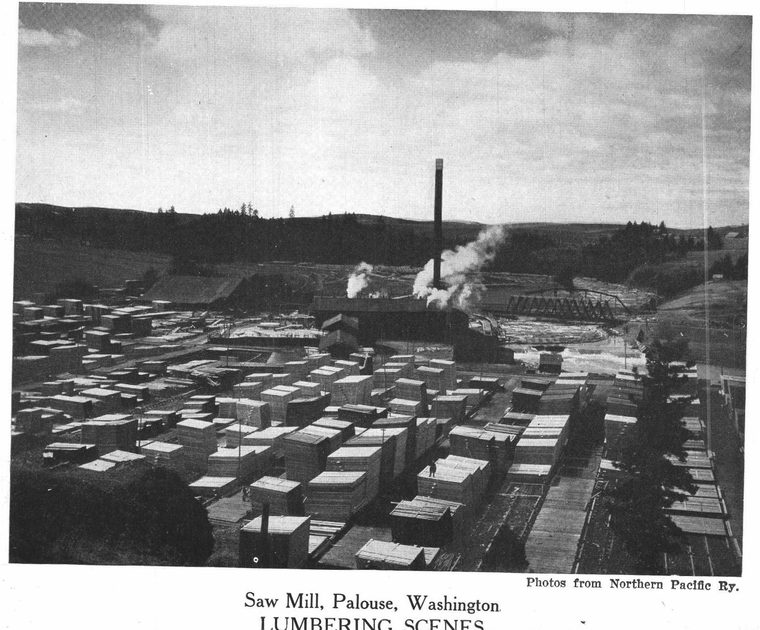
American lumbering began in Maine. Before the Pilgrims set foot at Plymouth the tall white pines on the islands and the coast of Maine were in demand for masts. The early colonists of the Atlantic coast from Massachusetts to Georgia became expert in the use of the ax, in felling trees, and in building log houses. The methods of lumbering developed in the forests of Maine may be said to have extended throughout the white pine and winter snow region from the North Atlantic coast to Minnesota, including the adjacent parts of Canada. Lumbering is one of the picturesque and enticing occupations. Passing by the neighborhood sawmill and the local supply of logs, we may say of the lumberman who has swept away the pine forests of the region named that he saws in the summer time and logs in winter. The sawmills, which at an earlier day were driven by water power, are now operated largely by steam. They are situated on rivers or lakes, it may be hundreds of miles below the headwaters of a district abounding in the coveted hemlock, spruce, or pine. In the autumn the lumberman establishes his camp in the very heart, it may be, of the tract he proposes to cut over. He builds low, broad, frost-proof, or, at least, warm log buildings, roofed usually with tarred paper. A typical camp includes a kitchen and eating house, combined with sleeping quarters for the cook and the "cookee"; a sleeping house provided with tiers of bunks for the men; a shop for the mechanic who mends sleds and provides handles for the tools; stabling for teams; and, very possibly, a cabin for the foreman. A camp favorably situated as to the supply of timber may serve for several years. Not infrequently a number of camps are maintained by the same firm and are kept in provisions, baled hay, and horsefeed by "tote" teams from an accessible center where a warehouse and an office are maintained.
As early in autumn as the swamps are frozen over, and without waiting for snow, logging operations begin in earnest. The men around a logging camp are dubbed lumberjacks rather indiscriminately; but, as a matter of fact, they are punctilious as to their duties. The teamster, for instance, drives his team faithfully and will not allow another to handle his lines; but he would see the camp in smoke before he would seize a cant hook and roll logs on the skidway or carry in an armful of firewood for the cookee. The entire business is systematized. One set of men fell the trees and saw the trunks into suitable lengths or logs. The swampers cut roads. Men and teams are employed to snake the logs to the roadside, where they are piled up on skidways. Ere the ground be frozen, a broad level road is built to the nearest watercourse. Hills are graded, often at heavy expense. As far as possible the route follows swamps, as they afford a level, solid roadway in winter. Strong sleds of unusual width, and provided with wide bolsters, are used in hauling. Teams, usually of four heavy horses are employed. Enormous loads of logs built up to twice the height of a man are hauled from the skidways to the stream where they are banked until the waters rise in the spring. Here the amount of lumber in each log is measured by a scaler, and each log is marked by one or more blows on the end, given with a sledge or marking hammer having raised letters or other marks on its face. These log marks, together with the bark mark of the camp, cut by the loggers in the bark with an ax before the log leaves the skidways, serve to proclaim the ownership of the log when afloat. A floating log unmarked is the property of the finder, but a log properly marked is personal property and is protected by law, even though a freshet carry it into the dooryard of a farmer and leave it stranded there. The rivers are full of sunken logs.
When the break-up comes in spring, men and horses hurry out of the woods before the swamp roads become impassable. The camp is abandoned unless, indeed, a caretaker is left to hunt, fish, fight mosquitoes, herd oxen, or raise a patch of potatoes for future use. Meanwhile the logs on the bank are rolled into the swollen streams to float down to the mill. Drivers, men wearing boots set with spiked nails to prevent slipping, and carrying long pike poles with which to push, pull, and guide the logs, follow down the stream and keep the logs going. Points where logs are likely to lodge are guarded. Sometimes, in spite of effort, a jam forms and the logs collect, filling the stream from shore to shore. The breaking of a jam is dangerous work. Sometimes a hardy driver ventures out to cut an obstructing log. Sometimes the forefront of the mass of logs is blown up by a charge of dynamite. Sometimes a drive is hung up because the water goes down, and sometimes a freshet carries the logs far out into the river bottom, where they go ashore unless piloted to midstream by the drivers. The driver learns to cross a stream by jumping from log to log and to walk a rolling, bobbing log, or, if able to stab a neighboring log with his pike pole, the two logs form a raft on which he journeys unconcernedly.
In case logs are hauled to a lake they are unloaded on the ice, and are surrounded by a boom consisting of long logs laid end to end and linked together by boom chains. When the ice goes out, the boom with its contents may be towed to its destination or to an outlet having a current. Lumbermen find it advantageous to combine in driving. Usually a leading logger undertakes to drive his own logs and at the same time drive the logs of his neighbors at a price agreed upon. The driving in the upper Mississippi, for instance, as far down as the Falls of St. Anthony, is accorded to a single driving company. The various loggers bring their small drives down the tributaries and turn them into the main stream to be driven by a large crew under foremen who have made a specialty of the Mississippi drive for a half of a century. The uncertainty of a favorable stage of water, the loss of logs from sinking, and the delay in delivery has led to the building of logging railways to take the place of the small streams. Logs are loaded on flat cars, usually by a steam derrick.
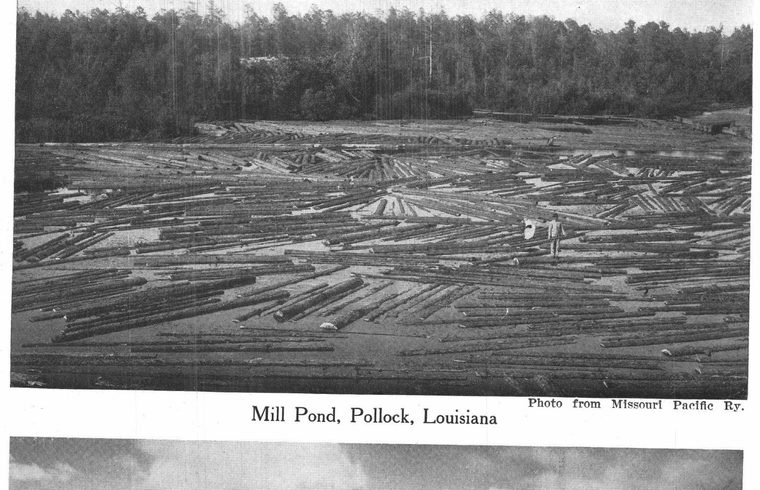
Lack of snow in the South Atlantic and Gulf states has necessitated the employment of somewhat different methods. Snaking is done on the bare ground, or else one end of the log is suspended beneath the axle of a two-wheeled cart. Steam drums mounted on flatboats, anchored at the edge of a lake or river, are used to wind up cables and drag logs for half a mile or more through the swamps into open water. This is a customary way of getting cypress afloat. Logging railways and steam derricks for loading take the place of river driving almost exclusively in the Southern hardwood and yellow pine districts.
The timber of the Pacific coast grows to such an enormous size that special methods are employed. The trunks are so large that the workmen erect staging in order to cut above the swollen knees of the stump. Stumps ten and even fifteen feet high are not infrequent. The logs are too heavy for team work. They are drawn to the skidways by stationary donkey engines and cables. In case of distance, the logs are taken forward by successive cables to the sidings, where they are rolled upon flat logging cars by steam power. A feature of the lower Columbia is the building of enormous rafts for shipment. The logs are first built or piled within an oval frame cradle larger than the hull of a Dreadnought. They are then bound together with chains forming a huge oval fagot stout enough to withstand the buffeting of ocean waves. These great rafts are towed to San Francisco and other coast points, where the logs are converted into lumber.
Logs are cut, driven, bought, and sold at a price based on the number of board feet of lumber they will make. A cruiser reports the standing timber or stumpage on a certain tract at, let us say, 100,000 feet; the scaler reports 90,000 feet of white pine on the bank; the manager of the drive charges for 80,000 feet delivered in the boom at the sawmill; the foreman of the mill reports a season's cut in feet-all meaning board feet. The buyer and the seller may agree on the number of feet, but the usual method is to call on an official scaler to measure up the logs. In a district where farmers and small loggers own timber, the lumberman buys logs, usually at a price per thousand (feet of course) banked.
Some idea of the extent of the lumbering industry may be had from the statement made by the American Lumberman that, between the landing of the Pilgrims and the close of the nineteenth century, 1,000,000,000,000 feet of lumber was sawed in the United States and Canada. Prior to 1850 the northeastern part of the Union led in the production of lumber. About the date last named, the lumbermen attacked the white and Norway pine forests of the Great Lakes in earnest. During the period 1830-1897 the pine cut of Michigan, Wisconsin, and Minnesota was not less than 286,000,000,000 feet, or, if we add 75,000,000,000 feet of hardwood, the three states named contributed not less than 363,000,000,000 feet of lumber to build farmsteads, towns, roads, and bridges. By 1905 the Southern States led in the production of lumber. In 1910 it was estimated that the Pacific coast was contributing a fifth of the total lumber supply. The cut of the Northeastern States is now largely second growth. The original forests of the Great Lakes region are about gone. The Western States are gaining rapidly on the South and no doubt will soon lead in the output of lumber.
In 1905 the United States authorities took the most exhaustive and authentic census of the lumber industry that has been made to date. According to this report (1905), the lumbering states ranked in magnitude of cut, as follows: Washington, Louisiana, Wisconsin, Pennsylvania, Arkansas, Michigan, Mississippi, Minnesota, Texas, Georgia, Alabama, California, North Carolina, Virginia, West Virginia, Florida, Oregon, Maine, Missouri, Tennessee, South Carolina, New York, New Hampshire, Kentucky, Ohio, Vermont, Indiana. The following statistics are chiefly from this report; the figures do not include farm operations:
Capital.....$90,454,494
Timekeepers, clerks, etc.....3,953
Salaries.....$3,673,000
Wage-earners.....146,596
Wages.....$66,000,000
Keep of teams.....$12,212,000
Stumpage, thousand feet, board measure.....27,940,097
Average stumpage value per thousand.....$2.59
Stumpage value, total.....$72,347,000
Scalers' figures, thousand feet board measure.....27,980,000
Railway ties.....36,445,000
Telegraph and telephone poles.....2,080,482
Fence posts.....17,483,268
Hemlock bark, cords.....391,691
Oak bark, cords.....69,873
Number of sawmills.....18,227
Capital.....$381,000,000
Wage-earners.....223,000
Wages.....$100,310,000
Lumber, mill value.....491,524,000
Lumber Output-
Rough lumber, thousand feet......34,135,139
Shingles, thousand.....14,547,477
Lath, thousand.....2,647,847
Cooperage-
Hoops, thousand.....546,879
Staves, thousand.....2,464,689
Headings, thousand sets.....125,354
Cut in feet-
Yellow pine.....12,812,307,000
White pine.....5,332,704,000
Hemlock.....3,268,787,000
Douglas fir.....2,928,409,000
Spruce.....1,303,886,000
Cypress.....749,592,000
Redwood.....519,267,000
Cedar.....223,035,000
Tamarack.....31,784,000
Ash.....169,178,000
Birch.....224,000,000
Chestnut.....243,537,000
Cottonwood.....321,574,000
Elm.....258,330,000
Gum.....523,990,000
Hickory.....106,824,000
Basswood.....228,041,000
Oak.....2,902,855,000
Poplar.....853,554,000
Walnut.....31,455,000
Maple.....587,558,000
Sycamore.....18,002,000
Other hard woods.....312,930,000