Muskrat
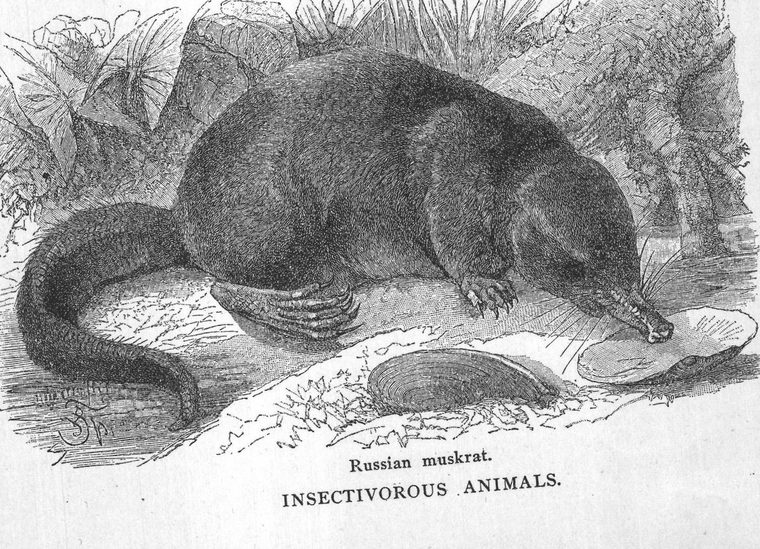
a large representative of the mouse or rat family. It takes its name from its musky odor. It has an appearance midway between that of a large rat, which it resembles anatomically, and the beaver, to which the fur and a flat, bare tail have no little resemblance. The muskrat is naturally an inhabitant of cold regions. The farther north it lives, the better its fur. It makes considerable journeys on land, but its native home is in the reedy edge of a lake or river bayou. It constructs long burrows leading from under water in the pond, up into the bank, where its young are usually brought forth. Conical piles of reeds, grasses, and moss are built up from the bottom of the pond to a height of from one to six feet above the water. Passages lead from the bottom up through the house to interior chambers, sometimes one, sometimes several in the same house. Each chamber has two passages,--one of easy grade up which the muskrat ascends, the other almost perpendicular down which it plunges when it desires to leave its nest. The muskrat lives chiefly on the roots of water plants. It is active all winter. When the long outer hairs are pulled off, the fur of the muskrat is very fine, soft, and thick. Now that the beaver is so scarce it is in increasing demand. The North American trapper receives from four to twenty cents a pelt according to season and size. In 1910 the price for prime skins was advanced to seventy-five cents.