Nest
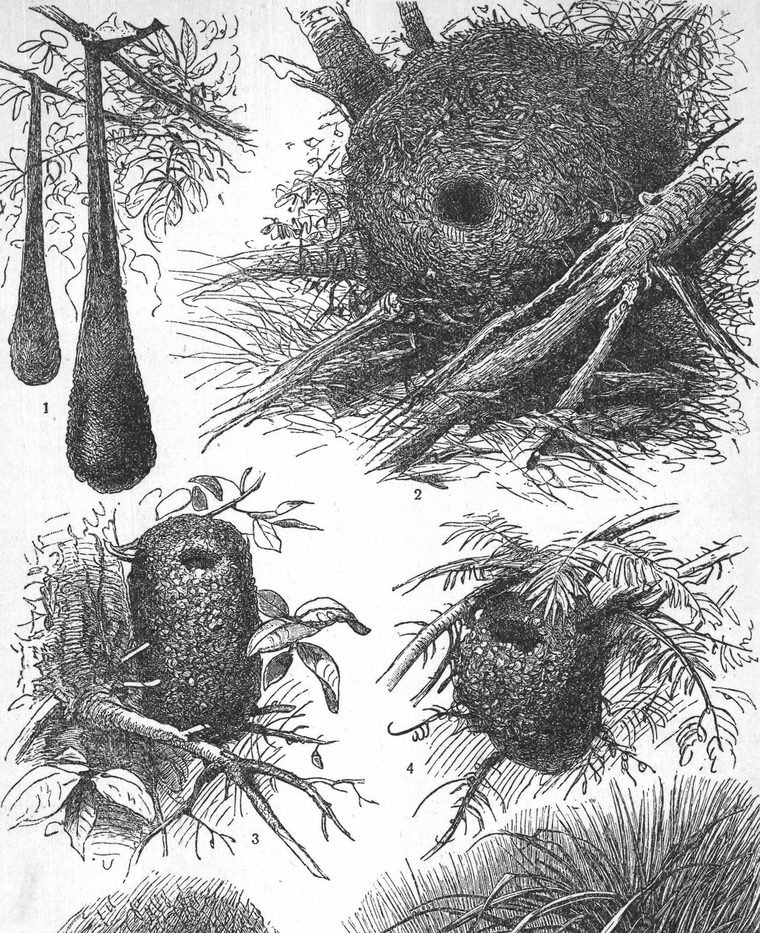
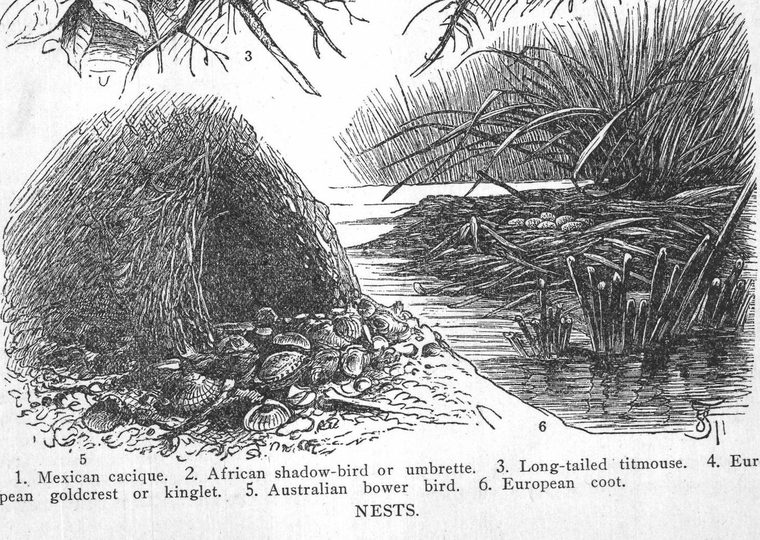
in natural science, the bowl-shaped or purse-like receptacle in which birds and other animals rear their young. Some rodents, as mice, dormice, and many squirrels construct nests with care. The form of a hare may be regarded as a nest. Some fishes, as the croppy and stickleback, make nests for their eggs. Even the salmon and trout work up sand into shape to protect their eggs. Many insects construct nests for their eggs. The comb of the bee, wasp, and hornet may be regarded as composed of nests. Ordinarily speaking, however, the nest is the characteristic home of the bird during the season when eggs and young require care.
It is difficult to classify birds' nests. Some of the lower seafowl, as the murre, guillemot, and auk lay their eggs singly on rocky ledges. Although these eggs lie on a bare, rocky floor so thick that one can scarcely step between them, and are as alike as peas, the apparently stupid mothers seem to know each her own egg. Once in a while a fracas breaks out with the result that areas of eggs are swept into the sea. The emperor penguin holds its egg on its foot. The puffin, unlike its fellows, digs a tunnel several feet into a sandbank. Gulls and terns take the pains usually to collect a little grass and seaweed. Grebes and mudhens form nests of floating, decayed vegetation. The eggs lie in wet muck. Ducks, geese, and swans, on the other hand, seek a dry spot hidden in bushes and grass, and construct a substantial nest, lining it with down from their own breasts. The eider duck in particular is so liberal in the use of down that the nests have a commercial value. The wood duck, the butterball, and even the hooded merganser nest in hollow trees. The loon nests near the water's edge, so as to be able to glide off like a boat into the water.
Wading birds and shore birds also differ greatly in their nesting habits. Many snipes lay their eggs in the merest depression. The plover arranges short bits of weed stems, so as to point toward the center. Herons form colonies and build platforms of sticks in trees or bushes. Bitterns hide their nests snugly in grassy sloughs. The flamingo builds a column of mud ten or twenty inches high and nests in the top of it. Failing trees, the stork builds a nest of sticks across the top of a chimney.
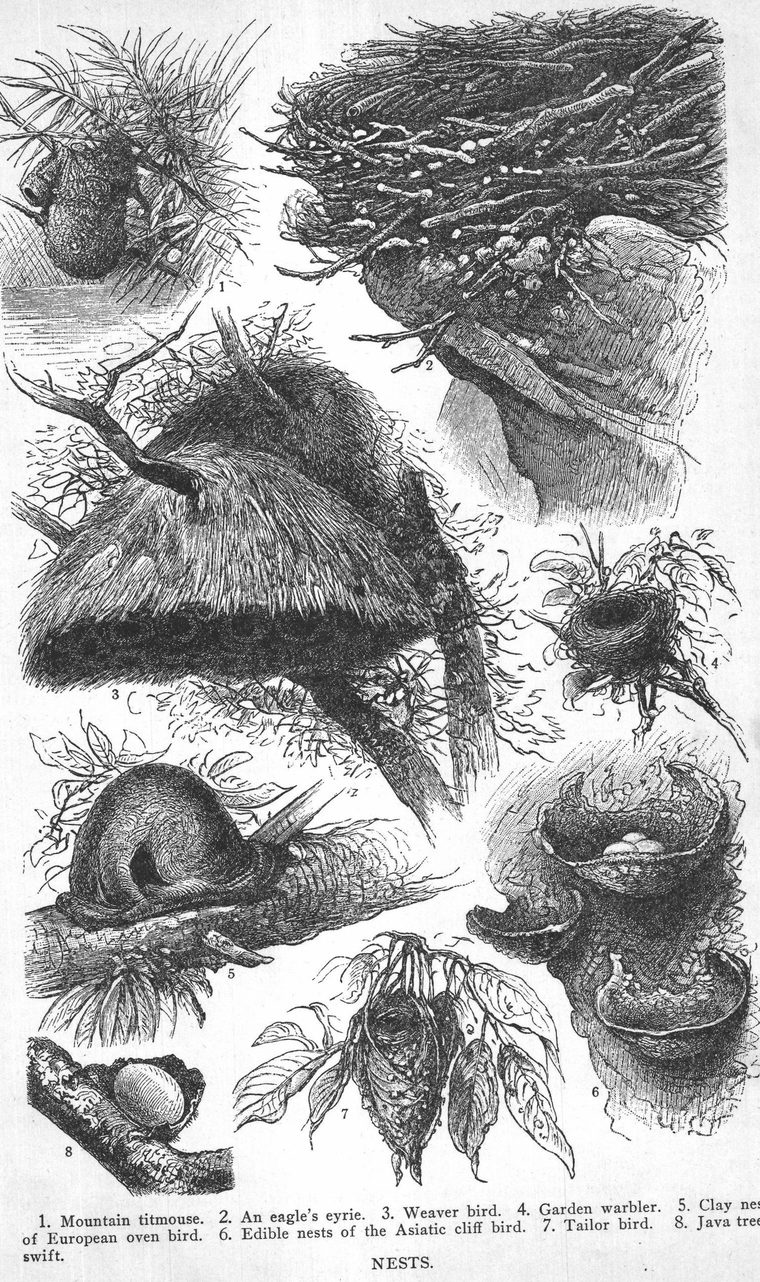
Birds of prey usually build bulky nests of sticks. Vultures nest carelessly under logs or bushes or in hollow stumps. The condor builds on an inaccessible cliff in the region of the clouds. Eagles use the same nest from year to year, adding additional sticks. The golden eagle prefers a rocky cliff; the bald eagle a tall tree. Each hawk and kite has its own kind of a place in which to build, but the species differ widely. The marsh hawk or hen harrier builds on the ground amid bushes or grass. The peregrine falcon or duck hawk prefers a cliff or hollow tree. The osprey wants to build on a broken stub thirty feet from the ground. Seventy feet suits the chicken hawk better. The sparrow-hawk enlarges a woodpecker's hole in a high stub. The barn owl likes an old tower or steeple. The screech owl is pleased with the hollow limb of an apple tree. The great horned owl saves labor by using an old crow's nest. The saw-whet crowds into a woodpecker's hole. The snowy owl nests on the ground in the arctic barrens. The burrowing owl makes a nest of pieces of buffalo "chips" or dried cow dung several feet within the burrow of a prairie dog or badger.
The kingfisher is also a burrower; her nest is at the end of a tunnel in some dry bank. The woodpeckers, sapsuckers, and flickers cut holes in dead trees. Failing these, old telephone poles answer the purpose. The nuthatch, the titmouse, and the chickadee nest in knot holes or deserted holes made by larger birds.
The chimney swift builds a bracket of twigs and gluey saliva half way down the inside of a chimney. The swift of Indo-China builds a similar nest wholly of saliva on rocky walls and in caverns. This is the edible nest of the Chinese. The species of the swallow tribe have various notions. The purple martin is partial to a box on a pole or to crevices in a cornice. The cliff swallow has left its cliff and builds a mud bracket under the eave of a barn or other building. The barn swallow builds inside on a rafter or beam. The bank swallow still tunnels into clay cliffs.
Quails, partridges, pheasants, prairie chickens, ptarmigan, blackcock, and, in fact, grouse of all sorts nest on the ground. The same is true of the wild turkey. Wild pigeons and doves build flat, careless nests of twigs on the spreading branches of trees or bushes; the mourning dove chooses a branch usually about ten feet or less above the ground. The passenger pigeon builds higher.
The bluejay weaves roots and grass together in the crotch of a tree about twenty feet from the ground. Of a dozen jays' nests in a grove there will not be five feet variation in height. The common crow, a relative, chooses a crotch as uniformly ten feet higher, and lines her stick nest with fine shreds of grape bark, moss, and grass. The robin, in the same grove, builds its nest of grass and mud five feet lower than the jay.
Of familiar birds, the king bird is least set in her own way. The nest is built with care of weed stalks and grass, and is lined with fine hair, moss, thistledown, and lint; but the intersection of two fence rails and a limb twenty-five feet above ground seem to answer equally well. The whole flycatcher family seems more or less indifferent as to elevation.
Most blackbirds build deep, well constructed nests of grasses, supported by reeds or bushes standing in marshes. The cowbird, an unworthy member of the family, leaves its eggs in the nest of some songbird. The bobolink nests on the ground in meadows. The meadow-lark builds an overarched nest under shelter of a tuft of grass. The orchard oriole hangs a pocket of grass from the tip of a branch fifteen feet from the ground. The Baltimore oriole, the pride of the blackbird family, weaves a pouch of grass, hair, strings, and roots and hangs it from a limb twenty feet higher. It does not object to a tree top sixty feet high.
The grosbeaks, the purple finch, the cross bills, red polls, goldfinches, cardinal birds, indigo bunting, and dickcissel build hemispherical nests in bushes or trees, from five to thirty feet above the ground, each species at its own height. Most American sparrows build similar nests on the ground.
The nests of perching birds, though of a general type, possess an individuality as marked as that of the birds themselves. Size, shape, material, workmanship, method of attachment, and size of twig enable the expert to identify a nest usually at a glance. It is useless to look for certain nests outside of an evergreen tree, and as useless to look for others in one. How it is that a bird a year old, with no experience and with no instruction in nest-building from her parents, can build a nest at all, much less choose a site and build a nest precisely like that in which it was fledged a short summer ago, is one of the puzzling questions of animal instinct.
Naturalists describe many curious nests. The tailor bird forms a nest by sewing the edges of growing leaves together with grass. The weaver birds associate and form a rainproof roof of leaves, under which they all build. The brush turkey of Australia amasses a heap of several tons of leaves apparently for the warmth produced, for the leaves heat like a hotbed.
The most extensive collections of birds' nests are to be found possibly in the Natural History Museum of South Kensington, London, and the American Natural History
Museum in Central Park, New York.
See Birds