Panama Canal
a proposed canal across the Isthmus of Panama. It is to be constructed from Colon on the Caribbean Sea to Panama on the bay of that name on the Pacific coast. Owing to the crookedness of the isthmus the Pacific end of the canal is farther east than the Atlantic end. The construction of this canal has been under consideration for nearly a century. The gold discoveries of 1849 led to the building of a railway near the proposed route. In 1876 a French commission surveyed the isthmus. Three years later a French company organized by De Lesseps received permission from Colombia to build the canal. The company sold stock to the French public and expended many millions in the purchase of machinery and in actual work of construction. Charges of wasted money and peculation led to an investigation of the affairs of the company and to the suspension of work.
In 1904 the United States government purchased the rights of the canal company of France for $40,000,000. The warrant for the amount, dated May 9, 1904, is said to have been the largest single check ever issued by our government. Colombia refused to ratify the treaty; the province of Panama seceded and set up as an independent republic. A treaty negotiated with this new government arranged for the payment of $10,000,000 for the right of way, and an annual payment of $250,000 a year to begin ten years later. The United States took a lease of the canal for 100 years with the privilege of renewal. The right of protecting the approaches to the canal and of policing the right of way was granted to the United States government.
The Panama project provides for a canal forty-nine and nine-tenths miles in length. The route includes the excavation of swamps on both coasts. The Panama route presents many engineering difficulties. First of all, the climate is unfavorable. Tropical heat prevails the year around without change of season. Yellow fever and malaria are constant. The coasts are swampy. Lake Bohio, lying midway between the oceans, discharges its waters through the Chagres River into the Atlantic. This stream is swollen frequently into a torrent by tropical rains. Between Lake Bohio and the Pacific is the Culebra range of hills, requiring a cut 320 feet deep. To construct a canal at sea level would require the removal of 275,000,000 cubic yards of earth and stone. The Suez Canal required the excavating of but 99,400,000 cubic yards.
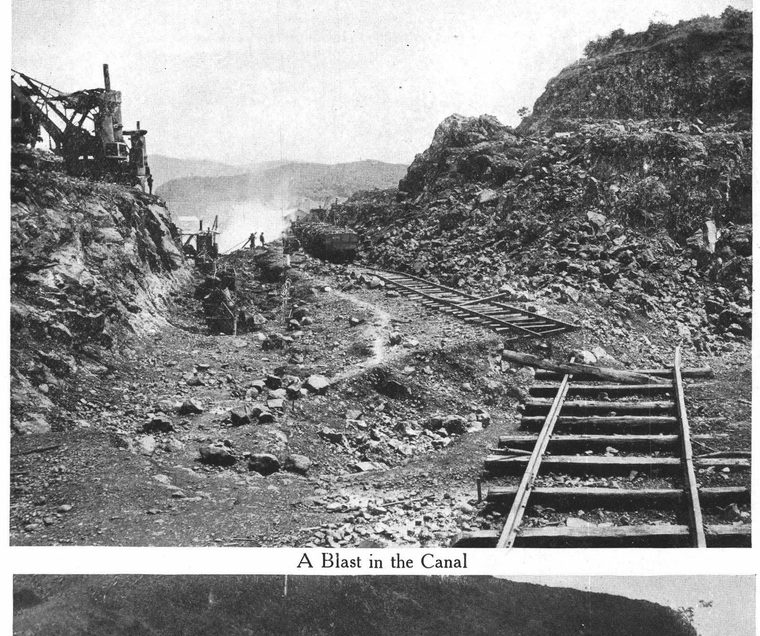
Two plans were under consideration. One, a sea level canal. This was admitted by all to be the more desirable, but it was abandoned as too expensive. The other contemplates several locks and an upper level eighty-five feet above the ocean. Even the sea level canal would require a lock, for at times the tides rise and fall twenty feet at Panama on the Pacific Ocean and but about two feet at Colon on the Atlantic coast. The entire length of the canal route has been divided into six sections and placed in charge of six engineering corps. Test borings have been made so that the chief engineer has a knowledge of the kind of material that must be removed. In order to overcome the floods of the Chagres River it will be found necessary to straighten the channel. It is proposed to construct dams and utilize the water power to operate a series of powerful electric lights from ocean to ocean. The nature of the climate is such that it is cooler and more healthful to work at night than in the daytime. Two or three different shifts of workmen can be employed. The difficulty of the work is increased by extensive land slides, particularly in the Culebra cut.
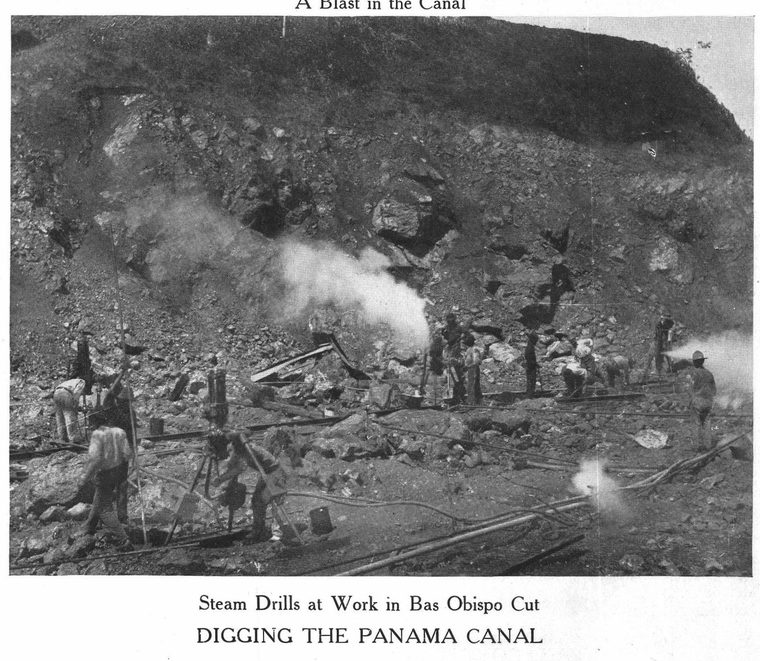
On taking possession of the work matters were found in great confusion. The loss of life had been distressing; the graves of 75,000 workmen, negroes, Americans, Frenchmen, and Germans line the hills and valleys in mute protest against the system of mismanagement. The French companies had removed about 80,000,000 cubic yards of earth, but a great part of it had been dumped where it had to be removed again, and part of the excavations were abandoned necessarily. All along the fifty miles of the route machinery to the value of $29,000,000, or $600,000 worth to the mile, was found lying in every condition of rust and neglect. Much of it was repaired and used, however. At the time of the purchase the work was still going on slowly, and had not been discontinued at any time entirely. In 1905 there were 1,300 men on the payroll; in 1908, 44,816 persons. The American engineers use about 25,000 workmen. The United States government expended #60,000,000 in acquiring control of the plant and in making preliminary surveys. It is expected that the entire cost of the completed canal will not be less than $360,000,000. In addition to the French machinery powerful steam shovels for deep, heavy work have been constructed. Each of these weighs seventy tons and runs on a track. It scoops up five cubic yards at a lift, and is capable of removing 800 cubic yards an hour. It is considered equivalent to 500 laborers. The entire force is capable of removing 3,000,000 cubic feet a month. The utmost precautions are taken to provide sanitary conditions by establishing homes, boarding houses, and hospitals. The food and clothing supplied workmen in 1908 amounted to $3,793,587. Fifty thousand people were cared for.
To one approaching the canal from either ocean the neck of land seems small and of no great height, but an actual trip over the route and an inspection of the work necessary to be done shows that the proposed canal is the greatest engineering feat ever attempted. In all 114,515,000 cubic yards of earth and stone must be removed. Evan though the work be carried forward at all points simultaneously, with all the men and money that can be used to advantage, it will not be possible to open the canal before 1915. The American people will have cause for congratulation if the canal is in readiness by 1920. Up to January 1, 1910, the expenditure had almost reached $100,000,000.