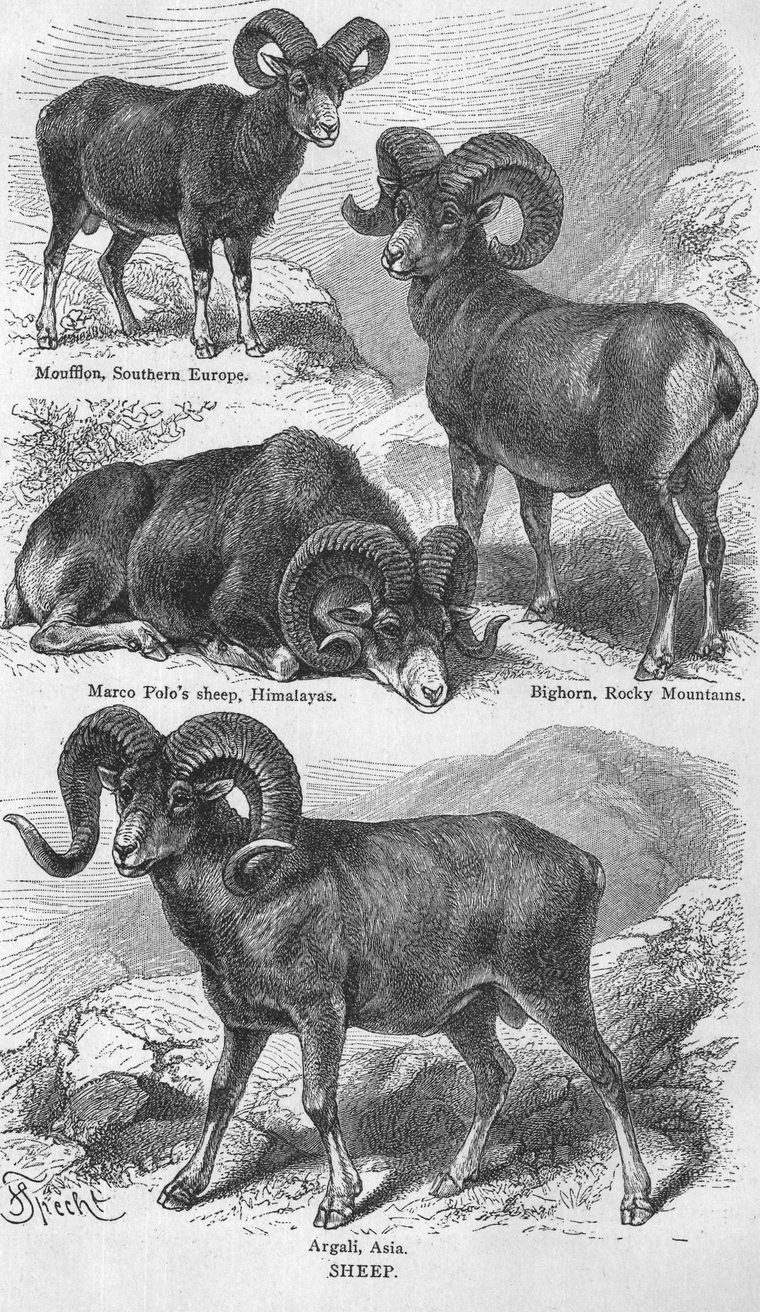
Sheep
a well known domestic animal. Scientifically speaking, a genus of cudchewing quadrupeds. The ancestor of the domestic sheep is not known. All wild sheep have short tails, while the domestic sheep has a tail that reaches to the ground, unless shortened by the shepherd. Sheep are allied closely to goats. They have, however, spiral horns and the chin is destitute of a beard. As all wild sheep are natives of elevated or mountainous regions, it is probable that domestic sheep originated in the mountains of Asia. The most celebrated breed is the Spanish merino, noted for fine wool and hardiness. The English types, the Cheviot, the Leicester, the Southdown, and the black-faced breeds, have long, comparatively coarse, straight wool and are noted rather for mutton.
The first sheep were brought to the new world by Columbus in 1493. Spanish explorers introduced sheep into Florida in 1565. The Spanish missions brought sheep to Mexico and the southwestern part of the United States at an early date. When these missions in California were disestablished and the property confiscated by the Mexican government in 1834, there were large flocks amounting to over a million head. An excellent account of sheep raising in this section may be read in Helen Hunt Jackson's Ramona.
The English introduced sheep into Virginia in 1609. They were so harassed by wolves, however, that forty years later the number did not exceed 3,000. The Dutch brought sheep to New Amsterdam in 1625. The Swedes of New Jersey and Delaware had flocks of sheep when they passed under English rule. The first sheep were introduced into New England about 1624. The sheep of Florida and the far southwest were of the merino type. Those of the Atlantic seaboard, as far south as Georgia, came from England. The question of long, coarse-wooled mutton sheep, versus fine-wooled merinos is still open. Breeders at the present time are trying to develop fine wool on mutton bodies.
Sheep raising is a profitable branch of industry. The sheep lives on the roughest kind of forage and is a very moderate eater. The fleece yields an annual income. Mutton is a wholesome food. If we except hogs, no other kind of live stock brings in so immediate a return. A flock of sheep multiplies rapidly with corresponding increase in value.
The male sheep is known as a ram, the female as a ewe, the young as a lamb. The wool of a single sheep is a fleece. An oil found on the wool is known as eke. The ewes may be expected to have lambs when a year old. So many ewes produce twins that with fair care a flock of ewes may be expected to double in number the first year.
In brushy countries a flock of sheep will do more clearing than a force of men. There are, however, drawbacks. Young lambs are exceedingly tender, and must be cared for well, at least for a week or two. Sheep are such climbers that it is difficult to restrain them in pastures. Wolves commit frightful ravages. Dogs destroy large numbers of sheep annually. It is said that a dog addicted to sheep killing cannot be cured of the habit. Sheep raisers declare that dogs kill more sheep annually than the whole tribe of dogs is worth. On the sheep ranges of the plains, the coyote, or prairie wolf, is the shepherd's wiliest foe. He soon learns to avoid poison. A great deal of antagonism exists between the sheep and cattle raisers. No greater insult can be offered a cowboy than to call him a sheep herder. Sheep bite so close to the ground as to destroy the grass on large areas.
The greatest profits are made, no doubt, in the West where sheep pasture on buffalo grass without winter shelter or feeding. Bands of shearers begin work in the far southwest and travel northward with the season. They charge five cents a head for shearing. The business of bringing sheep from the plains eastward and fattening them for market on wheat screenings and other grains, has grown to large proportions. The following statistics are gleaned from the United States agricultural report for 1909:
| Total number of sheep | 56,423,769 |
| Average value per head | $3.43 |
| Total value | $192,632,000 |
| Number of fleeces | 40,311,548 |
| Pounds of wool | 270,138,000 |
| Average value per pound, cents | 161/2 |
| Average weight of fleece in pounds | 6.70 |
It is estimated that 41,000,000 additional pounds of wool were pulled from pelts. American factories import, in addition, about one-half as much wool as we raise.
It is estimated (1909) that there are 100,000,000 sheep in Australia, 90,000,000 in Argentina, 70,000,000 in Russia, 70,000,000 in North America, and 20,000,000 in New Zealand. Gustav, the Russian mutton king, pastures 1,750,000 sheep in Siberia.
The United States produces about one-ninth of the world's mutton and wool. The English wool and mutton market is supplied largely from Australasia and Argentina. Frozen carcasses of mutton are shipped to London and other British cities in refrigerated ships. Wool is carried from these countries to London for one-half cent a pound.
The world's statistics of wool for 1906 may serve as an index of the sheep industry. In that year wool was produced as follows:
| Pounds. | |
| Australasia | 552,000,000 |
| Argentina | 370,000,000 |
| Russia, including Poland and Siberia | 320,000,000 |
| United States | 298,000,000 |
| Great Britain and Ireland | 133,000,000 |
| Spain | 52,000,000 |
| South Africa | 100,000,000 |
| France, including Algeria | 120,000,000 |
| Turkey in Europe and Asia | 100,000,000 |
| Uruguay | 66,000,000 |
| Germany | 25,000,000 |
| China | 42,000,000 |
| Italy | 21,000,000 |
| Sweden and Norway | 8,000,000 |
| Mexico | 10,000,000 |
| Canada | 12,000,000 |
Other countries bring the wool production of the year up to the incredible total of 2,605,000,000 pounds. As to what becomes of so much wool, we have only to remember that Great Britain alone has nearly 50,000,000 spindles engaged in spinning wool and cotton. The greater part of the world's production of wool finds its way into clothing.
Mohammedans are forbidden to eat swine's flesh. Mutton, therefore, is a favorite food with them. In Persia, Tartary, Syria, and Morocco they have developed breeds of sheep remarkable for accumulations of fat. Pouches of fat descend from the rump to such an extent as to obscure the tail. It is said, we do not know on what authority, that in this way the tail of the Syrian sheep attains a weight of from thirty to sixty pounds. In fattening choice specimens a pair of wheels is provided for the support of the tail.
See Tick; Foot Rot; Spinning; Shoddy; Goat; Clothing; Felting; Fleece