New Jersey
one of the original thirteen states of the American Union. The name is derived from the Isle of Jersey in the English Channel. The state occupies a peninsula of irregular shape between the Delaware River and Bay on the west and the lower Hudson and the Atlantic on the east. Its next door neighbors are New York, Pennsylvania, and Delaware. The state has but one artificial boundary,-a straight line forty-eight miles in length, from river to river on the northwest. The area, including inland waters, is 8,224 square miles.
TOPOGRAPHY. The northwestern part of the state consists of low mountain ranges and parallel spurs running at right angles to the Delaware River. The greatest elevation in the state is High Point, 1,804 feet above sea level. It is a region of wooded ridges, long valleys, blue vistas, and lakes. The Kittatinny Mountains are succeeded to the southeastward by the highlands, and the highlands by a narrow piedmont or foothill region. The last and largest, and a characteristic division of the state, is a coast plain running from Sandy Hook to Delaware Bay. It is from ten to twenty miles wide. It includes the noted pine barrens, a district well known to botanists as the home of the pyxie or flowering moss and other plants seldom found elsewhere.
MINERALS. The foundation of the state is granite, gneiss, and sandstone. Above these, geologically speaking, are slates, limestones, and marbles. Trenton limestone takes its name from an exposure at Trenton. Building stone, slate roofing, lime, and cement are obtained in the highland region. There are mines of lead, zinc, iron, copper, and graphite. Sand suitable for glass, potter's clay, brick clay, and marl are found. Nearer the ocean, the rock formations dip far beneath the surface.
AGRICULTURE. The key to the industries of New Jersey must be sought in the natural resources, the unusual facility for transportation, and the situation between the two cities of New York and Philadelphia. Staple crops, as corn, wheat, rye, oats, buckwheat, and hay, all do well, but the total value does not exceed $15,000,000, not more than is produced by a single county in the food-producing region of the North Central States. A variety of soil, forty-five inches of rainfall, a mild climate, and nearness to the great markets have led to small farms and a high state of cultivation. Dairies, orchards, and truck farms are the rule. The New Jersey farmer on ten acres often handles more money in a year than a western farmer on a section of land. The milk of the state is valued at $10,000,000 a year.
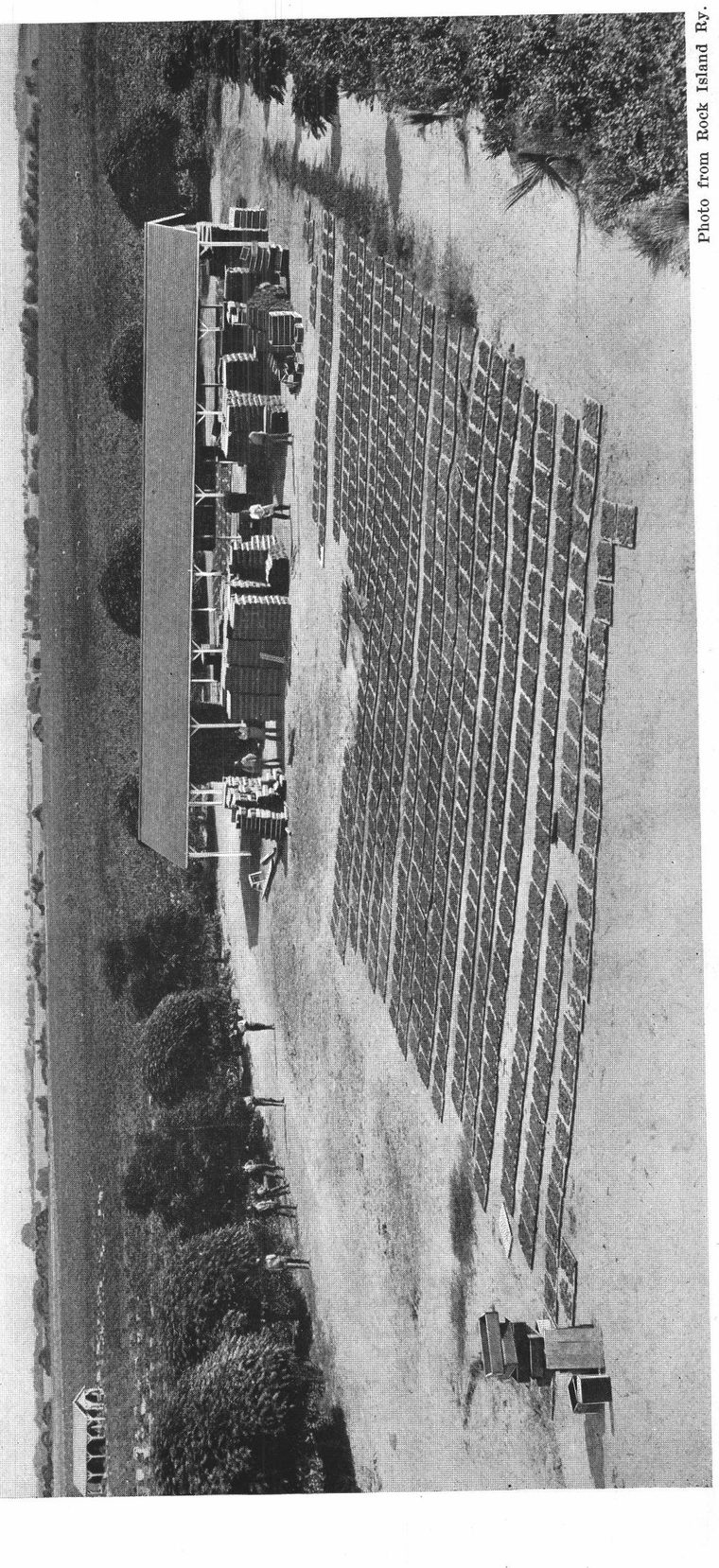
New Jersey is a great fruit state. Peaches are the leading orchard fruit. Other fruits named in order of their money value are apples, strawberries, pears, blackberries and raspberries, grapes, currants, cherries, gooseberries, quinces, and plums. As these fruits are but from five to fifty miles from market they may be had on the table of the consumer in a delightfully fresh condition. The raiser is in position to command the highest prices. Of wild fruits, the pine barrens and hills produce blue-berries, and certain swamps near the coast have been converted into famous cranberry marshes.
Truck farming, especially on the coastal plain, has become an industry of magnitude. Melons, tomatoes, beets, turnips, radishes, potatoes, cucumbers, in short, garden vegetables of all sorts, are a source of profit. One wayside station is credited with shipping 100 tons of asparagus in a single month. The sweet potato crop alone is worth $1,250,000. In certain belts, small truck farms lie side by side clear across the state. Attractive barns, hothouses, residences, evergreen dooryards, and well kept, macadamized highways give the roadside the appearance of a populous street. A large amount of capital is invested in greenhouses and the business of supplying cut flowers. Roses alone are cut to the value of over $1,000,000 a year.
TRANSPORTATION. The state is unusually well supplied with the means of transportation. Active little boats follow the windings of the rivers and the ocean inlets, calling every morning at a thousand local piers for milk, butter, fruit, flowers, and vegetables for the city market. A hundred suburban trains gather country produce at wayside stations. There is no more prosperous section in the Union than the favored portion of New Jersey.
MANUFACTURES. From a money point of view, manufacturing is of still greater importance. The wholesalers of New York and Philadelphia draw on Camden for chemicals; Elizabeth for sewing machines; New Brunswick for hosiery; Vineland and other towns for glass; Newark for leather, jewelry, celluloid goods, and hats; Paterson for silks; Passaic for woolens; Jersey City for tobacco and soap; and Trenton for pottery. There are important manufactures of fire brick, terra cotta, and locomotives. Ships are built at Camden and Elizabeth. The output of manufactures in twelve large cities is valued at $400,000,000 a year.
HISTORICAL. Aside from prehistoric man, whose stone implements and red bones are found at Trenton, and the historic Lenni-Lenape or Delaware Indians, whom the novelist Cooper commemorates in the Last of the Mohicans, the earliest settlers of New Jersey were Dutch and Swedes,-the former near New York; the latter along the Delaware. About 1655 the Swedes acknowledged Dutch control. In 1664 the entire region passed under English rule. The Indians gave little trouble. In 1758 they were placed on a reservation in the pines, the first in the United States. Later, they were removed to New York, and finally to Indian Territory.
A heavy immigration of Huguenot and Scotch-Irish set in. As a result, the opening of the Revolutionary War a century later found the colony decidedly Presbyterian and disposed to maintain the patriotic cause. Governor William Franklin, a son of Benjamin Franklin, gave his father and the good people of New Jersey no little anxiety by his Tory sentiments. He fled to New York City, where he continued to give the British army the benefit of his advice and to organize raids upon the colonists. The "Pine Robbers," as these foraging raiders were known, became a scourge. No less than a hundred skirmishes and pitched battles were fought on Jersey soil. The most noted were those of Trenton, fought December 26, 1776, and Princeton, January 3, 1777, giving rise to the Revolutionary cry of "Great news from the Jerseys." Washington wintered twice with his army at Morristown. The battle of Monmouth was fought June 28, 1778. The state was the third to adopt the Federal Constitution. During the Civil War, New Jersey furnished 88,305 men to the Union army, and advanced $3,000,000 for equipments, transportation, and maintenance.
EDUCATION. The initiative in education was taken by various religious bodies. A state system of common schools was set in operation in 1817. There are public high schools and numerous private and denominational academies. The leading institutions of higher learning are Princeton University, Presbyterian; Rutgers College, Episcopalian, at New Brunswick; Stevens Institute of Technology at Hoboken.
CORPORATIONS. The laws of the state are unusually favorable to the incorporation of companies. The great trusts that center in New York and Philadelphia are incorporated under the laws of New Jersey and maintain "home offices" in the state. The fees derived from filing the articles of incorporation with the secretary of state form a large item. A revenue of over $3,000,000 a year is derived from taxing these corporations.
POPULATION. In 1900 the population was 1,883,669; in 1905, 2,144,143. Owing to the enormous growth of manufacturing towns since the Civil War a half million people of foreign birth, German and Irish predominating, were found to have been added to the population. There were at this date 69,844 negroes. There are twelve cities having a population exceeding 20,000. Two-thirds of the people reside in towns having not less than 4,000 inhabitants. The usual term of elective state and county officials is three years.
The highlands are full of quiet pleasure resorts. The state is noted for its watering places. Long Branch, Asbury Park, Ocean Grove, Atlantic City, and Cape May are the most noted names, but nearly every available foot of shore from Sandy Hook southward has been occupied by towns or cottages. There are also many quiet resorts among the pines and on the mountain lakes.
STATISTICS. The following statistics are the latest to be had from trustworthy sources:
| Land area, square miles | 7,525 |
| Population | 2,196,237 |
| Newark (1909) | 308,669 |
| Jersey City (1909) | 253,711 |
| Paterson (1909) | 116,615 |
| Trenton (1909) | 92,878 |
| Camden (1909) | 89,305 |
| Hoboken (1909) | 70,351 |
| Elizabeth (1909) | 67,470 |
| Bayonne (1909) | 49,894 |
| Passaic (1909) | 45,685 |
| Atlantic (1909) | 45,397 |
| Number counties | 21 |
| Members of state senate | 21 |
| Representatives | 60 |
| Salary of governor | $10,000 |
| U. S. representatives | 10 |
| Presidential electors | 12 |
| State revenue | $4,400,000 |
| Assessed valuation of property | $1,841,000,000 |
| Bonded indebtedness | none |
| Acres of improved land | 2,000,000 |
| Agricultural Products-- | |
| Corn, bushels | 10,500,000 |
| Wheat, bushels | 1,860,000 |
| Oats, bushels | 1,840,000 |
| Potatoes, bushels | 5,250,000 |
| Sweet potatoes, bushels | 2,500,000 |
| Fruit, value | $4,000,000 |
| Cut flowers, value | $2,000,000 |
| Market vegetables, value | $9,000,000 |
| Hay, tons | 699,000 |
| Butter, pounds | 7,300,000 |
| Eggs, dozen | 12,000,000 |
| Domestic Animals-- | |
| Horses | 102,000 |
| Milk cows | 190,000 |
| Other cattle | 82,000 |
| Sheep | 44,000 |
| Swine | 155,000 |
| Fowls | 2,000,000 |
| Miles of railway | 2,297 |
| Output of manufactured goods | $777,000,000 |
| Capital invested | $715,000,000 |
| Operatives | 266,000 |
| Raw material | $470,000,000 |
| Output of textile goods | $96,000,000 |
| Silk products | $42,000,000 |
| Pounds canned goods | 39,000,000 |
| Tons of iron ore | 550,000 |
| Output of zinc (1907) | $1,600,000 |
| Output of pig iron | $7,500,000 |
| Clay products, brick, etc | $16,000,000 |
| Quarry products | $1,250,000 |
| Bank deposits | $356,000,000 |
| Teachers in public schools | 10,734 |
| Pupils enrolled | 424,534 |
| Percentage of male teachers | 11.05 |
| Average monthly salary of teachers | $65.82 |
| Average annual expenditure per pupil | $37.36 |
SEE HOBOKEN; JERSEY CITY; NEWARK; PRINCETON; FRUIT.