Silk
the product of the caterpillar of the silkworm moth. For a general idea of the stages in the silkworm's life, see article on INSECT. The silk moth is a native of northern China, where its culture and the production of silken fabrics was a secret jealously guarded for centuries. It is said that a traveler brought away the first eggs in the hollow joint of a bamboo cane. The young caterpillars can be fed for a short time on lettuce and will thrive fairly well on the leaves of the osage orange, but the natural food of the silkworm is the leaf of the mulberry tree. This tree has been introduced wherever the production of silk has been attempted.
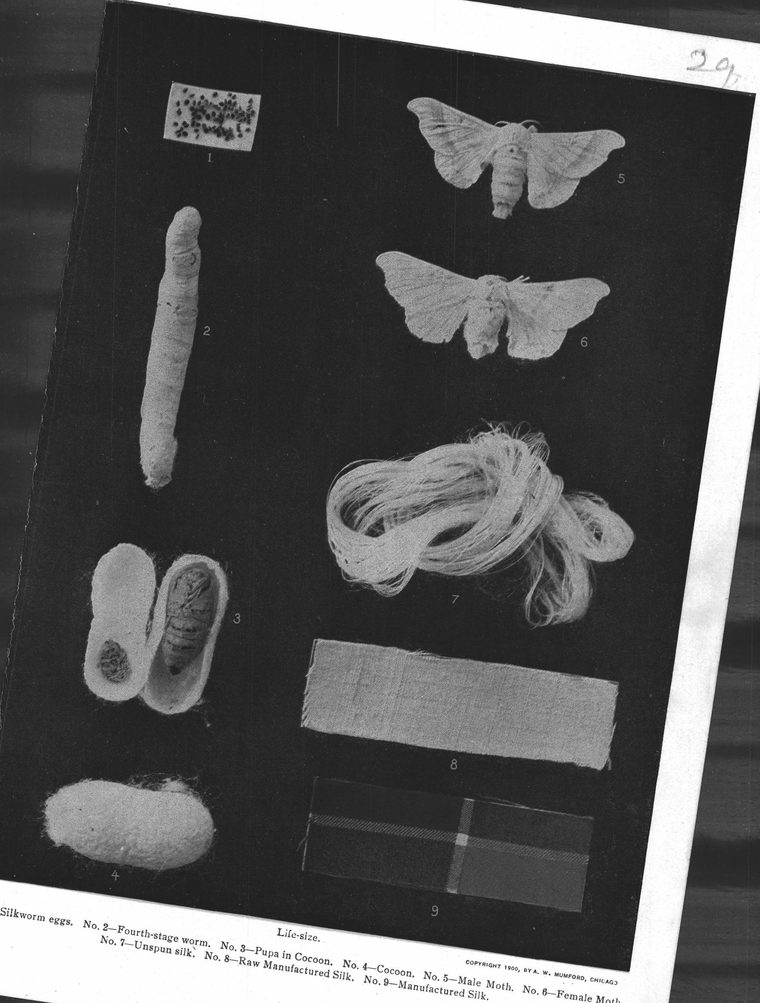
The moth is of a creamy color. The females attach eggs the size of a pinhead to some surface and die soon afterward. The caterpillar is at first one-fourth of an inch in length. As it grows it has to change its skin a number of times. In about eight weeks it attains a length of three inches. At this time two tubes running lengthwise of the creature's body and uniting in a nipple-like spinneret at the mouth are gorged with a viscid substance with which the caterpillar spins a silken thread. It winds this thread around its body to form a cocoon. At first the thread is coarse and rough, for the outside shell, then it grows soft and fine for the inner lining. The finished cocoon in which the worm proposes to rest until ready to emerge as a moth is about the size of a pigeon's egg. It is understood, of course, that the silkworm is a caterpillar not a worm.
Four to five days are spent in winding a cocoon. The silkworm rearer selects and lays aside those he desires to keep to increase his stock. These are placed on a canvas in a darkened room kept at a moderate temperature. In about twenty days the moths appear and stay contentedly on the cloth until they lay their eggs and die. Instead of placing the young caterpillars on the tree, they are kept in trays and are fed mulberry leaves. Whether from nature, or whether long domestication has changed its temper just as taming for generations has changed a wild animal into a stable-loving cow, neither caterpillar nor moth are restless in confinement.
The cocoons intended for silk are plunged into boiling water or heated in a oven to destroy the chrysalis. The hard outside of the cocoon is then removed and the silk is wound or reeled. A primitive method followed by the Asiatics of which all others are imitations is the following: A number of cocoons are placed in lukewarm water and stirred with a twig of several branches until the floating ends of several threads have caught on the twig. These are united with a twist and passed through an eye to a whirling wheel or reel on which they are wound into a skein. The warm water softens the mucilage of the cocoon, but leaves enough on the strands to cause them to cohere in a single thread as they pass through the eye. The reel is far enough from the floating cocoons to allow the thread to harden before it is wound. The threads are so fine as to be almost invisible to an inexperienced eye.
The operator watches his cocoons with care. If one ceases to move on the surface of the water, he knows the strand is broken, and he picks it up instantly and puts it in anew. If a cocoon is unwound, he introduces an end from a new cocoon, so that the thread on the reel may be of uniform size. A cocoon contains from 2,000 to 4,000 yards of silk. Rarely can more than 900 yards be reeled off. The rest is classed as "spun silk," because it can be made suitable for use by spinning. The filaments of from four to twenty cocoons are reeled together according to the size of thread desired. When a sufficient quantity has been wound on the reel, the skein is tied to prevent tangling and is then a hank of the raw silk of commerce. From 300 to 600 cocoons, including the chrysalids, are required to weigh one pound. Three and three-fourths pounds of cocoons yield about one pound of raw silk. When this has been freed from gum, about twelve ounces of pure silk remain. One pound of pure silk may be woven into about twenty yards of dress silk.
Silk from injured cocoons, or from those in which the fiber has for any reason become entangled or broken, was, until about 1857, regarded as a waste product. An Englishman, Samuel Lister, found that it could be spun and put to many useful purposes. This waste silk is worked by the spinners either with the gum in it, when it is called Schappe silk, or else is first scoured. It is then treated by the "breaker," which disentangles the mass and breaks it into short lengths. It may then be carded, combed, and spun. It is very lustrous, and, while not to be compared with the reel silk, is used in the production of many articles. Machine thread, cords, tassels, laces, ties, mufflers, ribbons, and a variety of fabrics for furniture coverings and decorative purposes may be made of spun silk. When the silk has been reeled, it is "thrown," which involves the twisting and doubling processes. This corresponds to spinning in some respects, as it involves the twisting into a thread. Technically speaking, reel silk is not spun.
The silk is next "conditioned," that is, tested for the amount of moisture it contains, etc. It is "scoured," or boiled in soap and water to remove the gum. Silk loses from twenty-six to thirty-two per cent of its weight by this process. Dyeing follows. An interesting part of the dyeing process is what is called "weighting." By "weighting" is meant the loading of the fibers, either in the yarn or in the woven fabric, with iron, tin, or other foreign substance to increase the thickness and weight. Silk fiber will absorb of these substances from 50 to 200 per cent of its own weight. It is said that silk has in rare instances been increased by these methods to nine times its original weight.
The rearing of silkworms and the manufacture of silken products from the "raw" silk form two quite distinct industries. The rearer's work is finished commonly with the completion and sorting of the cocoons. They are sent to the filature for the reeling.
The moth and its young are reared under shelter. The production of silk is entirely possible wherever its food, the mulberry tree, can be raised successfully. One ounce of larvae, numbering usually about 40,000, requires 1,400 pounds of mulberry leaves during the twenty-four days of the larval stage. Of course some of this is wasted in fragments. It is estimated that the larvae actually consume about 772 pounds. This one ounce in the completed cocoons will weigh from 80 to 120 pounds. China, Japan, and the Mediterranean countries of Europe are the chief centers of silk production.
Serious attempts have been made to establish the silkworm in America. James I offered a liberal bounty for the encouragement of silk raising in Virginia. The French Huguenot settlers of South Carolina brought the silkworm with them from France. Efforts were made in Pennsylvania. At the beginning of the Revolutionary War the American colonies were actually exporting 1,000 pounds of silk a year. In the early part of the nineteenth century, efforts were made by Congress to encourage the raising of the mulberry tree and the silkworm, but, as a matter of fact, silk raising does not pay in the United States. Even France finds it more profitable to buy raw silk from China and Japan than to produce it at home.
Statistics are at variance, but it is stated on trustworthy authority that the world's production of raw silk, that is to say, silk in skeins, was in 1905 about 42,000,000 pounds.
Perhaps one-third of the eastern silk is of inferior quality. It is worked up on hand looms and does not reach the market. China weaves about 14,000,000 pounds of silk at home yearly. While the United States may be said to raise silk merely as a curiosity, it is the second silk-weaving country in the world. Over 11,000,000 pounds of raw silk are imported annually and converted into silks, ribbons, thread, and lace. Of dress silks, velvets, plushes, upholstery, tapestry, ribbons, twist, embroidery, wash silks, gloves, laces, veils, and trimmings, the United States now produces over $133,000,000 worth a year. Paterson, New Jersey, is the American center of silk weaving. It has been called the "Lyons of America." In the amount of raw silk worked up into fabrics, France is the third country of the world.
Raw silk to the weight of 9,000,000 pounds is converted into ribbons, silks and laces, chiefly in Lyons, St. Etienne, Calais, Le Nord, and Paris. Next come Japan, weaving 6,600,000 pounds; Germany, 6,100,000; Switzerland, 3,400,000; India, 3,000,000; Russia, 3,000,000; England, 1750,000; Austria, 1,500,000; Turkestan, 1,500,000; and Hungary, 1,500,000. Of raw, that is to say, cocoon silk, China is credited with producing 39 per cent; Italy, 30 per cent; Japan, 12 per cent; France, 8 per cent; Turkey and the Levant, 6 per cent; India, 4 per cent; and the rest of the world put together, 1 per cent.
See Mulberry; Lyons; St. Gall; Ribbons; Satin; Taffeta; Grosgrain