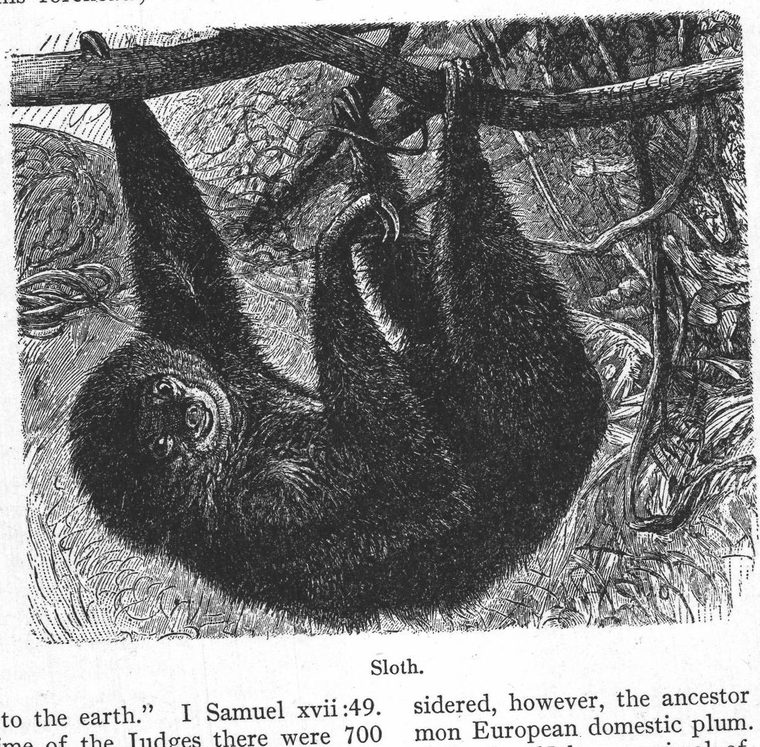
Sloth
sloth, an animal of Central and South America related to the armadillo and the anteater. The sloth is so called from the sluggishness of its movements. It is the slowest four-footed animal known. It has rather a clumsy looking body, of the size, possibly, of a raccoon. It is covered with shaggy hair. It has long legs terminating in peculiar feet with the soles turned inward, like the palms of one's hand. The hind foot is armed with four long curved claws; the front foot is armed with three or two, according to the species. The natural home of the sloth is the dense forests of tropical America. It feeds on the leaves and tender shoots of certain trees. It reaches them by climbing out, back downward, on the under side of a limb and hanging on with three legs, while it reaches for food with the fourth. The hair lays long and moss-like. The single young of the sloth is produced in a tree-top and clings to its mother's fur until it is old enough to crawl about and obtain food for itself. The sloth shows considerable activity in getting about a tree-top, and is quite skillful in swinging from the top of one tree to that of another. It descends to the ground with great reluctance. It will strip a tree of every leaf on it, rather than come down. On the ground, the sloth is almost helpless. An early though exaggerated account of the sloth says that it will not travel farther in fifteen days than a man can throw a stone. It manages to shuffle along somehow, walking on its knuckles. Large snakes are the chief enemies of the sloth, against which it is said to defend itself with its strong front claws, and not infrequently to come off victor. In South America there are fossil remains of a gigantic sloth larger than a rhinoceros. It had hands a yard long with which to pull down branches of trees.
On the mighty Essequibo River, in British Guiana, I once made a special hunt for sloths. I took a leaky old canoe, an Indian to help furnish power, and paddled fifteen miles and back. We followed the shores, going and coming, and secured eight specimens of the three-toed sloth.
We found them in the tops of low trees at the water's edge, spread-eagled on the outer branches, or hanging upside down, but always eating leaves. They did not know what it was to "take alarm" and try to escape. Judging by the awful deliberation of those that we saw in motion, I estimated that a really swift sloth could travel half a mile in twenty-four hours if not side-tracked.
We shot some of our specimens, and others we took alive by cutting down their trees. One tree fell with its top in the river, and the sloth was carried four feet under water. But even the prospect of drowning did not make him hurry to the surface. To my amazement he climbed up through the branches, slowly and deliberately, until at last, with dignity entirely unruffled, he appeared above the surface, and looked at me with a most disgusted expression on his wooden countenance.
Sloths eat so slowly that before one meal is over it is time for the next, so that their meals overlap one another.-William T. Hornaday, Natural History.