Home › Miscellaneous Receipts › How to Tie a Parcel
How to Tie a Parcel
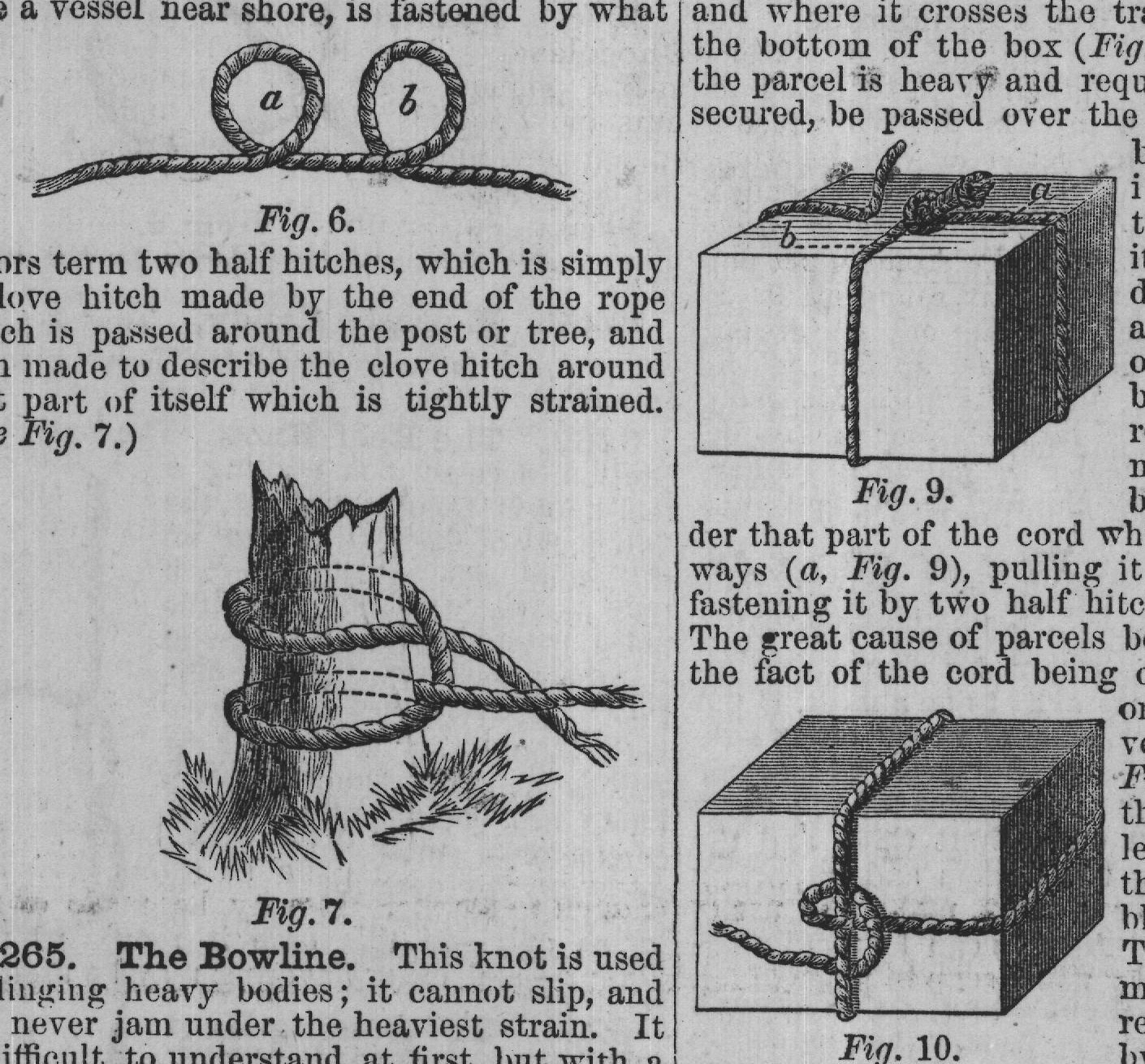
The tying so as to make both loops correspond, and pass up of parcels in paper is an operation which them over the object to be tied, tightening is seldom neatly performed by persons whose the ends; if this is properly done, the knot occupations have not given them great facilwill not slip, although surrounding a tolera- ities for constant practice. Let a single knot bly smooth cylindrical object, as a pillar, be made in the end of the cord, which is then pole, &c. This knot is employed by surgeons in reducing dislocations of the last joint of the thumb, and by sailors in great part of the standing rigging. The loop which is formed when a cable is passed around a post or tree to secure a vessel near shore, is fastened by what a Fig. 6. b sailors term two half hitches, which is simply a clove hitch made by the end of the rope which is passed around the post or tree, and then made to describe the clove hitch around that part of itself which is tightly strained. (See Fig. 7.) passed around the box or parcel. This knotted end is now tied by a single hitch around the middle of the cord (Fig. 9) and the whole pulled tight. The cord itself is then carried at right angles round the end of the parcel, and where it crosses the transverse cord on the bottom of the box (Fig. 10) it should, if the parcel is heavy and requires to be firmly secured, be passed over the cross cord, then back underneath it, and pulled tightly, then over itself; lastly, under the cross cord, and on around the other end of the box. When it reaches the top it must be secured by passing it un- Fig. 9. der that part of the cord which runs lengthways (a, Fig. 9), pulling it very tight, and fastening it by two half hitches round itself.
The great cause of parcels becoming loose is the fact of the cord being often fastened to one of the transverse parts (as b, Fig. 9), instead of the piece running lengthways, and in this case it invariably becomes loose.