Home › Miscellaneous Receipts › The Binding Knot
The Binding Knot
The binding knot, (Figs. 4, 5,) is exceedingly useful in connecting broken sticks, rods, &c., but Fig 3. some difficulty is often experienced in fastening it at the finish; if, however the string is placed over the part to be united, as shown in Fig. 4, and the long end b, used to bind around the 6261. The Sheet Bend or Weaver's Knot. This knot is usually employed by netters, and is called by sailors the sheet bend." It is readily made by bending one of the pieces of cord into a loop (a, b, Fig. 1), which is to be held between the finger and thumb of the left hand; the other cord, c, is passed through the loop from the further side, then round behind the two legs of the loop, and lastly under itself, the loose end coming out at d. In the smallness of its size, and the firmness with which the various parts grip together, this knot surpasses every other; it can, moreover, be tied readily when one of the pieces, viz., a, b, is exceedingly short; in common stout twine, less than an inch being sufficient to form the loop. Fig. 1.
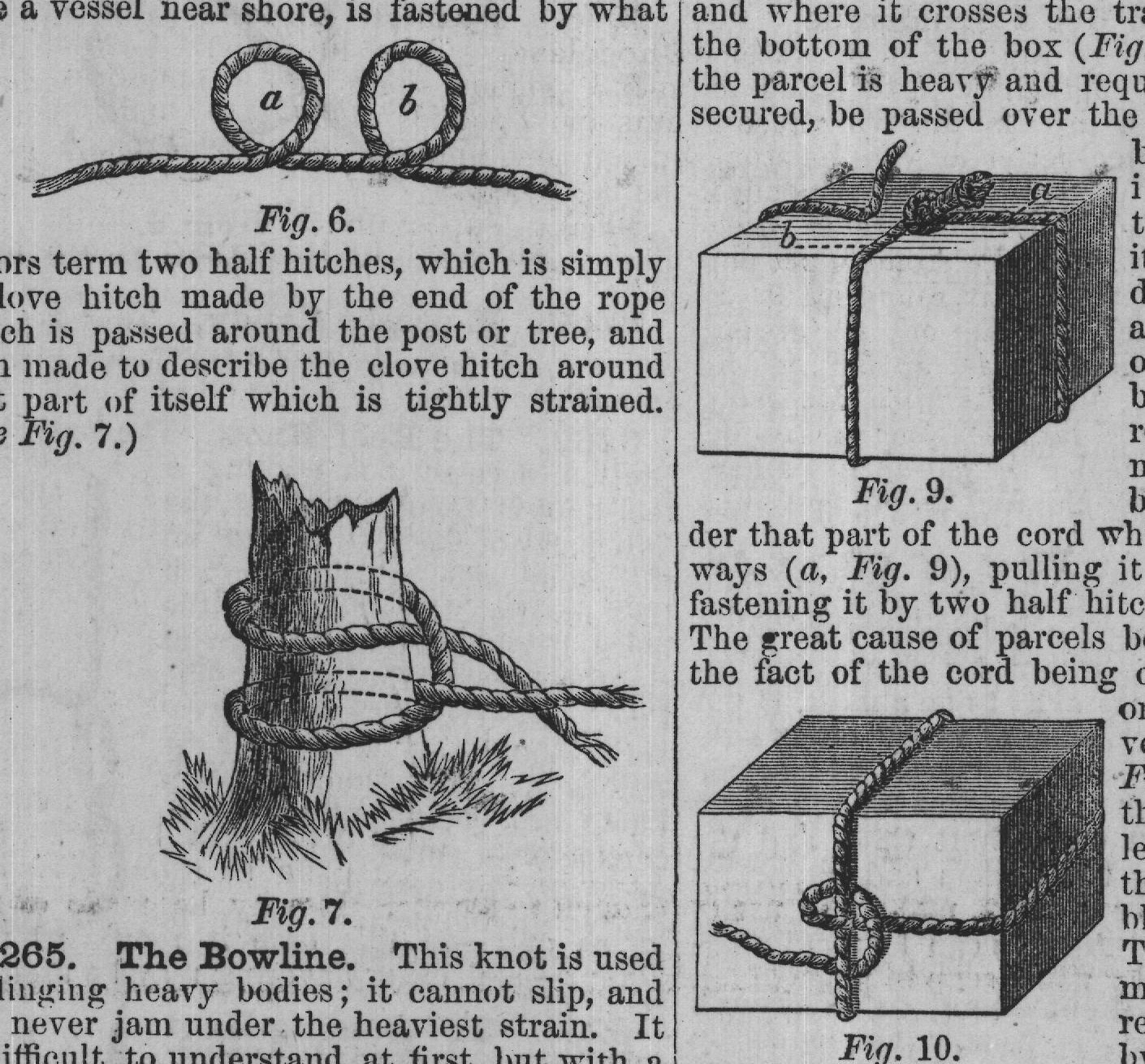
The above method of forming it is the simplest to describe, although not the most rapid in practice; as it may be made in much less time by crossing the two ends of cord (a, b, Hitch or Clove Fig. 2) on the tip of the forefinger of the left Hitch. For fasthand, and holding them firmly by the left ening a cord to Fig. 5 thumb, which covers the crossing; then the any cylindrical object, one of the most useful part cis to be wound round the thumb in a knots is the clove hitch, which, although exloop, as shown in the figure, and passed be- ceedingly simple and most easily made, is one tween the two ends, behind a and before b; of the most puzzling knots to the uninitiated. the knot is completed by turning the end 6 There are several modes of forming it, the downwards in front of d, passing it through most simple being perhaps as follows: make the loop, securing it under the left thumb, two loops, precisely similar in every respect, rod, and finally bpassed through the loop a, shown in Fig. 5, it is readily secured by pulling d, when the loop is drawn in, and fastens the end of the cord. 6264. The Double Half 7 b Fig. 4. as a and b, Fig. 6, then bring b in front of a,