Important: Safety Warning
This page prescribes plants as medicine according to pre-modern medical theory. Several of the plants named are toxic, correct identification is difficult, and the doses given have no scientific basis. Do not ingest or apply any preparation described here.
In addition, this page presents medical treatment from an era before modern medicine. The remedies described are ineffective against the conditions named, and some of the ingredients or doses are harmful. Do not use them to treat any illness; consult a qualified medical professional.
This information has been left in for historical purposes but should not be acted upon.
Home › Preparations › To Prepare Extracts
To Prepare Extracts
The process of obtaining an extract of a substance involves two distinct operations: First, the production of a solution of the soluble portion of the substance operated on; and next, powerful affinity for water and absorbs its vapowder by bruising, or sliced with a knife, so hat every portion may be fully exposed to the action of the solvent. Refractory substances are first softened by the solvent and then 'sliced. Other substances whose nature does I not require reducing, are used without preparation. Different fluids are used for solvents, as best adapted to the solubility of the substance under treatment. Some bodies, such as fresh vegetables, yield their juice by expression alone. In the preparation of aqueous extracts, the ingredients are treated with rain or distilled water, until all the soluble matter that is desired to obtain from them is dissolved exposed in a stove or drying room to a temperature of about 100° Fahr., allowing free acfree access for the air. The extracts thus evaporated are said to be lighter in color and more transparent than by most other ways. The method for evaporating an alcoholic or an ethereal solution is substantially the same as that pursued with an aqueous solution; except that, as a matter of economy, the vapor may be led off and condensed again.
A good extract should be free from grit, and wholly soluble in 20 parts of the solvent used for making the extract, forming a nearly clear solution; it should be of a proper consistence and of uniform texture and color, smooth and :
SPECIFIC GRAVITY. glossy in appearance; this latter can only be Specific pecific Gravity is the density as the extract thickens; and may be promoted posed, compared with the density of another of the matter of which any body is comby adding 3 or 4 per cent. each of olive oil body, assumed as the standard, or 1.000. and gum arabic, with 1 or 2 per cent. of spirit This standard is pure distilled water for of wine. Extracts should be put into pots as soon as made, securely tied down with blad liquids and solids, and atmospheric air for der, and kept in a dry place. Any tendency States and England the specific gravity, unless gaseous bodies and vapors. In the United to become mouldy may be prevented by add- when otherwise expressed , is always taken at ing, the last thing before removing from 60° F.; but in France at 320, or the temperathe evaporating pan, a few drops of oil of ture of melting ice.
In most cases, however, cloves, or a still less quantity of creosote, dis- it is sufficient merely to note the temperature, solved in a little alcohol; or by moistening and to apply a correction , depending on the with oil of cloves or creosote, the inside of the bladder used for covering the pots. known density of water or air, at the different degrees of the thermometric scale. 45. To obtain Vegetable Juices by Expression. The juices of plants are ob- the weight of an equal bulk of different sub- The above plan has been adopted, because tained by bruising the fresh leaves in a mar- stances varies greatly. Thus, as gold is 19 ble mortar, or in a mill, and expressing the and silver 10 times heavier than water, those juice which, after defecation for some hours numbers, 19 and 10, are said to represent the in a cool situation, is either filtered through specific gravity of gold and silver. The paper, or strained after coagulating its albu- heaviest of all known substances is the very ninous matter by heat. Some plants require hard metal used for making points to the sothe addition of its quantity of water before called diamond gold pressing. The expression of the juice of lem- hard metal used for making points to the sopressing. The expression of the juice of lem- dium; its specific gravity is 23. Next comes ons, oranges, quinces, &c., is facilitated by platinum, 21; gold, 19; mercury, 13.5; lead, previously mixing the pulp with clean chop- 11.3; silver, 10; copper, 8; iron, 7; zinc, 6; ped straw. Mulberries , &c., after being different kinds of stones, crushed between the hands, are left 3 or 4 different kinds of stones, from 4 to 1; alumicrushed between the hands , are left 3 4 days to undergo a slight fermentation, before num, 2.5. Flax and all woody fibres have a pressing. A very powerful screw press is re- than water, but wood will float or sink acspecific gravity of 1.4, and are thus heavier quired for this purpose. The PRESERVATION cording to the number of its pores into which of the juices of the narcotic plants, and some the water does not penetrate. So ebony and other vegetables, has lately assumed considerable interest, from these preparations having kinds of soft wood float. Cork is the lightest many kinds of hard wood sink, pine and all been proposed as substitutes for the common wood, its specific gravity being only 0.24, less tinctures. It appears that the juice of young than one-quarter that of water. Alcohol is plants just coming into flower, yields only about three-quarters the weight of water, and the amount of extract which may be obtained from the same quantity of juice expressed amount of alcohol it contains, this strength is from the matured plant, or when the flowers simply found out by its specific gravity indiare fully blown ; and the strength of the pro-cated by the more or less floating of a little induct is also inferior.
The leaves alone should strument called a hydrometer, the weaker be preferably employed, and should be exclu- liquid being little lighter than water has the sively of the second year's growth, when the strongest buoyant power; solutions of difplants are biennials. as the strength of liquor depends on the Bruise the leaves in a marble mortar (on water, have a stronger buoyant power; vesferent salts, sugar, etc., being heavier than the large scale, in a mill), and submit them water, have a stronger buoyant power; veslarge scale, in a mill), and submit them sels therefore will draw less water in the sea to the action of a powerful press; allow the than in fresh water, and it is more difficult to juice to remain for 24 hours in a cold place, swim in the latter than in the sea. then decant the clear portion, add + part by lightest of all liquids has a specific gravity of measure of spirit (90 per cent.), agitate, and 0.6; it is called chimogene , and is made from in 24 hours again decant the clear, and filter petroleum; it is exceedingly volatile and it through paper. Keeps well under ordinary combustible; in fact, it is a liquefied gas. circumstances.
The method directed by the Paris Codex is times lighter than water; common air, 800; Carbonic acid gas or choke damp is about 500 marble mortar, is added an equal weight of as follows: to the fresh leaves, bruised in a street gas about 2,000, and pure hydrogen, marble mortar, is added an equal weight of the lightest of all substances, 12,000 times. rectified spirit, and after maceration for 15 The heaviest substance has thus 23×12,000 days, the whole is pressed, and the resulting or more than a tincture filtered. days, the whole is pressed, and the resulting or more than a quarter of a million times tincture filtered.
The commencing dose of the narcotic juices est; and the substance of which comets conmore weight than an equal bulk of the lightprepared the preserved juices of aconite, bel- is about 5 drops. In the above manner are sist, has by astronomers been proved to be prepared the preserved juices of aconite, belladonna, colchicum (corms), hemlock, hen- hydrogen gas. even several thousand times lighter than bane, foxglove, lactuca virosa, taraxacum, &c. 48. To find the Specific Gravity of a 46. To Extract Essential Oil from Substance heavier or lighter than Wa- Wood, Barks, Roots, Herbs etc. Take ter. In order to ascertain the specific gravity balm , mint, sage, or any other herb, &c., put of a body heavier than water, the following into a bottle, and pour upon it a spoonful of method is adopted. First weigh it in air, then ether; keep in a cool place a few hours, and weigh it immersed in water. then fill the bottle with cold water; the es- between these two weights will be its loss of sential oil will swim on the surface, and may weight in water, or, in other words, the weight be easily separated. of the water displaced. Then divide the weight The difference in air by its loss in water, and the result is varies with the temperature or heat of the the specific gravity.
Thus, suppose a substance weighs, 12 pounds in air, and 10 pounds in water. - Its loss is 2 pounds in water.
Divide 12 (weight in air) by 2 (loss in water), and the result is its specific gravity , 6.- That is, the substance is, bulk for bulk, 6 times as heavy as water. liquid. Many instruments have been introduced to determine the quantity of absolute alcohol contained in any spirituous liquors, and these are known as hydrometers, or alcoor alcoholmeters. Hydrometers made by different inventors have come into use in different countries; thus the hydrometer made by Tralles has been adopted by the governments of the United States and Prussia; that made by Gay Lussac has been legally sanctioned in sanctioned ir If the substance will not sink in water, France and Sweden; while that invented by then weight must be added to make it just Sikes has been approved and made the excise sink below the surface. This extra weight, standard in Great Britain. 54. Tralles' Hydrometer. Tralles' hyadded to the weight in air, show its loss in water. Thus, if a substance weighs 8 pounds drometer is the instrument used by our in air, but requires 2 pounds to be added to government to ascertain the strength of imadded to government to ascertain the strength of imsubmerge it in water, its loss of weight in ported liquors, and is made of glass. Tralles water is 2 added to 8-10 pounds. has adopted as the standard of comparison Proceeding as before, we divide its weight pure or absolute alcohol in volume at the in air, 8, by its loss in water, 10 and we have it specific gravity 16.8. 49. To find the Specific Gravity of a Liquid or a Gas. Weigh it in a specific gravity bottle, glass flask, or other vessel of temperature of 60° Fah., the strength of which he expresses by a scale divided into 100 deinto 100 degrees or parts, each of which represents τόσ part of alcohol. When floated in any spirituous liquor at a temperature of 60° Fah., it im- ., it im known capacity; and dividing that weight by mediately indicates the strength. For in- For inthe weight of the same bulk of water, the stance, if in a brandy at that temperature it sinks to 65, it shows that 65 parts of the quotient is, as before, the specific gravity .
50. To find the Specific Gravity of a liquor is absolute alcohol, and 35 parts water, should it sink to 90, it indicates that the liquor is 90 parts or per cent. strong, and so on. so on.
An increase of heat causes liquids to exliquids to ex- Solid Body Soluble in Water. Take its specific gravity in regard to some liquid which does not dissolve it, and multiply by the specific gravity of the liquid. Thus, a piece pand in volume, and a decrease produces con- , a piece pand in volume, and a decrease produces conof sugar, whose weight is 400 grains, is found to lose 217.5 grains if weighed when imwhen immersed in oil of turpentine; this would make its specific gravity, as compared with oil of turpentine, 2=1.84. The specific gravity of the turpentine is .87; then, 1.84.87 =1.6, the real specific gravity of the sugar. a traction; therefore spirits over the normal temperature of 60° Fah. appear stronger than they really are, and below 60° they are really stronger than they appear to be.
It is therefore evident that the degrees of percentage of this hydrometer are only correct when the spirit under trial has the nortrial has the normal temperature of 60° Fah. When the temperature varies from 60°, the percentage can only be ascertained by a long and tedious calculation. To avoid this Mr. Tralles has 51. To find the Specific Gravity of Body in Powder Insoluble in Water.
Introduce it into a bottle whose capacity is known; fill the bottle with pure water at 60°. at 60°.
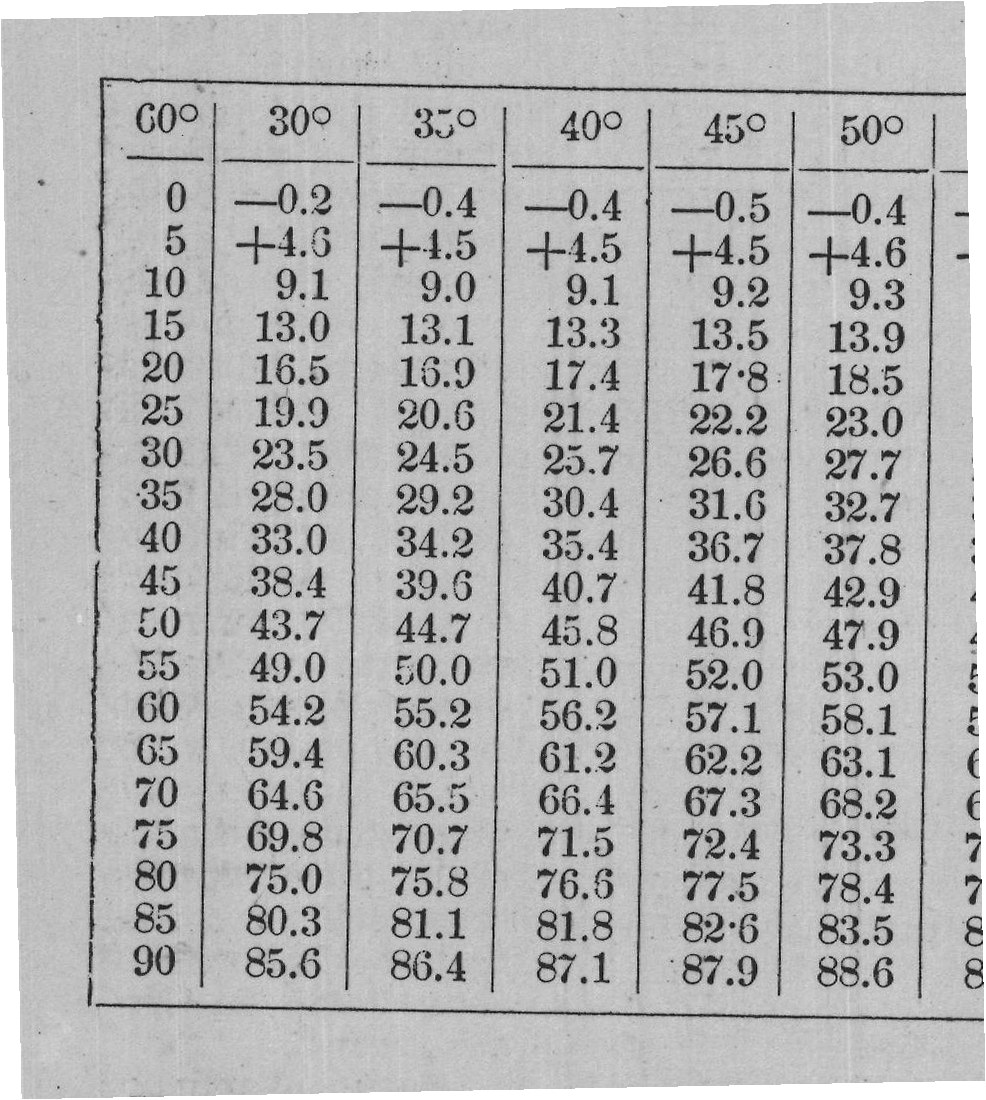
It will hold as much less water as is equal to constructed a simple table by which the real the bulk of the powder, and the weight of the percentage of alcohol is found in liquids of powder in air divided by this difference will give the specific gravity. Thus, supposing the bottle to hold 1000 grains of water, 100 grains of emery are introduced, and the bottle filled up with water. If no water were diswere displaced the two should weigh 1100 grains; they really weigh 1070; the difference, 30 grains, is the weight of water displaced; 100-30-3.333 , specific gravity of the emery. different temperatures from the results exhibited by the instrument. (See No. 55. ) The horizontal line at the top shows the various temperatures given by the thermometer; the column of figures under 60° shows ° shows the true percentage of strength at the normal or standard temperature of 60°; the figures under the other degrees of temperature show the observed or apparent degrees of strength as indicated by the hydrometers. 52. To Determine the Weight of a Body from its Specific Gravity. A cubic foot of water weighs 1000 ounces; hence, to ; hence, to determine the weight of a given bulk of any body the specific gravity of which is known, is at 75°, Fah., and that the hydrometer sinks multiply the cubic content in feet by 1000, and this by the specific gravity, and the product will be the weight in ounces avondupois.
As an example of the simple manner by which this table may be used, we will suppose that the temperature of the spirits to be tested to 53° on the scale; this would be the observed or apparent degree or percentage of strength.
Now to find the real percentage of strength at 60°, we turn to the table and find the upfind the upright or vertical column of figures headed 75°, we then run down the figures until we Alcoholmetry. The percent- arrive at 53.0; having ascertained this, we age of absolute alcohol in any spi- then trace the horizontal line to the left or rituous liquid may be given either by vol- right to the outside column headed 60°, and ume or weight, but as liquors are sold by at the point when the horizontal line running measure, not weight, it is generally preferred from 53.0 meets the column headed 60°, will to know the percentage by volume. The be found the number 50. We thus ascertain per cent. of weight remains the same in all that a spirit at 75° having an observed strength temperatures, but the per cent. by volume of 53 has only a real percentage of 50 at the normal or established temperature of 60°. | the true percentage of the brandy at 60° Fah. Suppose that another sample of brandy, instead of being at 75° is at 50°, and the instru- ture of 300 be found to contain 23.5 per cent. Again, if an alcoholic liquid at a tempera- Suppose that another sample of brandy, inbeing at 75° is at 50°, and the instru- ture of 30 be found to contain 23.5 per cent. Again, if an alcoholic liquid at a temperament still sinks to 53. In the same way we by volume, by reference to the table 30 will select the column headed 50°, and run down be found to express its actual strength at 60° the figures until we find 53.0, then by tracing the horizontal line until we arrive at the outside column headed 60° (either the first or Fah. are sufficient to show the manner by which We might multiply examples, but the above * last column), we find the number 55, which is the table may be worked. 55. Table to find the true percentage of Absolute Alcohol by volume in a liquid at CO from the observed percentage indicated by a Glass Hydrometer at any other temperature.
GOO 30° 350 40° 45° 50° 550 65° 70° 75° 80° 85° 60° 0 -
0.2 -0.4 - 0.4 -0.5 -0.4 -0.2 +0.2 +0.6 +1.0 +1.4 +1.9 0 5 +4.6 +1.5 +4.5 +4.5 +4.6 +4.8 5.3 5.8 6.2 6.7 7.3 5 10 9.1 9.0 9.1 9.2 9.3 9.7 10.4 11.0 11.6 12.3 13.0 10 15
13.0 13.1 13.3 13.5 13.9 14.5 15.6 16.3 17.1 18.0 19.0 15 20 16.5 16.9 17.4 17.8 18.5 19.2 20.8 21.8 22.8 23.8 24.9 20 25 19.9 20.6 21.4 22.2 23.0 24.1 25.9 27.0 28.2 29.4 30.5 25 30 23.5 24.5 25.7 26.6 27.7 28.8 31.1 32.2 33.4 34.5 35.7 30 35 28.0 29.2 30.4 31.6 32.7 33.8 36.2 37.3 38.4 39.5 40.6 35 40 33.0 34.2 35.4 36.7 37.8 39.0 41.1 42.2 43.3 44.3 45.4 40 45 38.4 39.6 40.7 41.8 42.9 43.9 46.1 47.1 48.2 49.2 50.3 45 50 43.7 44.7 45.8 46.9 47.9 49.0 51.0 52.0 53.0 54.0 55.1 50 55 49.0 50.0 51.0 52.0 53.0 54.0 54.9 56.9 57.9 58.9 59.9 55 60
54.2 55.2 56.2 57.1 58.1 59.0 60.9 61.9 62.9 63.8 64.9 60 65 59.4 60.3 61.2 62.2 63.1 64.0 65.9 66.8 67.7 68.6 69.6 65 70 64.6 65.5 66.4 67.3 68.2 69.1 70.8 71.7 72.6 73.5 74.5 70 75 69.8 70.7 71.5 72.4 73.3 74.2 75.8 76.7 77.6 78.4 79.3 75 80
75.0 75.8 76.6 77.5 78.4 79.2 80.8 81.7 82.4 83.2 84.1 80 85
80.3 81.1 81.8 82.6 83.5 84.3 85.7 86.5 87.3 88.0 88.3 85
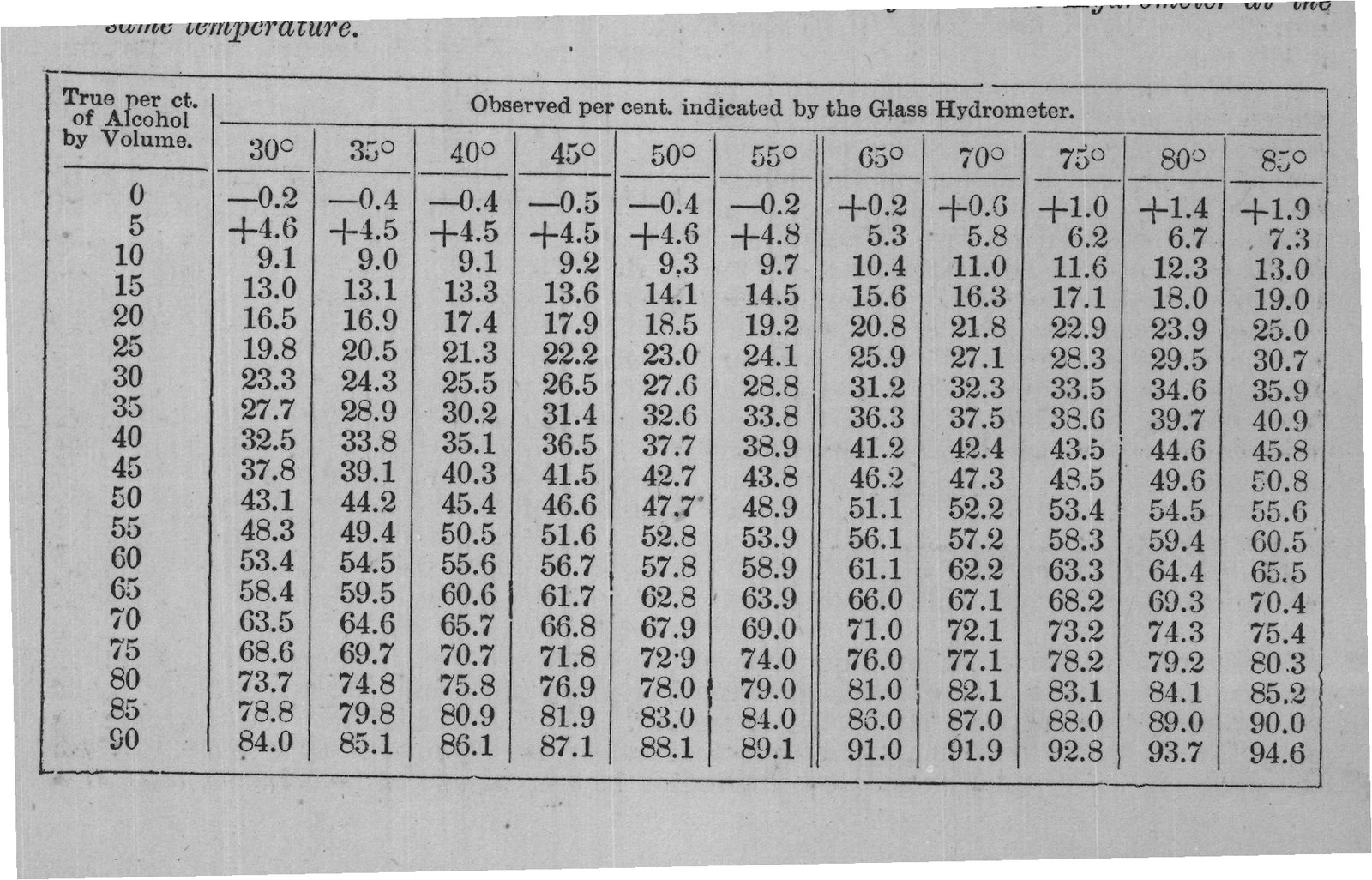
90 85.6 86.4 87.1 4 87.9 88.6 89.3 90.7 91.4 92.0 92.793.4 90 The following table gives the richness or when tested; it therefore requires that the the per cent. of alcohol by volume, in reference liquor should be tested exactly at the same to the volume of the liquid at the temperature | temperature at which it was measured. 56. Table to find the true percentage of Absolute Alcohol in a liquid of any temperature from the observed percentage indicated by the Glass Hydrometer at the same temperature.
True per ct. of Alcohol Observed per cent. indicated by the Glass Hydrometer. by Volume. 30° 35° 40° 45° 50° 55° 65° 70° 750 80° 85° 0 -
0.2 -0.4 -0.4 -0.5 -0.4 -0.2 +0.2 +0.6 +1.0 +1.4 +1.9 5 +4.6 +4.8 5.3 5.8 6.2 6.7 7.3 10 9.1 9.0 9.1 9.2 9.3 9.7 10.4 11.0 11.6 12.3 13.0 15
13.0 13.1 13.3 13.6 14.1 14.5 15.6 16.3 17.1 18.0 19.0 20 16.5 16.9 17.4 17.9 18.5 19.2 20.8 21.8 22.9 23.9 25.0 25 19.8 20.5 21.3 22.2 23.0 24.1 25.9 27.1 28.3 29.5 30.7 30 23.3 24.3 25.5 26.5
27.6 28.8 31.2 32.3 33.5 34.6 35.9 35 27.7 28.9 30.2 31.4 32.6 33.8 36.3 37.5 38.6 39.7 40.9 40 32.5 33.8 35.1 36.5 37.7 38.9 41.2 42.4 43.5 44.6 45.8 45 37.8 39.1 40.3 41.5 42.7 43.8 46.2 47.3 43.5 49.6 50.8 50 43.1 44.2 45.4 46.6 47.7 48.9 51.1 52.2 53.4 54.5 55.6 55 48.3 49.4 50.5 51.6 52.8 53.9 56.1 57.2 58.3 59.4 60.5 60 53.4 54.5 55.6 56.7 57.8 58.9 61.1 62.2 63.3 64.4 65.5 65 58.4 59.5 60.6 61.7 Gravity.
Specific Hyd'ter.
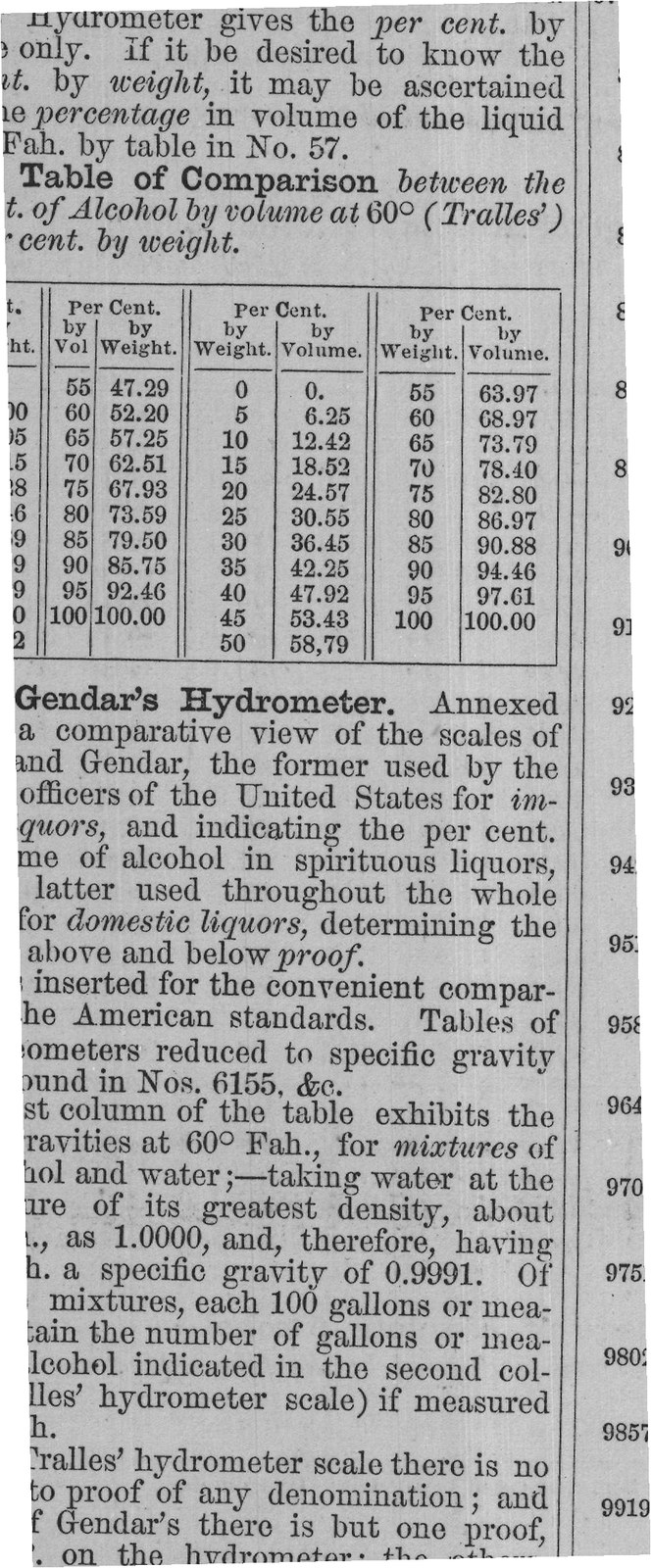
Tralles' Thus, if the Hydrometer indicated 59.4 per cent. in a liquid at 80° Fah., the table in No. 57 would give its true percentage (richness) 50 55 per to 55 per cent.; that is, 100 volumes of the contains 55 volumes of alcohol. 0.7939 100 Tralles' Hydrometer gives the per cent. by volume only.
If it be desired to know the per cent. by weight, it may be ascertained from the percentage in volume of the liquid 8157 95 at 60° Fah. by table in No. 57. 8332 90 57. Table of Comparison between the per cent. of Alcohol by volume at 60° (Tralles') and per cent. by weight.
Per Cent. by by 8488 85 Per Cent. 8631 80 by by Per Cent. by by by Vol Weight. Vol Weight. Weight. Volume. Weight. Volume. 00. 55 47.29 0 0. 55 63.97 8765 75 5 4.00 60 52.20 5 6.25 60 68.97 10 8.05 65 57.25 10 12.42 65 73.79 15 12.15 70 62.51 15 18.52 70 78.40 8892 70 20 16.28 75 67.93 20 24.57 75 82.80 25 20.46 80 73.59 25 30.55 80 86.97 30 24.69 85 79.50 30 36.45 85 90.88 9013 65 35 28.99 90 85.75 35 42.25 90 94.46 40 33.39 95 92.46 40 47.92 95 97.61 45 37.90 100 100.00 45 50 42.52 50 53.43 100 100.00 58,79 9126 60