Britannicus
Son of the emperor Claudius and Messalina, was born A. D. 42. Agrippina, the second wife of Claudius, induced the emperor to adopt her own son, and give him precedence over Britannicus. This son, the emperor Nero, ascended the throne in 54, See page 47.
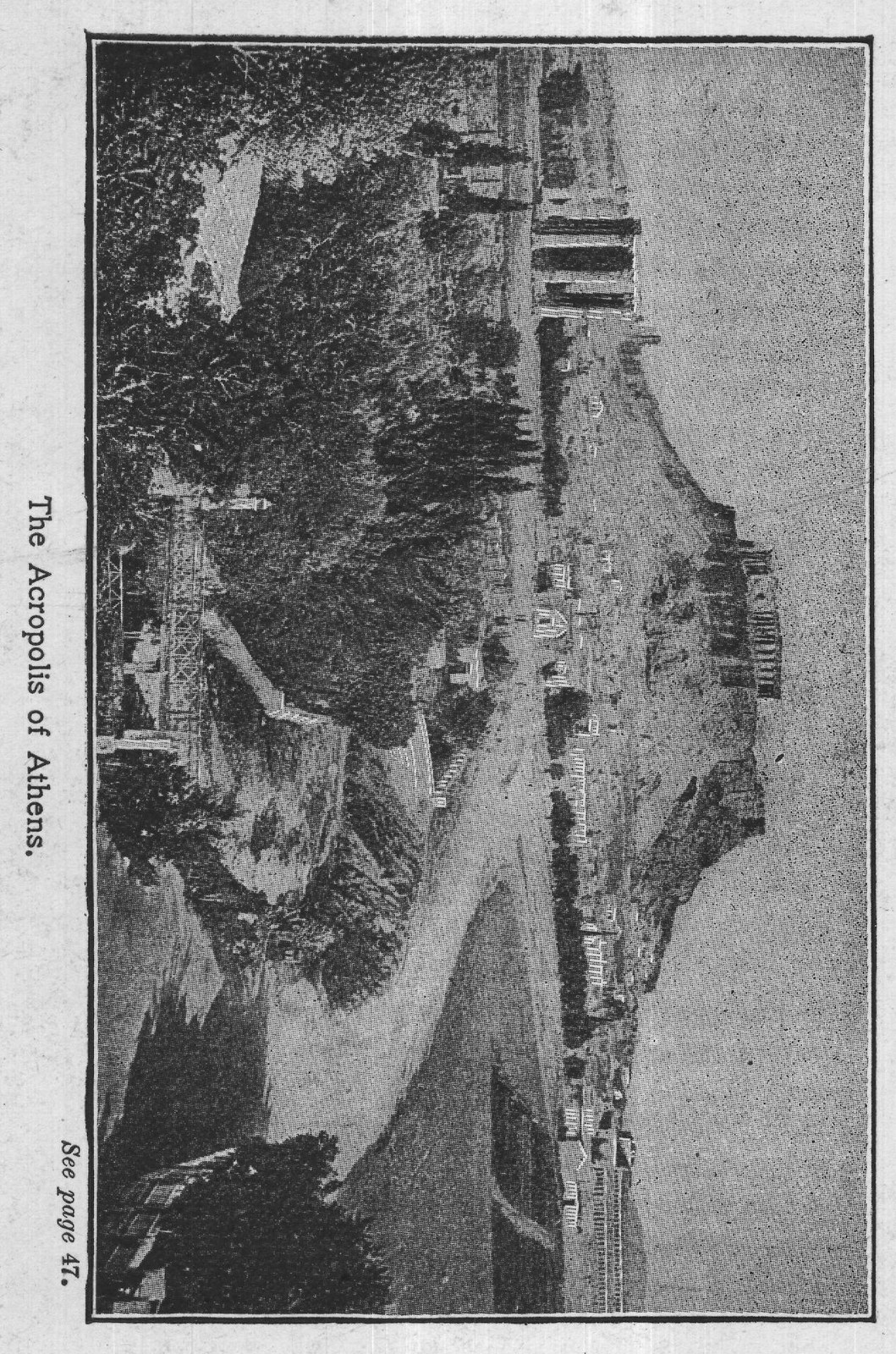
The Acropolis of Athens. and caused Britannicus to be poisoned in the following year.
Brundusium or Brundisium (Brindisi). A town in Calabria, on a small bay of the Adriatic, forming an excellent harbor, to which the place owed its importance. The Appia Via terminated at Brundusium, and it was the usual place of embarkation for Greece and the East. It was conquered and colonized by the Romans, B. C. 245. The poet Pacuvius was born at this town, and Vergil died here on his return from Greece, в. c. 19.
Brutus, L. Junius. Son of M. Junius and Tarquinia. When Lucretia killed herself, в. c. 509, in consequence of the brutality of Tarquin, Brutus snatched the dagger from the wound and swore upon the reeking blade immortal hatred to the royal family, and made the people swear they would submit no longer to the kingly authority. His sons conspired to restore the Tarquins, and were tried and condemned before their father, who himself attended their execution. Mr. John Howard Payne, the American dramatist, has written a tragedy of which Brutus is the hero.
Brutus, Marcus Junius. Father of Caesar's murderer, followed the party of Marius, and was conquered by Pompey, by whose orders he was put to death.
Brutus, Marcus Junius. The destroyer of Caesar, conspired, with many of the most illustrious citizens of Rome, against Caesar, and stabbed him in the senate-house. The tumult following the murder was great, but the conspirators fled to the Capitol, and, by proclaiming freedom and liberty to the populace, for the time established tranquillity. Antony, however, soon obtained the popular ear, and the murderers were obliged to leave Rome.
Brutus retired into Greece, where he gained many friends. He was soon pursued by Antony, who was accompanied by the young Octavius. The famous battle of Philippi followed, in which Brutus and his friend Cassius, who commanded the left wing of the army, were totally defeated. Brutus fell on his own sword, B. C. 42, and was honored with a magnificent funeral by Antony. Plutarch relates that Caesar's ghost appeared to Brutus in his tent before the battle of Philippi, warning him of his approaching fall. Shakespeare, in his tragedy of Julius Caesar, makes Antony speak of Brutus as "the noblest Roman of them all," adding, in reference to his character: "His life was gentle; and the elements So mix'd in him that Nature might stand up, And say to all the world, 'This was a man.'"