Bear
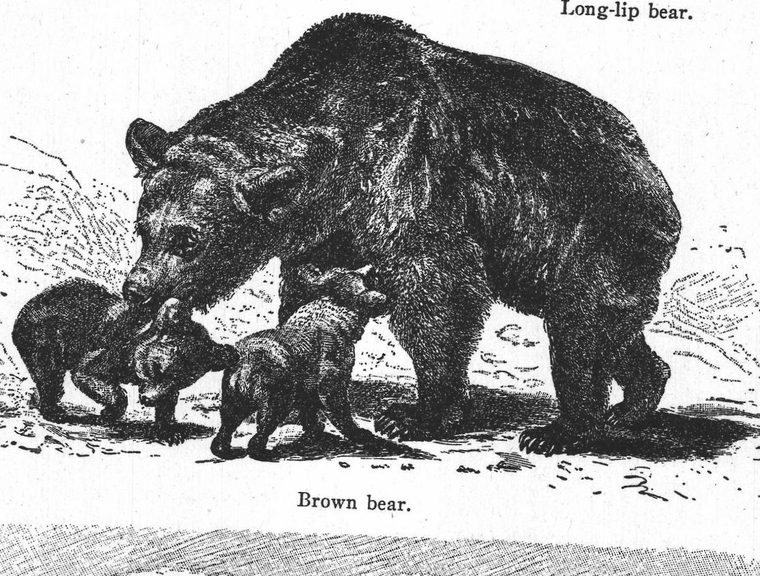
a family of well known animals. The bear has a shaggy coat, a heavy, clumsy body, and a short tail. It walks on the entire sole of the foot, rather than on the toes. The nearest American relative is the raccoon. There are many species, distributed throughout Europe, Asia, and America; but, excepting in the Atlas Mountains, none are known in Africa or Australia. The bear of history is the common brown bear of Europe, which, however, is becoming very scarce. It had disappeared in England by the time of the Norman Conquest. It is the heraldic emblem of the Swiss canton of Berne. Kipling likens Russia to "the bear that walks like a man."
Four groups are recognized in America: The black bear, the white bear, the grizzly bear, and the brown bear; in all, as some think, seventeen or more species. The cinnamon bear is classed with the black bear. The black bear is distributed everywhere in North American forests, unless exterminated. It is rather a solitary animal, each family occupying its own range, to the exclusion of others. It enjoys a great variety of food,--fish, insects, acorns, beech nuts, and, in time of scarcity, it is not averse to carrying away a farmer's pigs or sheep. It is fond of berries, especially of blueberries and bearberries. The bear is also very fond of honey. It digs up the nests of bumblebees, and will tear open a rotten log or tree in which a swarm of bees may have hived. Its thick hair protects it from the sting of the bees. This bear is entirely inoffensive and attacks a person only under the most extreme provocation, or in defense of its young. From one to three cubs are produced at a birth, and remain blind for about four weeks. In the autumn, the bear rolls itself up in a hollow tree or cavern, or in an excavation under some stump or log, and sleeps through the winter. It is a very imitative, good natured animal. If not tormented, a tame bear will roll about the dooryard playing with the dog and children. Specimens kept on the parade ground of a military post have been known to go through the manual of arms without instructions, shouldering a stick for the purpose.
In addition to the ordinary black bear, the group includes the Labrador bear, the Louisiana bear, the everglade bear, the cinnamon bear of the Rockies, the Queen Charlotte bear of British Columbia, and the glacier bear of Alaska, the latter being the smallest American bear known.
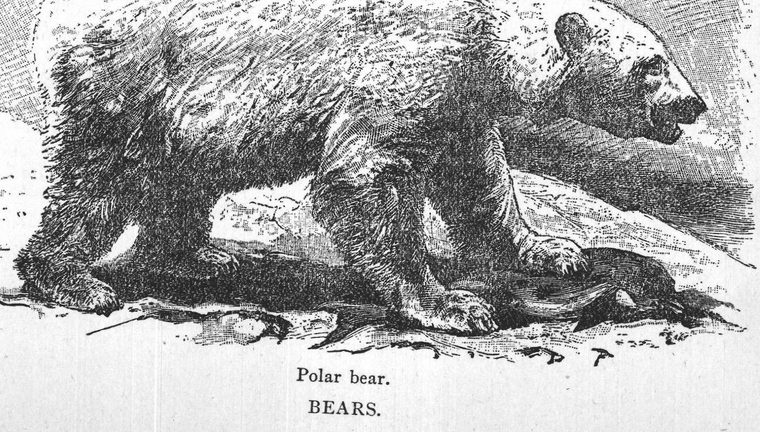
The polar bear of the far north is creamy white. This bear brings forth its hardy young in such a den as can be made in an Arctic region, frequently under the snow. It swims with great facility, pursuing seals and fishes in the water; the eider duck, and other Arctic birds on land. A young walrus is quite to the polar bear's taste. In summer, it varies a flesh diet with roots and mosses. This bear follows the edge of the ice pack. No water is too icy, no weather too cold, for this bear. With its warm, shaggy coat, it quite enjoys its Arctic home. Its tracks have been seen as far north as 84 deg.Owing to the nature of the region in which it lives, the polar bear is likely to live after all other species are extinct. As many as a score have been seen at one time on a single islet. A well grown specimen weighs eight hundred or a thousand pounds.
The prevalent western species of the Rocky Mountains is the powerful grizzly bear, a strong, but, if let alone, not a dangerous animal. It seldom attacks man. However, it is considered an undesirable neighbor in the vicinity of a stock ranch. Bret Harte has described the grizzly admirably in the following lines:
In whose lazy muscles lies
Strength we fear and yet despise;
Savage, whose relentless tusks
Are content with acorn husks;
Robber, whose exploits ne'er soared
O'er the bee's or squirrel's hoard;
Whiskered chin and feeble nose,
Claws of steel on baby's toes.
Joaquin Miller, who has written a whole book of bear stories, states that he never knew a grizzly to begin a fight or to eat human flesh. They are clumsy, good-natured eaters of berries, capable of becoming enraged, but they are never cruel. They never toy as a cat does with a mouse. Grizzly bears at one time were found as far east as Minnesota but the genuine grizzly of California is now rare. There are some fine specimens in the Yellowstone National Park. Allied species are the Sonora grizzly found in New Mexico, the Alaskan grizzly, and the Barren-Ground grizzly which is still hunted in the Great Slave Lake region.
The group of American brown bears was distributed until of late among the blacks and grizzlies. It contains several Alaskan species. The Kadiak bear, found chiefly on the island of that name, is the largest of all bears, the largest flesh eating animal known. It eats berries, grass, and salmon. Skulls nineteen inches in length are in museums. A specimen killed lately measured fifty-one inches in height at the shoulder. The outstretched forepaws were capable of spanning ten feet, six inches. The Kadiak bear weighs twice as much as a grizzly.
Bruin is a favorite character in juvenile literature. The story of the three bears, the big bear, the little bear, and the middle sized bear, with their chairs of corresponding sizes, is thoroughly characteristic. Of American writers, Ernest Thompson-Seton and his Lives of the Hunted should be mentioned for sketches of bear life.