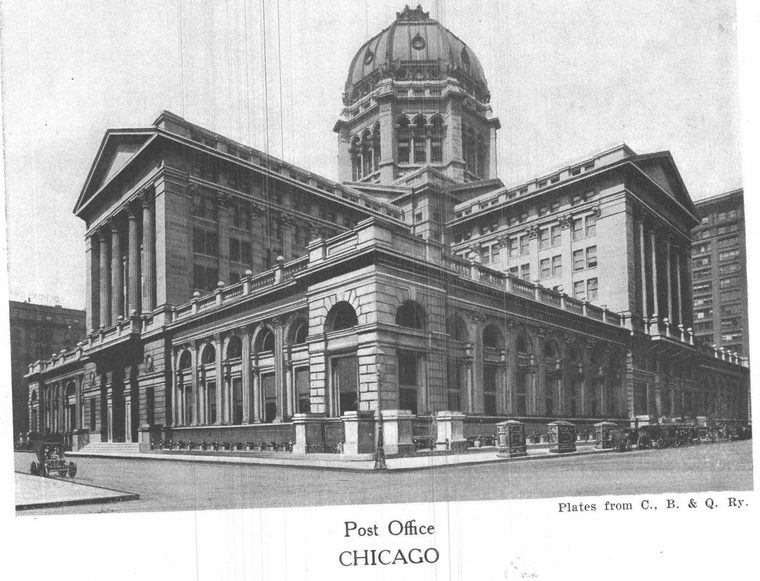
Chicago
a city of Illinois, situated on the west shore of Lake Michigan. It is the sixth city in the world. It is exceeded in size by London, New York, Paris, Canton, and Berlin. The population increased from 100 people in 1830 to 1,698,575 in 1900, and to 2,250,000 in 1905,--the most wonderful growth on record. The territorial growth of the city is equally remarkable. A French trader's house of squared logs, erected in 1774 during the Revolution, was reinforced in 1804 by an American stockade, called Fort Dearborn. It was built on a military reservation on the south bank of the Chicago River, adjoining the lake. After the War of 1812 a trading village sprang up under the protection of the fort. The original town was laid out on north and south lines in 1830. It occupied the oblong bounded by State, Madison, Desplaines, and Kinzie streets--about sixty blocks. It embraced the junction of the two branches of the Chicago River, but did not reach the lake front. The census area of 1900 was over 190 square miles, with a lake frontage of twenty-six miles. The territory outside of the two arms of the river is now called West Chicago, that between the south branch and the lake is South Chicago, and that between the north branch and the lake is North Chicago.
When first occupied there was little to indicate that this was to be the site of a populous city. In 1823 the United States commander at Fort Dearborn wrote to the secretary of war as follows: "I have the honor to inform you that this post should be abandoned, because the country surrounding it is such that it is impossible for a population to live here sufficient to justify the expense of keeping a fort at this place." The mouth of the river was obscured by a sand bar. The original trading post and stockade were located here. It was the lake terminus of a canoe route by way of the Illinois River and the south branch of the Chicago between the Great Lakes and the Mississippi. In 1833 Congress appropriated sufficient money to cut a passage through the bar. All this is in marked contrast with a present valuation of $30,000 per front foot as indicated by a recent transfer of property at the corner of Jackson street and Wabash avenue.
Immigration poured into the prairie region and Chicago became a lively lake port, a basis of farmers' and small traders' supplies. In 1852 the Michigan railways reached the city. Growth thenceforth was by leaps and bounds.
The harbor, the fact that northwestern railways almost necessarily pass through Chicago on the way eastward around the southern end of Lake Michigan, and the immense area of fertile territory that naturally buys and sells at Chicago, are the three natural factors that have caused the phenomenal growth of this city.
Sunday evening, October 8th, 1871, a great fire swept the central portion of Chicago. It started in a barn on the west side, tradition says, by a cow's knocking over a lamp. In twenty-four hours' time, the heart of the city, over 2,000 acres, was a mass of ruin. The heat was so intense that iron work became as soft as wax, and stone structures crumbled like sand. The loss of life is estimated at 300 persons. The loss of property is placed at $187,000,000. The loss was so enormous that many insurance companies went to the wall, and yet $46,000,000 insurance was paid. Notwithstanding this setback, the demand for business blocks was so great that in two years' time the city was rebuilt more solidly than ever. A stranger would not have noted that a fire had done any damage.
A noteworthy event in the history of the city was a world's fair held in 1892-3 to commemorate the four-hundredth anniversary of the discovery of America. It was called the Columbian Exposition. Six hundred sixty-six acres having two miles of lake front were set aside in South Chicago and beautified with lagoons of water and buildings on an enormous scale. The array of structures was built of dazzling stucco work, and known as the White City. The largest building, that devoted to manufactures, covered an area of thirty-one acres. A central hall in which great meetings, including a series of world's congresses were held, seated 75,000 people. Much taste was shown in adorning the buildings and grounds with statuary. Congress aided the fair with $5,000,000. The total cost was $43,000,000. The total number of admissions was 27,529,401.
Chicago is governed by a mayor and a council of seventy members, two for each of its thirty-five wards. The city sends ten congressmen to Washington. Public education is administered by a board of over twenty members. The system includes a normal school, 18 high schools, and about 250 elementary schools, 6,000 teachers, and 300,000 pupils. The annual expenditure for schools is over $10,000,000. seven-eighths of which is defrayed by local taxation.
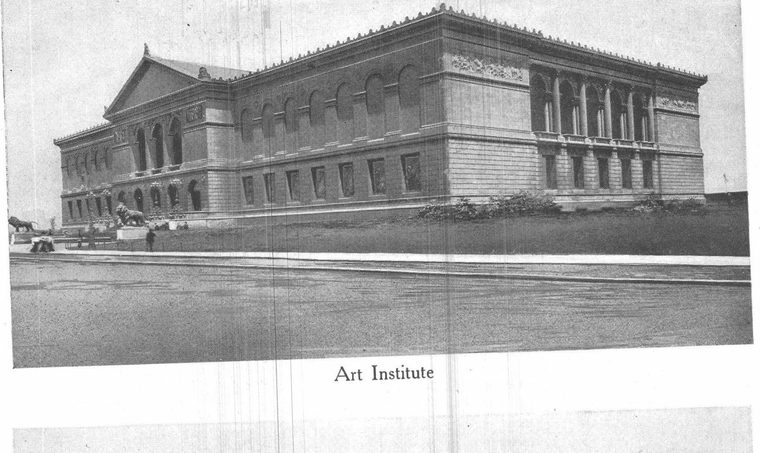
Each of the three great divisions of the city has a park board and a system of parks. The most noted parks are Jackson Park in South Chicago, where the exposition was held, and Lincoln Park, also on the lake shore, in North Chicago. The latter contains a celebrated collection of wild animals and plant houses. Every visitor to Chicago should go to see the bears, monkeys, eagles, seals, elk, deer, ostriches, and the rare orchids of this park. A fine statue of Lincoln, standing on a pedestal in front of a chair, is a prominent feature of the chief boulevard. A down-town park has been secured by filling in the lake front. The Field Columbian Museum and the Art Gallery are located in this tract. The total park and boulevard area of the city is over 2,000,000 acres with plans for increase in the near future.
City water is obtained through tunnels or enormous intake pipes built far out under Lake Michigan, to a point where the water is pure. To avoid danger of contamination $40,000,000 has been expended in constructing a drainage canal from the mouth of the Chicago River, by way of the Des Plaines River, into the Illinois, twenty-eight miles away. A current of clear water from the lake now runs up the old channel of the Chicago carrying the sewage of the city toward the Mississippi instead of into Lake Michigan. The least width of the canal is 110 feet; the least depth, 22 feet. It is proposed to enlarge it into a ship canal. The figures required to express the extent of municipal undertakings are too large to mean much. There are over 4,000 miles of streets and alleys, and 1,500 miles of sewers. The city uses 130,000,000,000 gallons of water yearly.
A public library with branch reading rooms expends $284,000 a year, and guards nearly a third of a million volumes. Of other libraries, the Newberry on the north side has 260,000 books; the John Crerar on the south side has 89,000; the law library in the Courthouse, 40,000; the University of Chicago, 500,000. Chicago is well provided also with institutions of learning. Armour Institute, on the south side, a technical school, has an endowment of $4,500,000, and an enrollment of 1,300 students. Lewis Institute, on the west side, has an endowment of over $2,000,000 and an enrollment of 1,400 students. The State University of Illinois maintains schools of medicine, dentistry, and pharmacy here. The University of Chicago, endowed by John D. Rockefeller, the oil magnate, has an endowment (1909) of about $17,000,000. It was opened in 1892. It is already one of the world's great universities, with an attendance approximating 5,000 students. While undenominational, its endowment requires that the balance of power must be held by Baptists.
Chicago ranks next to New York in volume of commercial printing. In 1909 one-tenth of the printing of the United States was done in the offices of Chicago. Over 25,000,000 telephone directories were printed for various cities. It is not uncommon for a mail order house to place an order with a job printer for 1,000,000 catalogs. The volume of printing business for 1909 was estimated at $60,000,000.
Chicago is one of the greatest wholesale and jobbing cities in the world. No other city equals Chicago as a railway center. Trains carrying express and trains carrying freight convey goods to all parts of the Mississippi Valley and the region westward. Chicago ranks second only to New York in the value of its manufactures. The census of 1900 gave 19,203 establishments, employing 262,621 wage earners and turning out $888,000,000 worth of manufactures a year. One-fourth of the farm machinery used in the Union is made at Chicago. The largest hog, sheep, and cattle markets and the largest meat packing industries in the world are here. In 1908 the stockyards received 3,305,000 cattle, 422,000 calves, 7,715,000 pigs, 1,148,000 sheep, and 85,500 horses and mules. Receipts of poultry products are heavy.
In his annual report for 1909 the city statistican estimated the population of Chicago at 2,572,835. According to this report the residents are three-fourths foreign, under which term he includes children whose parents were born abroad. The residents represent nearly forty European and Asiatic countries grouped as follows:
| Americans (including persons whose parents are not foreign-born) ... 699,554 | |
| Germans | 563,708 |
| Irish | 240,560 |
| Poles | 173,409 |
| Swedes | 143,307 |
| Russians | 123,238 |
| Bohemians | 116,549 |
These are the large groups, but thirty other nationalities are included in the list. The Chinese number 1,801, and the Japanese only 257. It is predicted freely that the population will reach 5,000,000 ere the year 1940 arrives.
The following additional statistics are significant of Chicago's recent growth and present commercial importance:
| Manufactures-- | |
| 1900 | $789,000,000 |
| 1905 | $955,000,000 |
| 1910 (estimated) | $1,782,935,000 |
| Wages, 1909 | $140,000,000 |
| New investments, 1906-9 | $200,000,000 |
| Deposits in banks | $810,000,000 |
| Railroads-- | |
| Trunk lines | 25 |
| Passenger trains daily | 1,600 |
| New buildings yearly | 9,000 |
| Cost of same | $80,000,000 |
| Northwestern station | $20,000,000 |
| La Salle hotel | $6,500,000 |
| Grocery stores, number of | 5,200 |
| Saloons, number of | 7,300 |
| Saloon receipts yearly | $115,000,000 |
| Elevator capacity, bushels | 54,000,000 |
| Bank clearings, 1909 | $11,853,814,943 |
| Wholesale trade | $1,892,949,000 |
| Insurance losses | $4,901,000 |
| Receipts of lumber, board feet | 2,577,000,000 |
| Real estate transfers | $140,000,000 |
| Fur sales | $19,000,000 |
| Library circulation, volumes | 2,500,000 |
| Live Stock Receipts-- | |
| Cattle | 2,932,000 |
| Calves | 410,000 |
| Hogs | 6,614,000 |
| Sheep | 4,440,000 |
| Horses | 9,300 |
| Customs receipts | $10,142,634 |
| Telephones | 207,000 |
| Deaths per 1,000 people | 14 |