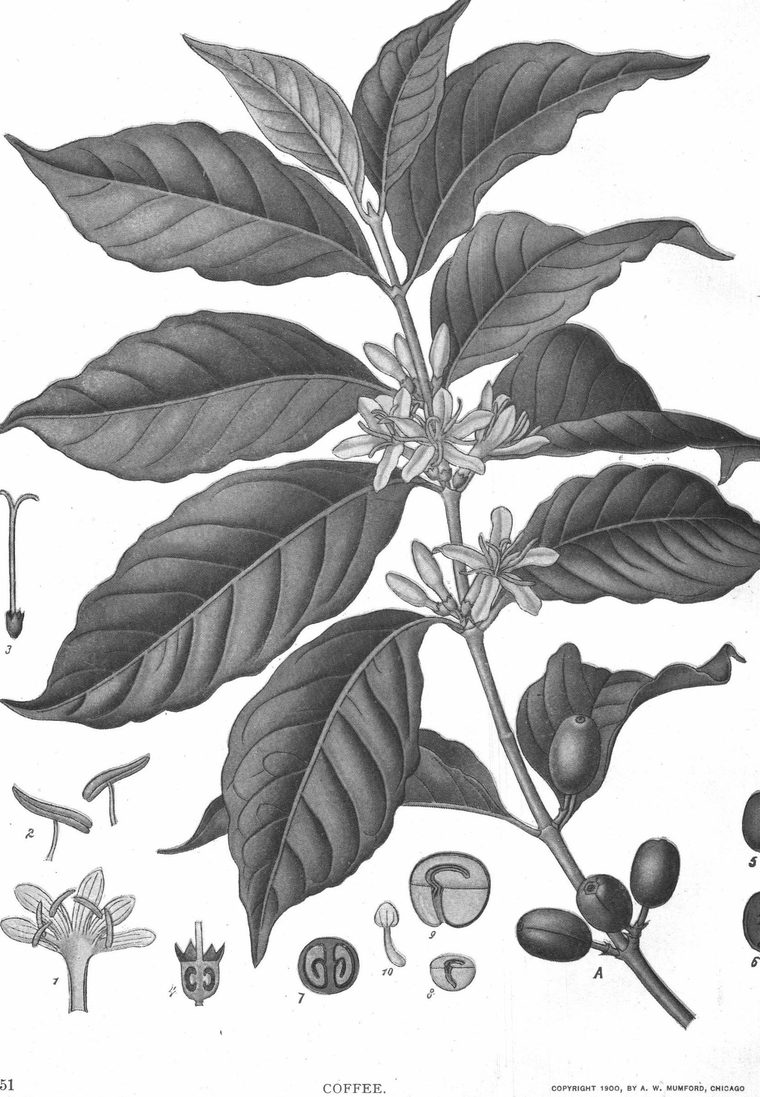
Coffee
kof'fe, the dried seed of a laurel-like evergreen shrub. Its native home is Abyssinia or Arabia. It grows to a height of six to thirty feet, but in cultivation it is pruned to a bush little higher than a man's head. Coffee trees are started in nurseries and are transplanted like fruit trees. A tree begins to bear when three years old, and produces from one to five pounds for twenty years. Methods of cultivation do not seem to differ materially from those used in raising cherries which, in fact, the ripe fruit resembles. In harvesting, the ripe berries are shaken down on cloths under the trees, the fruit is dried in the sun, then pulped, as the process is called, and washed. After drying again, and hulling and cleaning, the coffee beans are picked over, sorted, and put up in bags for market. Machines have been invented for removing the pulp green, thereby hurrying the crop to market. Mocha coffee gets its name from an Arabian port that formerly exported coffee. The supply of Mocha coffee is limited. There are no plantations. It is produced by groves of bushes surrounding the homes of the Arabs. Most of it is used by the Arabs themselves. Local dealers purchase small quantities, much as traders buy blueberries from the Chippewas. When a camel load has been collected in this tedious way, it is sent off in a caravan to Aden, perhaps 700 miles away.
Rio coffee is named from a Brazilian seaport. Brazil produces two-thirds of the world's coffee. Java coffee is supposed to come from the island of Java, but it is difficult to rely on names any more. Ceylon, Porto Rico, Cuba, Hawaii, and the Philippine Islands have large plantations or coffee orchards, as they are sometimes called. The United States is the great coffee market of the world, the people of Great Britain and the Continent being more inclined to tea. New York receives more coffee than any other city in the world. Ground coffees are so adulterated with carrot, parsnip, dandelion, beans, peas, lentils, and other cheap ingredients that public favor has been extended to whole coffee that may be ground by the grocer under the eye of the purchaser. Even then artificial coffee beans are palmed off. Adulterants mixed with coffee are ground up into a sort of dough. Machines have been devised for pressing kernels out of this paste that when dried and roasted look enough like the genuine to pass careless inspection.
An article in the United States Consular Report for February, 1904, gives much interesting information relative to the cultivation of coffee. According to the writer, there are in Asia, Africa, and America 49,000 coffee plantations, having 1,800,000,000 coffee-bearing trees. There are employed in the industry 2,220,000 men, women, and children. The total annual production is 2,881,000,000 pounds, or 21,500,000 bags. Five hundred trees are set to the acre. The average yield per tree is 1 3/5 pounds. The average cost of raising per pound is 4.7 cents. The average selling price at the plantation is 9 cents. The total value of the coffee crop to the planters is given at $225,000,000. Bailey's Cyclopedia (1908) puts the world's total production at "over 1,500,000,000 pounds" yearly.