Deer
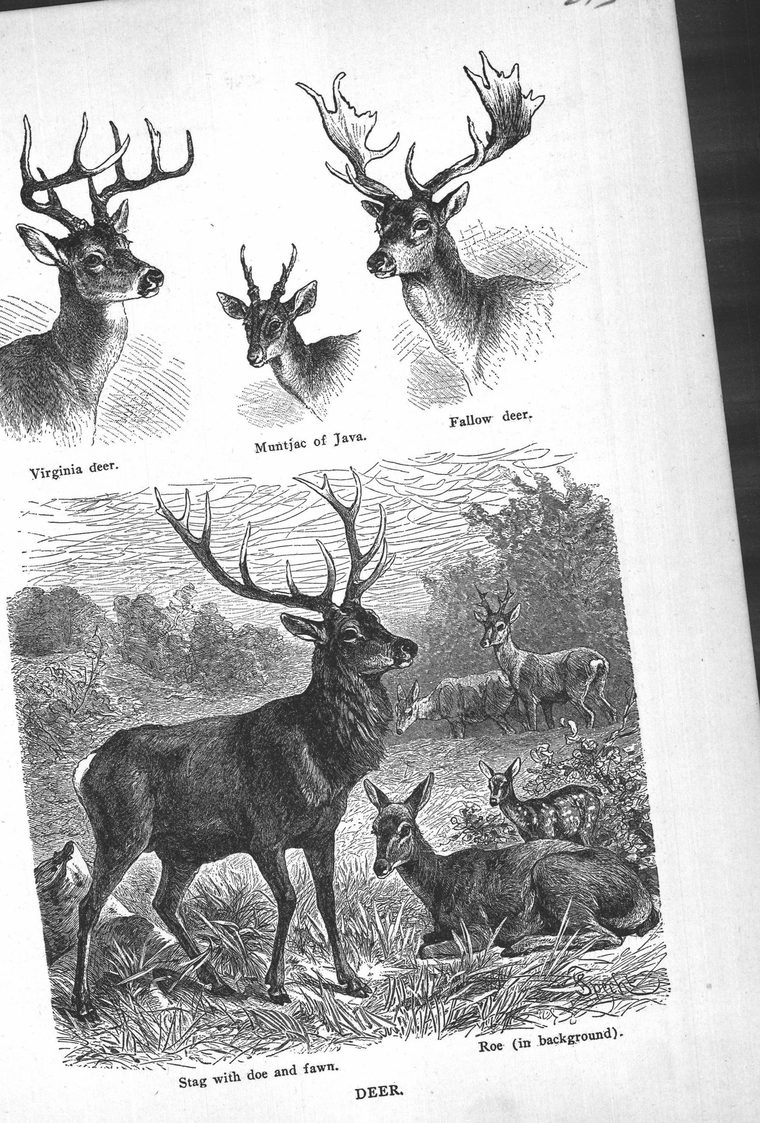
a family of cloven-hoofed, cudchewing animals, including the elk, moose, caribou, and reindeer. There are numerous species found in both hemispheres, but, generally speaking, the deer corresponds in the north temperate zone to the antelope of southern Africa. The male of the deer kind is known as a stag, or a buck; the female as a hind, or a doe; the young, which are frequently if not usually spotted, are called fawns.
The stag is provided with antlers. The antlers are bony outgrowths from the forehead. The first appearance of the antler is a blood-red swelling, which elongates rapidly until it has taken the shape of an antler. It is at first covered with a soft skin, when it is said to be in the velvet; after the bony material has set the velvet dries and rubs off. A stag sheds his antlers and grows new ones every year. His age may be known, within certain limits, by the number of branches. The antler of a stag a year old has but one prong; that of a two-year-old, two prongs. A royal stag is one with twelve-tined antlers.
The common red deer of Europe is celebrated in literature and in history, but has long since been exterminated, except where protected. Many fine herds are kept in the parks of England, as at Greenwich and elsewhere. Large deer preserves have been established in the Highlands of Scotland. Extensive tracts of rough country, of comparatively little value for agricultural purposes, in some instances comprising 50,000 to 70,000 acres, have been set aside for hunting purposes under the jealous care of gamekeepers. Many of these estates are let for an annual rental to those who can afford expensive sport. It is nothing for a wealthy member of Parliament or tradesman to pay from $5,000 to $20,000 annual rental for a Highland deer preserve with its hunting lodge and facilities for entertaining company. A million dollars or so are paid annually for the use of these preserves. Stags only may be taken. They cost these wealthy Nimrods about $250 apiece. There are several species in the wooded districts of South America and India.
There are three prominent game deer in the United States and Canada. The mule deer is the characteristic deer of the Rocky Mountain region. It is the largest and most stately of our deer. Large specimens attain a shoulder height of forty-two inches. The antlers attain a spread of twenty-nine inches. The coat is steel gray in winter, to match the gray rocks. The summer coat is of a grayish brown. The flag or tail, when lifted, shows white with a black tip. The mule deer lives in the Bad Lands and foothills and ravines of the Rocky Mountains, ascending plateaus 12,000 feet above the sea. It is capable of living on scanty vegetation. Even sagebrush does not come amiss. A small variety is found in Alaska. The mule deer is approaching extinction rapidly.
The Columbia black tail is a deer of the Pacific coast. Its flag is black, with a white fringe at the tip. It lives in the dense coniferous forests that extend from British Columbia to California. It feeds on evergreen foliage. Park specimens taken to the East die of stomach troubles.
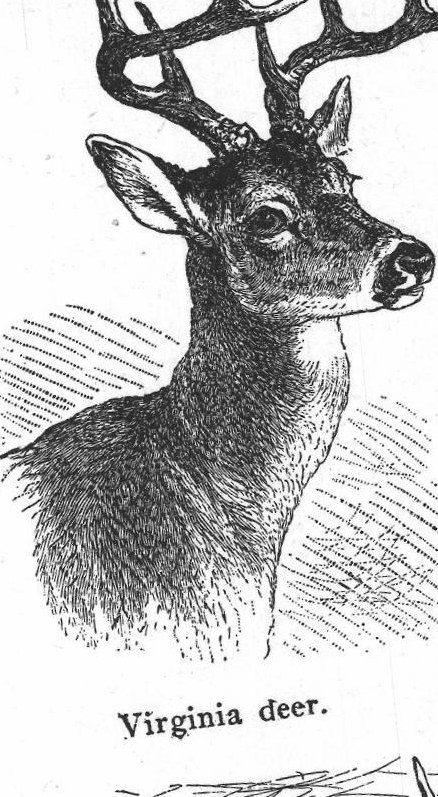
The deer of North American literature is the white tail or red Virginia deer. At present it reaches its greatest size and perfection in the evergreen country reaching from Minnesota to the Adirondacks. A large specimen stands thirty-six inches high. A small variety is called the Florida white tail. A western, somewhat dwarfed species is known as the Arizona white tail. This deer has the faculty of skulking in the summer time, and of rearing its young in brush near human habitations, without being discovered. It is still to be found in every state and territory of the Union, it is said, save Delaware, Oregon, Nevada, California, and Arizona. Its general color is chestnut red, turning grayish in winter; with a tail, white beneath, which, as hunters say, is thrown up like a flag when the deer leaps.
In eastern North America the deer was a factor in aboriginal life not unlike that of the camel among the Arabs, or the buffalo among the Indians of the plains. Its meat, called venison, was a staple article of diet. When cut into strips and dried or jerked in the sun, it could be kept for a considerable length of time. The hide was used for moccasins and clothing. The sinews, finely divided, were used for thread; deer's hair served for stockings, and untanned pelts, or pelts tanned with the hair on, were used for tents and for blankets in which to sleep. The white settlers who drove the Indians from their hunting grounds were scarcely less indebted to the deer for food and clothing. The buckskin hunting shirt and leggings are as much a part of the traditional hunter and guide as his coonskin cap. Cooper's Leatherstocking Tales take their name from the deerskin leggings worn by Natty Bumpus. Col. Boone and his Kentucky rangers were clad in buckskin hunting shirts.
At present deer are protected by law in the states and provinces where they are still found; but actual settlers, and those who supply meat to lumber camps, regard the laws as designed for the particular benefit of city hunters, and pay very little attention to them. The deer is very adroit in hiding itself in thickets, and brings up its young surprisingly, under difficult circumstances; but settlements, dogs, and guns are exterminating it rapidly. Warner's A-Hunting of the Deer is a sympathetic piece of writing. William J. Long has written entertainingly of the deer in his Secrets of the Woods.