Life-Saving Service
a bureau attached to the United States Treasury Department. This bureau is in charge of a general superintendent with headquarters at Washington. A board of experts selected from various branches of the public service passes on life-saving appliances. There were, in 1910, 280 stations; 201 on the Atlantic coast, sixty on the Pacific coast, sixty on the Great Lakes, and one at the Falls of the Ohio, Louisville, Kentucky. Each station is in charge of a keeper and a crew of six or seven surfmen. These men are deputy inspectors of customs and are the legal custodians of all property washed ashore. The stations deal with from 300 to 400 disasters yearly, involving about 4,000 persons and possibly $12,000,000 worth of property. Although fifty-two ships went to pieces on the rocks in 1908 only sixteen persons were lost. The yearly cost of the service is about $2,000,000.
The stations, usually two-story buildings, are placed at intervals of from three to thirty miles, according to the nature of the coast. They are connected by telephone and are in charge of district superintendents. Discipline is maintained as in a fire department. Patrols go up and down the coast watching for ships or small boats in distress. When a signal is turned in, by telephone or by a colored light, the surfmen make all speed to the place of danger with a carriage all in readiness with lifesaving appliances.
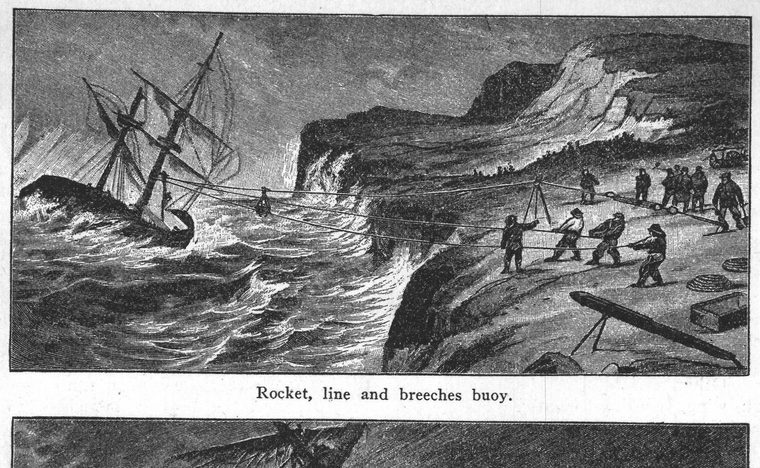
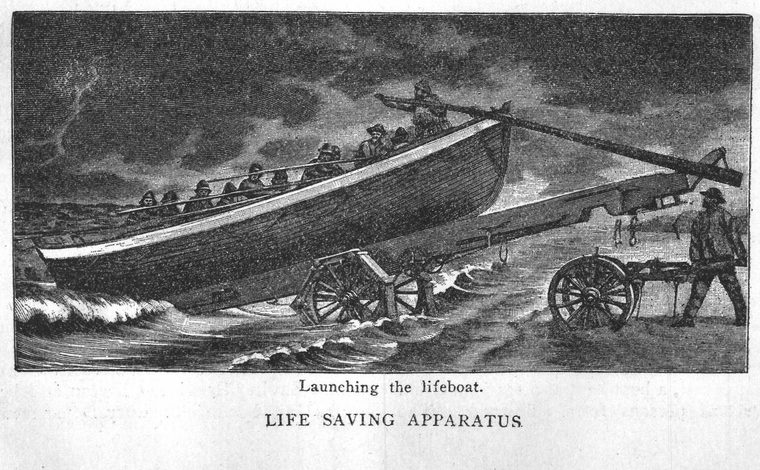
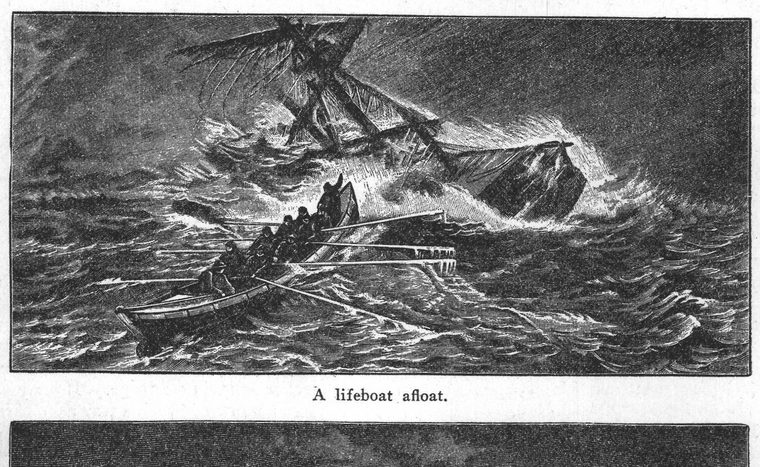
First in importance is the life-boat. This boat is launched by backing the carriage into the sea, when the surfmen, already seated at their oars, take advantage of a rising wave to pull away. An approved lifeboat is eight feet wide and thirty-three feet long. It is stout, light, roomy, and speedy. It is so broad that it is difficult to upset it and it is provided with weights and air chambers in such a way that, if upset, it rights itself immediately. An ingenious system of relieving tubes discharges any water that comes in over the edge of the boat. When a ship is beating on the rocks and human lives are in peril, the surfmen hold back for no personal danger, but, if the launching of a lifeboat is useless, yet another method is employed for the relief of ships near shore. Life-rockets are fired by means of a mortar or cannon carried on the cart for the purpose. A line, one end of which is attached to the rocket, may thus be thrown to the ship, and, if caught, be used to draw out a rope on which a traveling sling may be rigged to carry persons ashore. Such a sling, known as a breeches buoy, from the trouser-like contrivance in which the person rides, may be drawn to and fro by a cord until the ship wrecked passengers and crew are brought ashore one by one.
The earliest American life-saving stations were established by the Massachusetts Humane Society at Cohasset and other points on the coast of that state. In 1837 ships were detailed by the treasury service to patrol the Atlantic coast and aid the shipwrecked. The first national stations were established in pursuance of an act, 1848, on the Sandy Hook coast of New Jersey. England, as might be expected of the leading commercial nation, was a pioneer in this direction, but a life-saving service is now maintained by each of the maritime nations of Europe.