Lizard
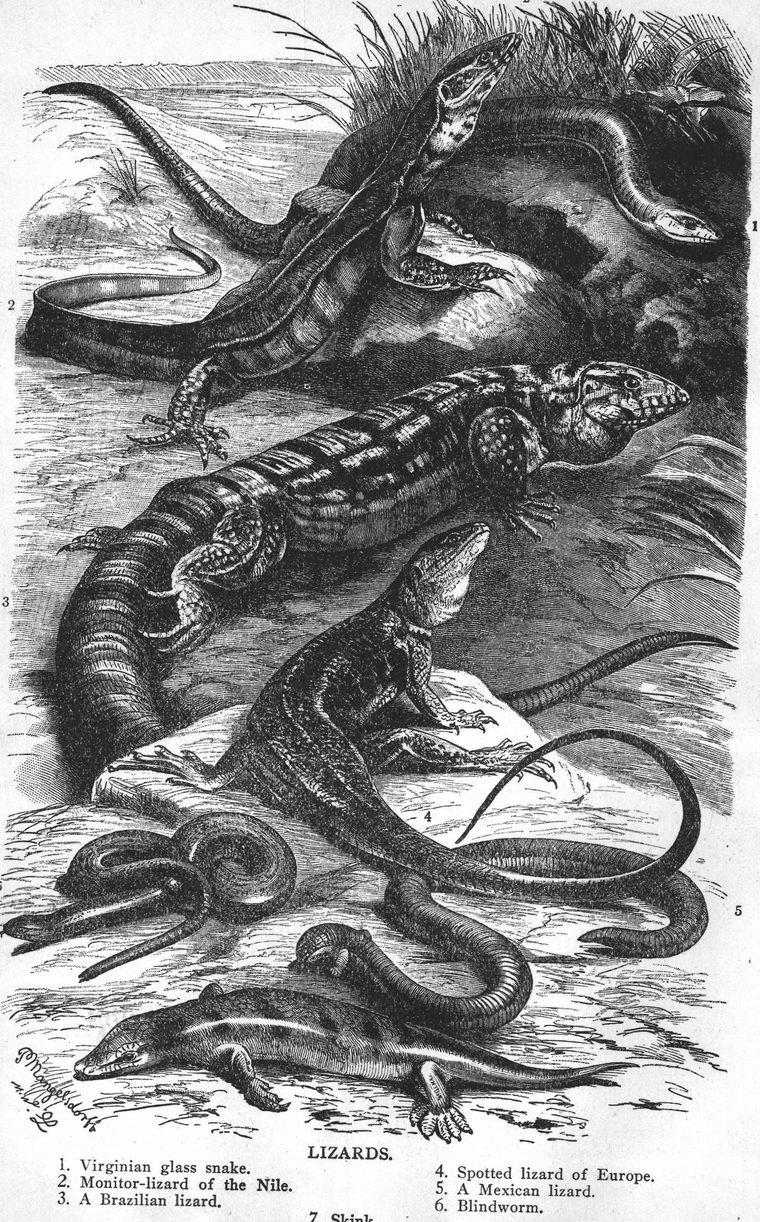
a scaly, four-legged reptile without a shell. Leave out the snake and turtle, any other reptile may be called a lizard. The largest lizard known is the crocodile, twenty feet long; the smallest may be held by the dozen in the palm of the hand. Ordinary lizards have two pairs of legs and a long, slender, tapering tail. The middle of each vertebra of the tail has a layer of cartilage that renders the tail liable to snap in two readily without apparent injury to the owner. A new tail grows quickly but it lacks vertebrae. It is merely a gristly tube. The eyes are provided with movable eyelids. The young are hatched from eggs, but do not undergo changes like those of the frog. Lizards live usually on insects, worms, and similar food.
The common lizard or swift is described by Jordan as "greenish, bluish, or bronzed, with black, wavy cross-bands above, throat and sides of belly with brilliant blue and black; scales of back rather large, strongly keeled, pointed, similar to lateral scales; body depressed; tail slender. Length, seven inches. United States, in forests and along fences, north to Michigan; abundant south; varies greatly in color."
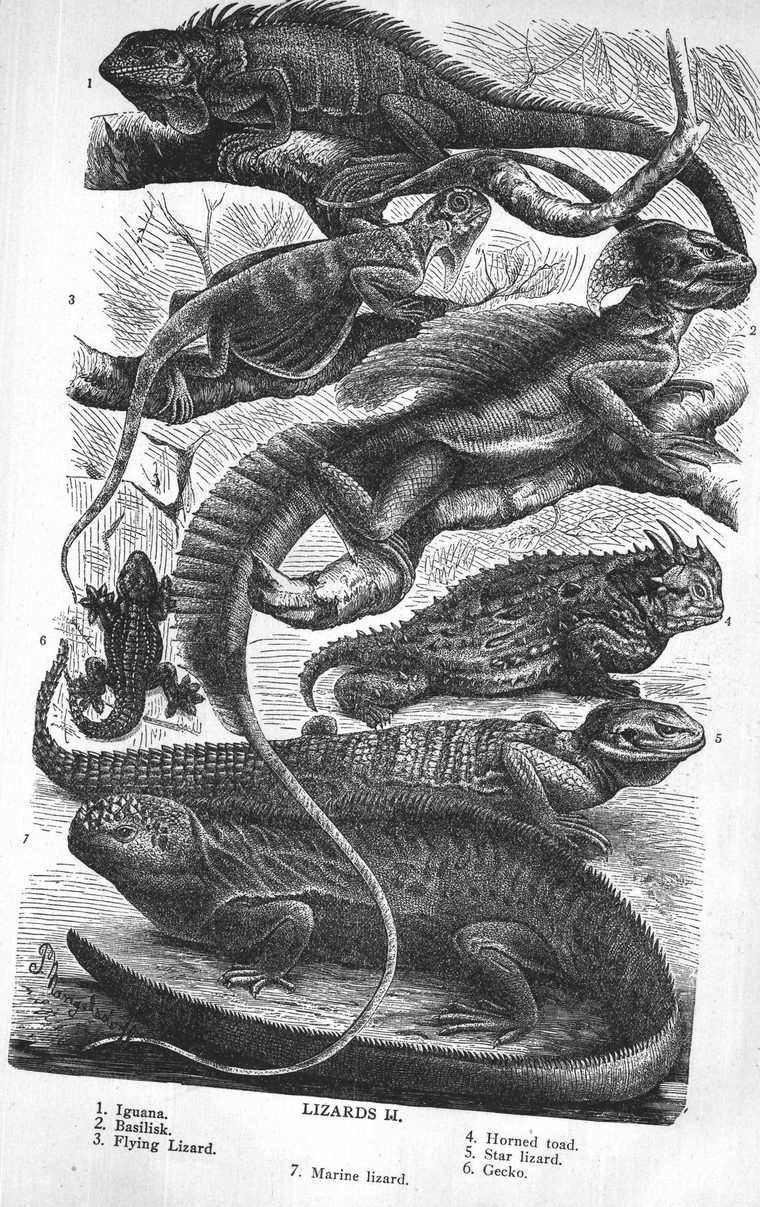
There are, counting allied forms, 1,600 kinds of lizards. The deserts of southeastern Asia, the Sahara region, and the coasts of the Mediterranean are noted for lizards. Some of the large lizards of Central and South America are valued for food. The glass snake is a lizard without legs. The gecko of Italy and Jamaica has two toes flattened into sucker-like disks that enable it to run about over stone walls and trees. A brilliantly colored tree lizard, native to the East Indies and Ceylon, is called the flying dragon. It is noted for a fold of skin running along the sides of the ribs. By extending this-fold, parachute fashion, the animal is able to swoop like a flying squirrel from branch to branch. It is obliged to run up the trunk, of course, so as to fly always to a lower level. The lizard is to be distinguished from the salamander.
See Chameleon; Iguana; Dragon; Basilisk; Slowworm; Salamander; Crocodile