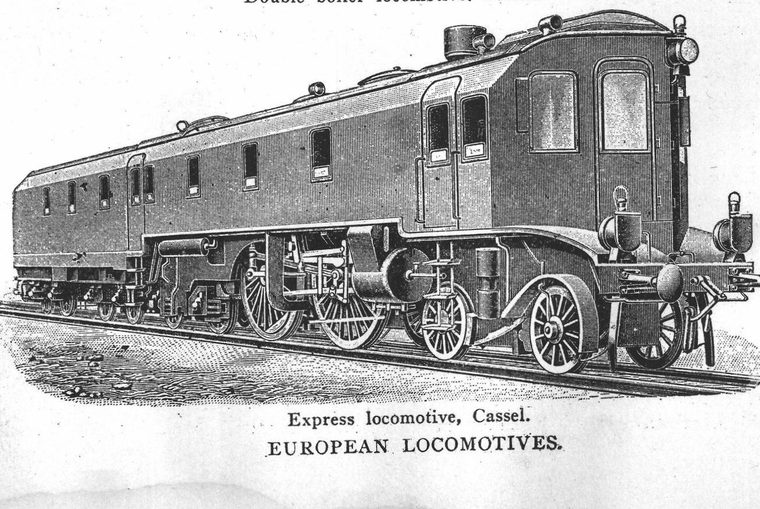
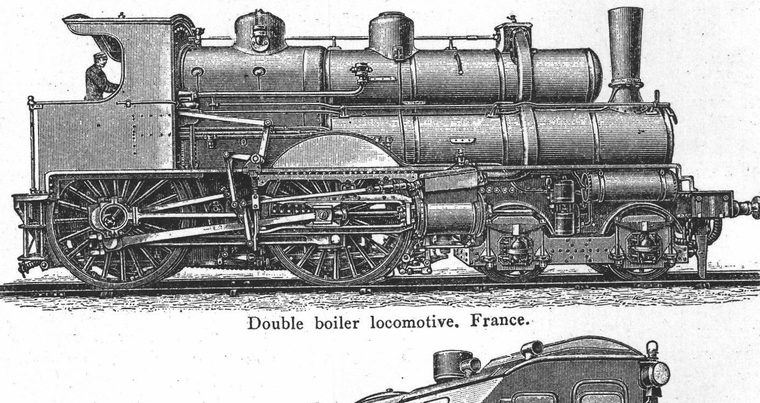
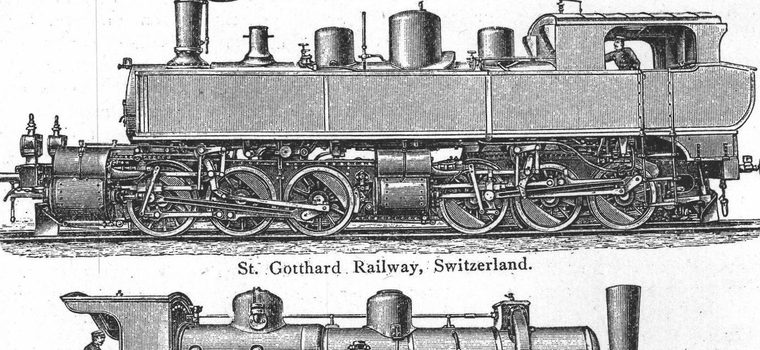
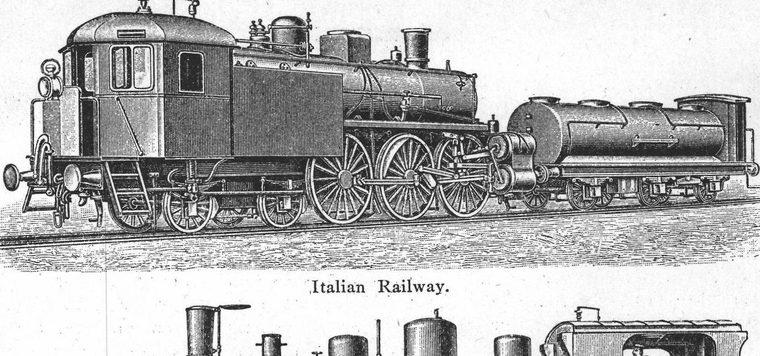
Locomotive
a steam-engine designed to run on a track and draw cars after it. The invention of the locomotive belongs to England. Sir Isaac Newton gave a hint in 1680. Murdock contributed a steam roadwagon in 1784. Richard Trevithick exhibited the first successful locomotive in 1803. It had four driving wheels and no others. He turned the exhaust steam into the smokestack to increase the draft. He used one cylinder, eight inches in diameter and fifty-four inches long. The first successful railway was opened in 1825. The cars were pulled by a locomotive designed by George Stephenson, who is not infrequently given credit as the inventor. Between 1803 and 1830, when the locomotive may be said to have become an established success, a number of famous locomotives were shown. They were named like race horses. Puffing Billy was built on the model of a grasshopper. The steel legs of the insect moved the wheels of the truck. Blucher, Hope, Black Diamond, Diligence, Experiment, Royal George, Novelty, and Sanspareil were favorites. Rocket, built also by Stephenson, won over all competitors in a trial called the Rainhill contest, in 1830.
The first locomotive in America was built by George Stephenson and was imported by the Delaware and Hudson Canal Company, arriving January 18, 1829. It was called the America. Another engine called the Stourbridge Lion by another English maker, but imported by the same firm, was the first actually to run on American soil. With English models before them American mechanics began the manufacture at once. American locomotives began to come on the market in 1832. The steam whistle is also an English invention dating from 1833. The first American builder was Peter Cooper of Cooper Institute fame. His first locomotive, a mere model named Tom Thumb, was completed in 1829. The names of Phineas Davis, Ross Winans, and Matthias Baldwin appear among the early designers. Best Friend and Old Ironsides were famous American engines built on English models.
American builders soon inaugurated changes to suit American conditions. The four-wheeled swiveled truck is one of these innovations. It permits the engine to round a sharp corner. The rocking feature, enabling an engine to adapt itself to an uneven track, is American. The cowcatcher is not seen on European railways. Among the points of construction readily understood by the ordinary reader is the use of large driving wheels on passenger locomotives for speed, and smaller wheels on freight locomotives for drawbar power in hauling heavy loads. The tendency has been to build engines heavier and heavier, until the standard engine of the eighties seems like a plaything by the side of the modern freight locomotive of the Mogul or Consolidation type. Care in the construction of roadbeds, and increase in the weight of rails have necessarily kept pace. A freight engine of the large type weighs from eighty to 100 tons, and costs as high as $15,000. Under ordinary conditions it is expected to draw a train load of seventy five loaded cars.
The Baldwin Locomotive Works at Philadelphia are the largest in the world. Baltimore, Boston, Providence, Manchester, Lowell, Lawrence, Taunton, Portland, Schenectady, Scranton, Pittsburg, Paterson, Jersey City, Trenton, Newcastle, Cleveland, Detroit, Milwaukee, San Francisco, and Richmond have locomotive works. These establishments employ 25,000 men and pay $15,000,000 a year in wages. The Canadian Pacific builds its own locomotives at Montreal. The average durability of a locomotive is twenty years. About the middle of the nineteenth century, American builders began to sell locomotives abroad. The American type is now well known. In 1898 English railways bought eighty. The Baldwin works alone have customers in fifty different countries.
The question of speed is largely one of keeping the track and of overcoming the wind created. Ordinary passenger locomotives are expected to make thirty or forty miles an hour; the regular run of the fast mail trains between New York and Chicago, a distance of 900 miles, is twenty hours. There are numerous short distance records for speed. In 1892 a train on the Reading road, between Philadelphia and Jersey City, attained ninety-seven miles an hour for a short time. In 1893 the New York Central reported 112 1/2 miles an hour for 32 seconds. In 1895 a special train on the New York Central ran from New York to East Buffalo, a distance of 436 1/2 miles, in 407 2/3 minutes, at an average speed of 64 1/4 miles an hour. The Germans are experimenting with a cigar-shaped locomotive designed to lessen the resistance of the air.
In addition to the first cost of a locomotive, the cost of keeping it in repair is heavy. C. C. Andrews, writing in the Railroad Man's Magazine for June, 1909, says that, "for every mile a locomotive runs, from one to three cents must be set aside for repairs." There were in 1906 57,672 locomotives in use on American railways. They were managed by 59,855 engineers and 57,672 firemen, an average of fifty-five engineers and firemen for each 100 miles of road. Lubricating oil costs $2 cr over per 1,000 miles of run. It takes from ten to 100 pounds of coal per hour to keep an engine from cooling off. The cost of fuel, water, repairs and wages, shops, engineers, firemen--the power of a railway system--is about one-third of the expense of operating.
It is difficult to keep track of the largest locomotive as it is of the largest steamship. Locomotive No. 4806 on the New York Central is described as seventy-eight feet long. It weighs 262,000 pounds. Engine and tender weigh 424,000 pounds. The latter has a capacity of fourteen tons of coal and 8,000 gallons of water. When running at the customary speed of fifty miles an hour, this engine requires seventy-two gallons of water per hour. Three locomotives purchased for the Erie Railroad in 1907 weigh, engine and tender, 672,000 pounds each. On a level track, each is capable of hauling a freight train two miles in length.
Under date of July, 1909, Popular Mechanics states that two new oil-burning locomotives for the use of the Southern Pacific Railroad on its Sacramento division, where the maximum grade is 116 feet per mile and the rating 1,212 tons of cars and lading, are the largest and most powerful in the world. Each locomotive with its tender weighs about 596,000 pounds and is ninety-two feet in length. The driving wheels number sixteen, eight in each coupled group, and the calculated tractive force is 94,640 pounds. The total heating surface of each locomotive is 6,393 square feet, the fire box having 232 square feet, the fire tubes, 4,941 square feet, and the feedwater heater, 1,220 feet. The outside diameter of the driving wheels is fifty-seven inches and the boiler, equipped for oil burning, is eighty-four inches in diameter. A superheater, placed in the piping system between the high and low pressure cylinders, is located in the smokebox. The tender is fitted with a 9,000 gallon water-bottom tank, and its capacity for oil is 2,850 gallons.
Other monsters have been turned out at the same works within the past few months. One, with tender, is 105 feet long, and heavy and powerful in proportion. It weighs 300 tons. Its driving wheels are seventy-three inches in diameter, its boiler seventy-two inches in diameter, and its height from rail to top of smokestack fifteen and one-half feet. Its tractive power, which means the weight which it could lift from the ground, is placed at 53,000 pounds.