Whale
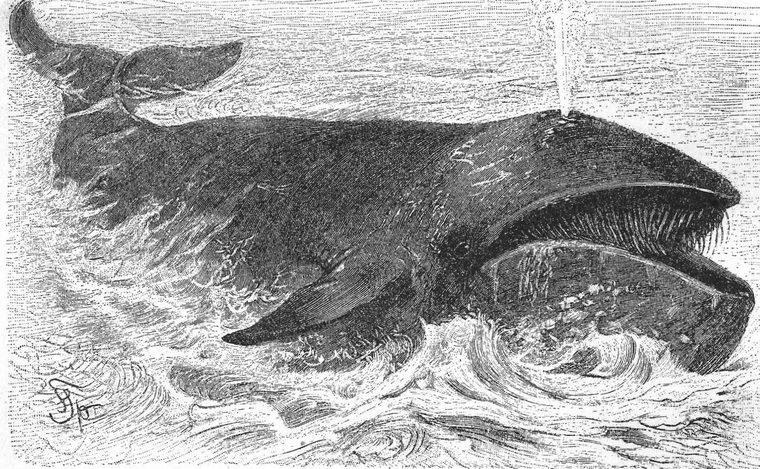
the name given to a large family of marine animals. They are not fishes, but are warm-blooded and suckle their young. They are supposed to be degenerate land animals. The hind legs have disappeared altogether. The front legs, which are enveloped in sacs, toes and all, are called flippers. The hide is without scales. The head of the whale contains four chambers, that of the fish but two. The whale has lungs instead of gills. Its lungs are connected with the top of its head by a single nostril through which it blows or spouts. The whale can descend to great depths, possibly a mile below the surface, but must reappear at intervals to breathe. Notwithstanding frequent expositions of its fallacy, the belief of mariners that whales spout through their blowholes water taken in at the mouth is generally shared by landsmen in all countries. This spouting or blowing is nothing more than the ordinary act of expiration. The whale breathes in air at much longer intervals than land animals do. When it rises to the surface for a fresh supply it expels forcibly from its lungs the air taken in at the last inspiration, which is highly charged with watery vapor in consequence of the natural respiratory changes. This, rapidly condensing in the cold atmosphere in which the phenomenon is generally observed, forms a column of steam or spray, which the spectator mistakes for water. It also often happens that the whale begins to blow just as it reaches the surface, thus forcing some water into the air with the blast.
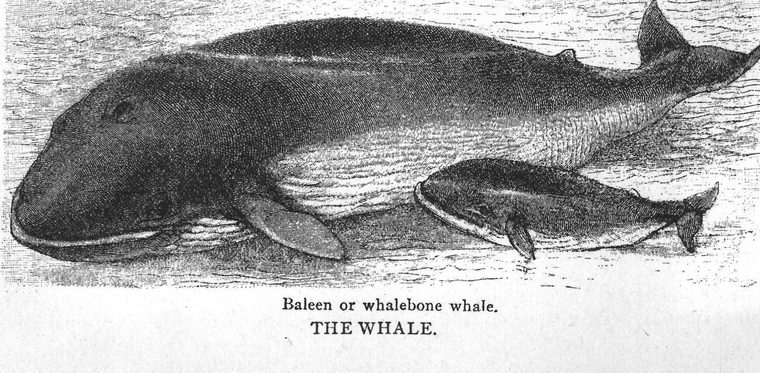
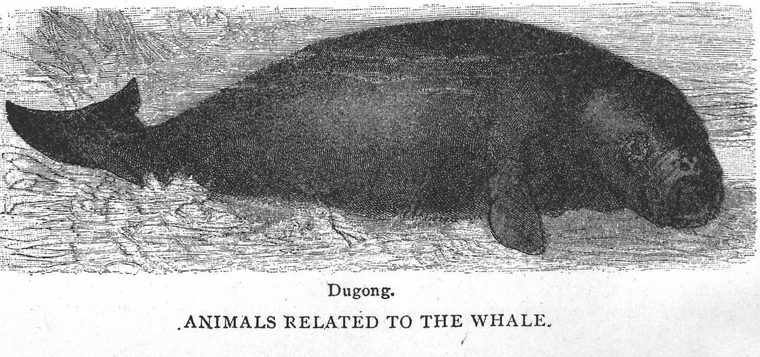
The whale belongs to an order known as cetaceans. The order includes also the dolphin, the porpoise, the grampus, and the manatee or sea-cow. Whales proper are divided into two families, baleen whales and sperm whales. The baleen whales have enormous mouths, but they live upon minute shrimps and shellfish found in myriads near the surface of the sea. The roof of the huge, cavern-like mouth is provided with two great, thin, horny plates set edgewise near together. The lower edges of the plates are fringed with a web of filaments, almost filling the mouth. This contrivance enables the whale to strain from the sea water the tiny animals desired for food. In feeding it moves straight ahead. The water, entering the mouth, passes out through the strainers, leaving the little animals lodged on the whale's tongue. The whale rises to the surface to breathe and swallow. The plates split readily into layers known commonly as whalebone. A thick layer of fat between the flesh and the skin is called blubber. It furnishes the whale oil of commerce.
The largest of the baleen whales is the sulphur-bottomed whale of the northern Pacific Ocean. It attains a length of 100 feet, a girth of 40 feet, and a weight of 300,000 pounds. It is the largest animal living, and, so far as we know from fossils, it is the largest animal that ever inhabited the globe. Such a whale yields about 800 pounds of whalebone in strips four feet long, and from 100 to 150 barrels of oil.
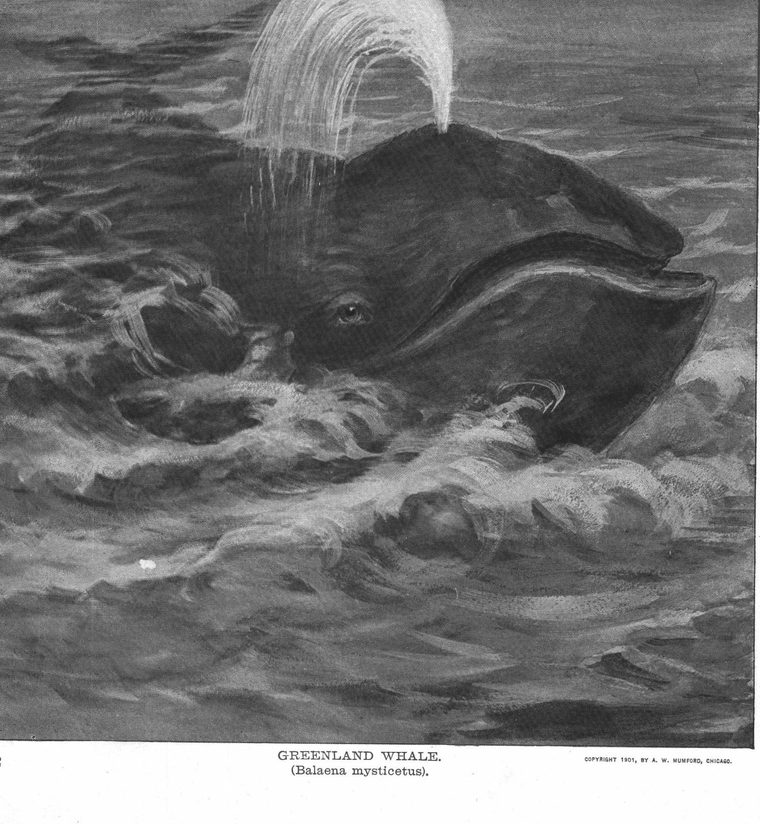
Another whale of commercial importance is the bowhead, Greenland, or polar whale of the northern Atlantic and Arctic Ocean. While not over half the size of the sulphur-bottom, it is yet more valuable to the whaler. A large bowhead yields 275 barrels of oil and 3,500 pounds of whalebone. Other whalebone whales are the right whale of Arctic waters, the right whale of the northern Pacific, the hump-back whale, which is the species most frequently seen in crossing the Atlantic, the fin-back whale, and the California gray whale.
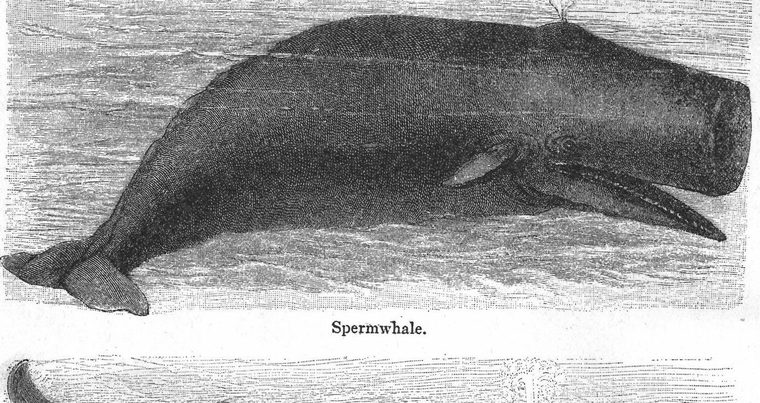
Another whale family is represented chiefly by the great sperm whale. The jaws are provided with teeth. The food consists of squids, mackerel, and various fishes. Fifteen different sperm whales or cachalots, as they are called by the older writers, are found in the open sea. They are the principal whales of southern waters. The largest attains a length of eighty feet or over, and it is claimed by some to be the largest of all whales. It has an enormous head, forming about one-half of the entire bulk, and occupying over one-third of the entire length. A blunt snout gives the head a shape not unlike the body of a bottle, hence the name, "bottle-headed," applied to this animal. The greater part of the snout is occupied by a cavity, frequently containing not less than ten barrels of spermaceti. When this whale is caught and towed to the whaler's ship the sailors cut a hole in the snout and dip out the oil with buckets as though from a cistern. The blubber, which is from eight to fourteen inches thick, yields the sperm oil of commerce. Ambergris is found in the large intestine. The mouth is not provided with whalebone.
Whalefishing has long been an important and adventurous industry. Sailing ships, fitted out with boats, implements, and apparatus for trying out oil, were accustomed to set out for a cruise of two or three years, remaining in the whaling region until they had secured a cargo of whale products. Many exciting stories are told of the danger incurred in taking whales with harpoons. When a whale was sighted by the lookout a ship's boat was lowered and manned with a picked crew. An old whaler with an experienced eye stood, harpoon in hand, directing the movements of the boat. When at the right distance from the whale he hurled the weapon with all his force into the mighty beast's flank, often driving it to a depth of several feet. Then followed an exciting chase. The line of the harpoon which lay neatly coiled in the bottom of the boat so as not to entangle the legs of anyone in running out, sang over the edge of the boat; the whale would dive, lead off, double back on its course, try to knock the boat into the air with its powerful tail or fluke, as it was called; but finally, if all went well and the harpoon held, the huge animal gave up the struggle, turned on its side, and was then towed to the ship. The blubber and the whalebone were removed, and the carcass was left afloat for the myriads of seafowl to feast upon.
The present world's annual yield is about 3,000,000 gallons of whale oil, and 1,600,000 pounds of spermaceti, together with whalebone and sperm oil. The Greenland whale is found usually singly. The sperm whale goes in herds, sometimes of several hundred. There are several smaller whales of commercial importance. The whaling industry has been confined largely to Japan, Norway, Newfoundland, and to New England. New Bedford is the American center. Whaling reached its height about 1854. In that year the American whalers secured 2,315,924 gallons of sperm oil, 10,074,866 gallons of whale oil, and 3,445,200 pounds of whalebone--worth in all $10,802,594. Seven hundred thirty-five American ships were at one time engaged in whaling. The present number is about forty. A single Greenland whale is now worth about $13,000. Whalebone is worth thirty-five to forty cents a pound.
With the discovery of kerosene oil for lighting purposes whaling has been less profitable. Persistent hunting has also reduced the number of whales so that it is difficult to secure a cargo of oil, at least in northern waters. A change in methods has also taken place, the harpoon being projected from a gun or small cannon, mounted for that purpose on the prow of the boat.