Home › Perfumery › Extract of Patchouli
Extract of Patchouli
Mix 14 ounces attar of patchouli, and ¼ ounce attar of rose, with 1 gallon rectified spirits. 1073. Directions for Distilling Perfumed Waters. The following directions are, in the main, those given by the thoroughly practical chemist, Mr. Arnold J. Cooley. In the distillation of odoriferous waters, manufacturing perfumers employ Aromatic, Odoriferous, or their utmost care, in order to produce a Perfumed Waters, &c. highly fragrant article, free from any contam- These are strictly pure water charged by dis- ination that can vitiate the purity of their tillation with the volatile, aromatic, and odor, or lessen their keeping qualities. The still may be of copper, but the head and worm should be formed of solid tin. It should be furnished with a high and narrow neck to prevent the liquor in it spirting over into the neck and condensing-worm. A still furnished odorous principles of plants; or they are solutions of these principles, chiefly the essential oils, in distilled water. The simple fragrant waters of the perfumers are of the Former kind; those of the wholesale druggists and of pharmacy belong to either class, ac- with a steam-jacket is the most convenient cording to the mode of their preparation. for the purpose, as the heat of steam, or of a 1071. Proportions of Aromatics salt-water bath, can alone be safely employed.
Submitted to Distillation for Making The common plan is to reject the first 2 or 3 Perfumed Waters. The vegetable matter fluid ounces that pass over, and to collect the (bruised, if necessary), in the quantity ordered, remainder of the runnings until the proper is to be put into the still along with 2 gallons quantity be obtained. The whole product is PERFUMED WATERS. then agitated together, and stored, loosely covered, in a cool cellar for some weeks, or even months, in order that it may lose its herbaceous odor and the rawness from recent stillage. It is a common practice to separate any volatile oil floating on waters after distillation, but Mr. Haselden, of England, recommends the excess of oil to be well shaken with the water and the whole transferred to the stock vessel, where the oil will separate; it keeps better thus treated, and full strength is ensured. He prefers the stock vessel to be of stoneware, furnished with a tap about 2 inches from the bottom, whereby the water can be drawn out clear, the oil either rising to the top or sinking to the bottom, according to its specific gravity. As soon as it has acquired its full odor, or reached maturity, it is carefully decanted into bottles, which are then well corked or stopped, and stored in a moderpart of the latter will separate, and thus the water will lose some of its fragrance. (Sce No. 1076.) 1075. To Prevent Distilled Waters from Souring. To prevent carelessly prepared distilled waters acetifying or turning sour, and to recover those which have begun to spoil, a common plan is to shake them up with a little calcined magnesia, or to dissolve in each pint of them 1 grain each of powdered borax and alum. This, however, is not to be recommended, as it unfits the waters for use as vehicles. Whenever it is unavoidably had recourse to, the best plan is to re-distill the water a few days afterwards. 1076. Practical Suggestions for Making Distilled Waters. There are certain general rules or points to be adhered to in distilling perfumed waters: Dry, hard, or fibrous substances should be mechanically divided, ately cool place. Some of the leading manu- and macerated in water before undergoing disfacturing perfumers keep a separate still for tillation. Too great a quantity of materials each of their more delicate distilled waters, and thoroughly clean them out and dry them after each distillation, as it is extremely difficult to remove any odor or taint that adheres to the still, still-head, and worm. Even should not be introduced at one time into the body of the still; if this precaution be noglected, there is a risk of the liquid boiling over or spirting into the receiver. Ebullition should be attained as quickly as possible, and -blowing steam through them for some hours be continuous. Sufficient water should be will not always sufficiently purify them for left undistilled to cover the matter in the still, this species of distillation. In the preparation to guard against its coming in contact with of distilled waters for medicinal purposes, a the sides of the vessel. In this case the matclean, sweet still, still-head, and worm, must ter would be decomposed by the heat, and also be employed. The two last should be of yield empyreumatic products; besides, if the tin or glazed stoneware; and the receivers distillation is carried too far, a slimy formashould be of glass or stoneware. The utmost tion is apt to adhere to the sides of the still, care should be taken to prevent contamination which would also be decomposed by the heat, of distilled waters by contact with copper, and have a similar effect on the product. lead or zinc, since they slowly oxidize and These risks may be greatly lessened, if not dissolve these metals. In almost all cases, entirely avoided, by applying heat by means salted or pickled flowers, herbs, &c., are great- of an oil-bath, regulated by a thermometer; ly superior to the fresh vegetables for the and still better by a bath containing a solution preparation of fragrant distilled waters. of chloride of calcium (muriate of lime). Any When the former are employed the product degree of heat between 2120 and 285° Fahr. has little or none of the herbaceous and raw may be obtained and sustained by regulating odor which is always present when the latter the strength of the solution. (See No. 7.) are used, besides which they keep better, and Another convenient method is by steam. (Sce reach maturity, or the full development of their odor, in a much shorter time. (See No. 1349.) Carefully prepared distilled waters keep well, and are not liable to any change, but when the reverse is the case, particularly when the liquor in the still has spirted over the neck of the still-head into the condensing worm, they are apt to acetify, and even to become ropy and viscid. A common, but very objectionable plan, in such cases, is to agitate them with a little carbonate of magnesia, and to filter them through paper. The only safe remedy is to re-distill them on the first indication of such change, for magnesia weakens them. Indeed, all their essential oil and fragrance may be removed by increasing the quantity of it. If magnesia, in any form, be used for filtering distilled waters, it should be the carbonate; but a little of even that will be dissolved if the water be ever so slightly acidulous.
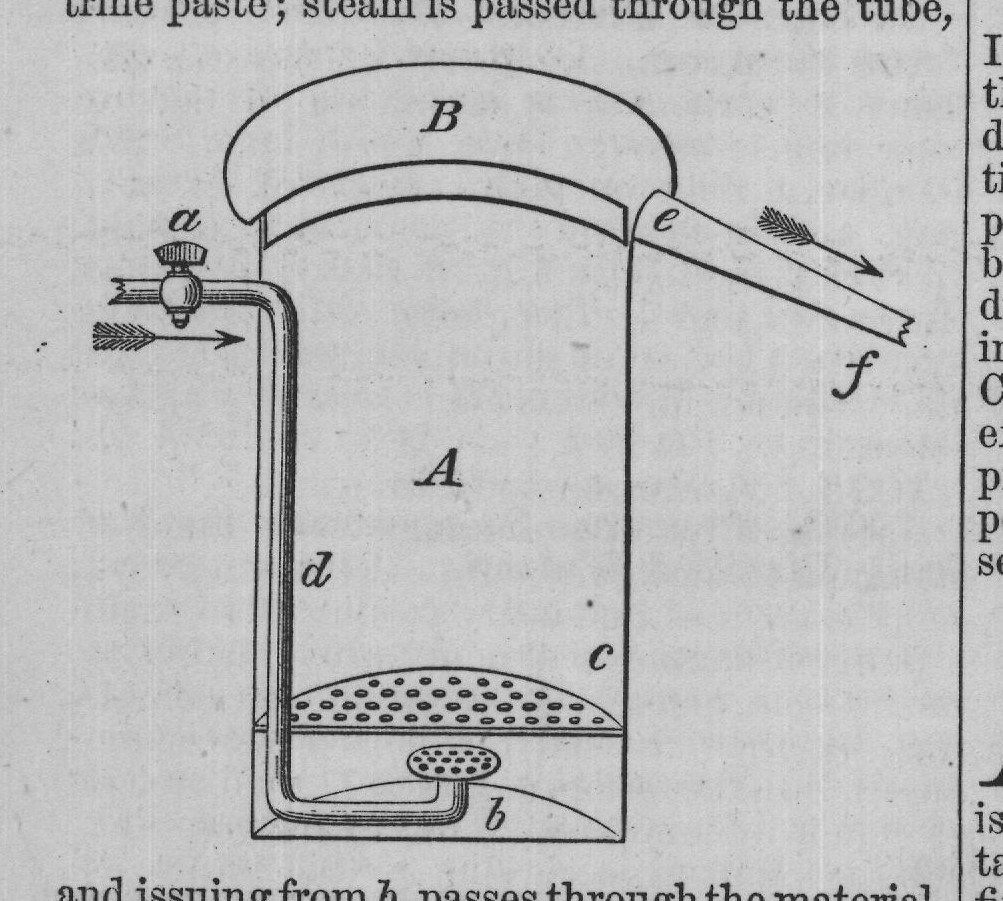
No. 1077.) Waters distilled from plants are apt to have a smoky odor at first, even when the greatest care and precaution have been observed in their distillation; exposure for a short time to the air will remove this, after which they should be kept in closely-stoppered bottles, and preferably in bottles containing only sufficient for probable use at one time; they should be entirely filled and closed air-tight. 1077. Soubeiran's Steam Apparatus for Distilled Waters. The illustration given is a vertical section of Soubeiran's apparatus used in France for obtaining distilled waters.
A cylindrical tinned-copper or iron boiler, A, of convenient size, say 3+ feet high and 2 feet in diameter, is surmounted by an expanded head or capital, B, which is furnished with an inner ledge, forming a kind of gutter, to receive the liquid condensed on the inner surface of the capital, and opening into the exit tube, e. About 6 inches from the bottom of the e. 1074. To Remove the Burnt Smell cylinder is placed a false bottom or diaphragm, of Freshly Distilled Waters. The burnt c, pierced with small holes. A steam pipe, d, smell of waters, frequently arising from care- having a stop-cock, a, is introduced in the less stilling, is usually lost, or greatly lessened, cylinder in the manner shown, terminating in by freezing, or by exposure to a temperature an expansion, b, perforated like the rose of a approaching the freezing point; but if the watering-pot, and located a little below the water be highly charged with essential oil, diaphragm. AROMATIC VINEGAR.
The material to be distilled, after proper lex (quartz) is unobtainable. Magnesia and preparation, is placed upon the diaphragm, the capital, B, is applied and luted with dextrine paste; steam is passed through the tube, B d A b C e f and issuing from b, passes through the material, becomes loaded with the volatile matter, rises into the capital, condenses, and passes through f, into a worm or other suitable condenser. sugar were each formerly used for the purpose, but are objectionable. (See No. 1080.