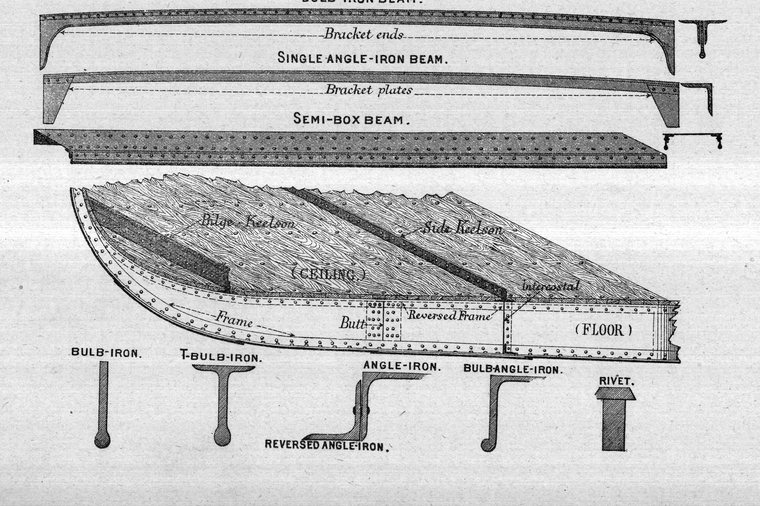
Beams
The substantial pieces of timber which stretch across the ship from side to side to support the decks and keep the ship together by means of the knees, etc., their ends being lodged on the clamps, keeping the ship to her breadth.
Beam Arm, or Fork Beam, is a curved piece of timber, nearly of the depth of the beam, scarphed, tabled and bolted for additional security to the sides of beams athwart large openings in the decks, as the main hatchway and the mast-rooms.
Breast Beams are those beams at the forepart of the quarter deck and poop, and afterpart of the forecastle. They are sided larger than the rest, as they have an ornamental rail in the front, formed from the solid, and a rabbet one inch broader than its depth, which must be sufficient to bury the deals of the deck, and one inch above for a spurn-water. To prevent splitting the beam in the rabbet the nails of the deck should be crossed, or so placed, alternately, as to form a sort of zigzag line.
Half-Beams are short beams introduced to support the deck where there is no framing, as in those places where the beams are kept asunder by hatchways, ladder-ways, etc. They are let down on the clamp at the side, and near midships, into fore-and-aft carlings. On some decks they are abaft the mizzen-mast, generally of fir, let into the side tier of carlings.
The Midship Beam is the longest beam of the ship, lodged in the midship-frame or between the widest frame of timbers.