EngineEngineering
The mechanism by means of which part of the energy stored in steam is converted into useful work. The various kinds of engines come under the following heads:
Atmospheric. One stroke is caused by the steam, and the return stroke by the pressure of the atmosphere made effective by condensing the steam under the piston after it has performed its work.
Back Acting. The crank is between the cross-head and cylinder.
Beam. (See Walking Beam or Working Beam.)
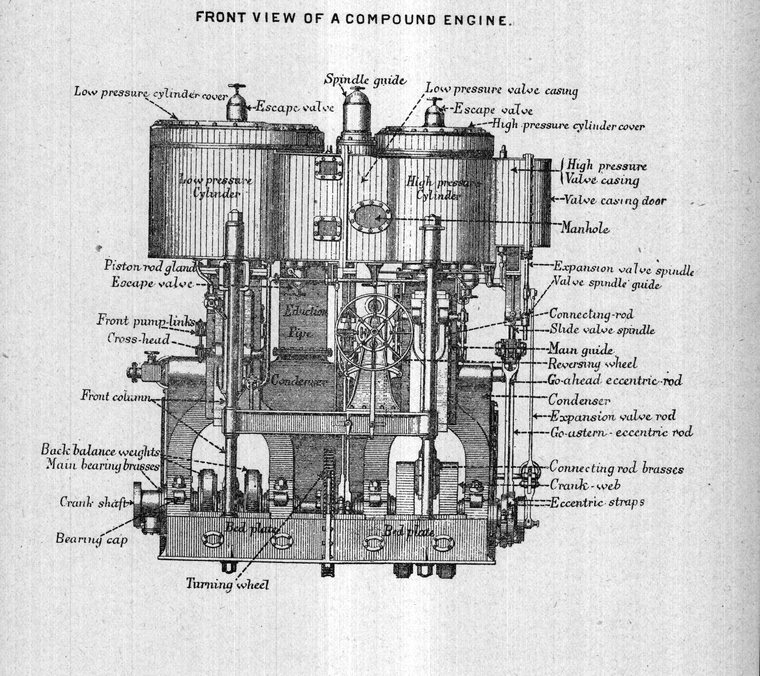
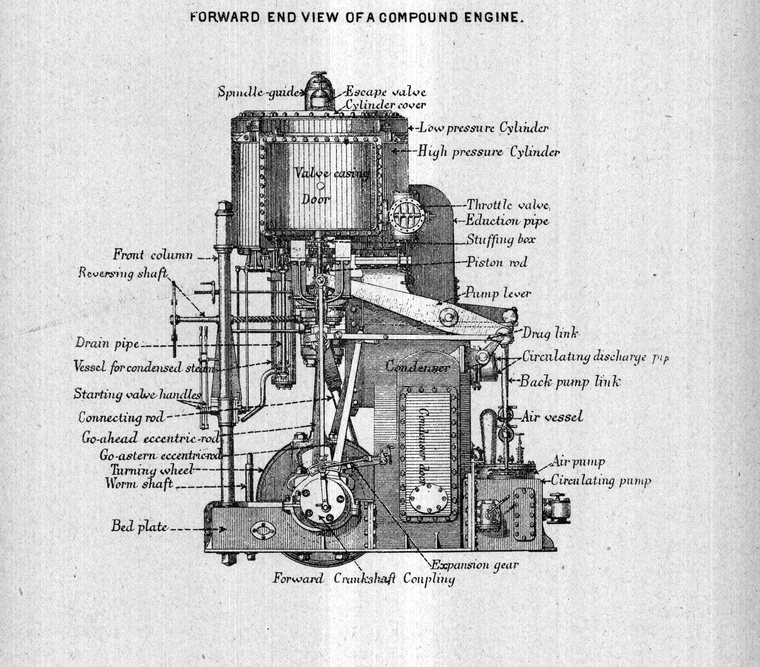
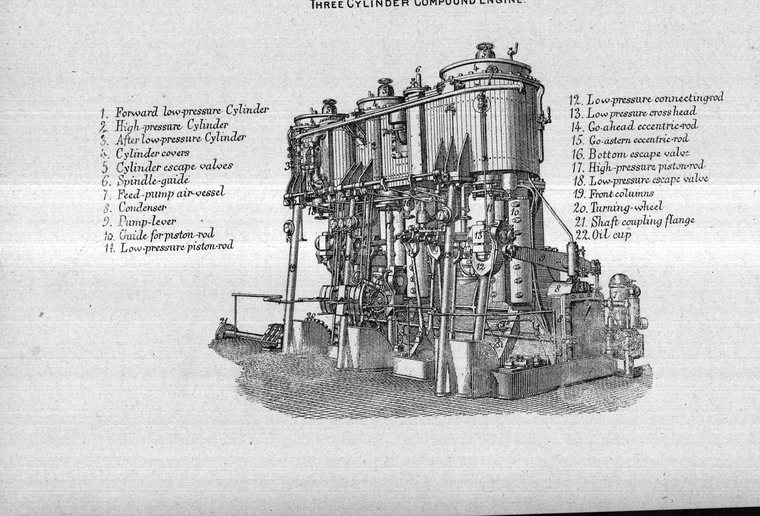
Compound. The steam, after doing work in one cylinder, is discharged into another of larger diameter, and thence to the condenser.
Condensing. The exhaust steam is discharged into a condenser.
Direct Acting. When the crosshead is between the cylinder and crank.
Double. When steam is used in two cylinders and the power is exerted on the same shaft, each cylinder receiving the same initial pressure.
Grasshopper. A side-lever engine, the beams of which are pivoted at one end, and the connecting rods take hold of the beams near their middle points.
High Pressure. A term commonly applied to an engine that exhausts into the atmosphere.
Inverted Cylinder. One the cylinder of which is supported above the crank shaft.
Low Pressure. A term commonly applied to an engine using steam of less than about 60 lbs. pressure per square inch, and exhausting into a condenser.
Non-Condensing. The exhaust steam is discharged into the atmosphere.
Oscillating. The cylinder is supported and vibrates on two trunnions, which also form the inlet and outlet for steam. The outer end of the rod is connected directly to the crank pin, and the cylinder follows the vibration of this rod.
Quadruple Expansion. When the steam used passes successively through four cylinders, each being larger in area than the one preceding it.
Side Lever. A beam engine having two beams, one on either side of the cylinder and below the level of the cylinder top, the whole engine being below the shafts.
Simple. When the steam after doing its work is discharged into the atmosphere or a condenser.
Single. When the steam is used in only one cylinder.
Steeple. A vertical, back-acting engine, the axes of whose shafts pass through or above the cylinder, intersecting and perpendicular to its axis.
Triple Expansion. When the steam used passes successively through three cylinders, the area of each being larger than the one preceding it.
Trunk. The connecting rod is connected at one end to the piston, and vibrates in a cylindrical shell, one end of which is secured to the piston, and reciprocates steam tight through the cylinder head.
Vertical, Inclined, or Horizontal. Dependent upon whether the axis of the cylinder is perpendicular with, inclined to, or parallel with the foundation.
Walking Beam, or Working Beam. The cylinder is vertical, and the power is transmitted upward to one end of a vibrating lever or beam; from the other end of the beam hangs a connecting rod through which the power is transmitted to the crank.