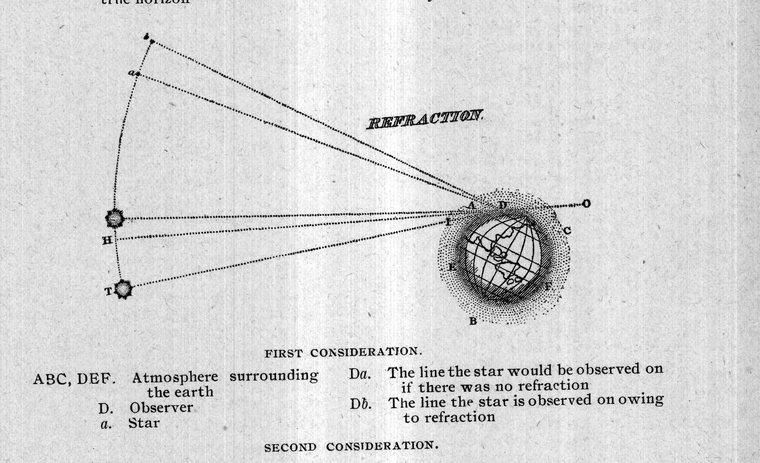
Refraction
Astronomically considered, refraction is the change of direction assumed by rays of light passing through atmospheric mediums of varying densities. All the visible heavenly bodies, out of the zenith, are apparently elevated above their true place owing to refraction. The refracting power of the atmosphere changes according to the density--its temperature and moisture. As shown in engraving, when a heavenly body is in the zenith there is no refraction, the rays of light passing through the earth's atmosphere in direct lines; but the nearer the body is to the horizon the greater is the refraction. At the horizon refraction amounts to 33 min. of arc; consequently, that being about 1 min. more than the diameter of the sun or moon, those two bodies may actually be entirely below the horizon and yet appear slightly above it. The table of mean refractions considers the barometer to stand at 30 inches, and the temperature to be 50 deg. F. Terrestrial refraction has reference to the apparent change in position assumed by a terrestrial object owing to the difference in density of various portions of the earth's atmosphere--the amount varying from 1-3 to 1-23 of the intercepted arc.