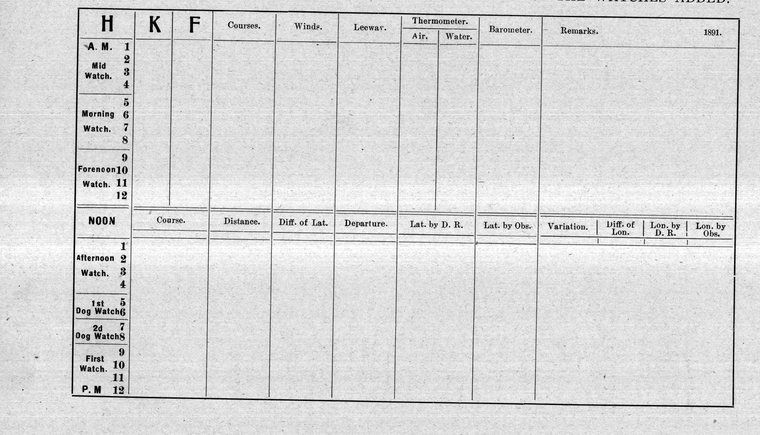
Watch
There are seven watches on board ship during the 24 hours. They are named as follows: From midnight until 4 a. m., mid-watch; from 4 a. m. to 8 a. m., morning-watch; from 8 a. m. till noon, forenoon-watch; from noon till 4 p. m., afternoon-watch; from 4 p. m. till 6 p. m., first dog-watch; from 6 p. m. till 8 p. m., second dog-watch; from 8 p. m. till midnight, first watch. On a merchant ship the crew are mustered aft at 8 p. m. on the day of sailing, the men divided into the captain's and mate's watch, and the first watch set at that time, the captain's watch, remaining on deck while the other goes below. The captain always takes the first watch out and the mate the first watch home. The stewards and cooks are known as "idlers," and they stand no watch. The captain's watch is called the "starboard," and the mate's the "port" watch. If there is an uneven number of men in the forecastle, the odd man goes into the captain's watch by courtesy. Provided the vessel carries a second mate, the captain's watch is kept by him, so that the captain has no regular deck duty, but goes and comes as he pleases. The officer on watch is known as the "officer of the deck," and, while left in possession, his orders must be obeyed to the letter. He has full powers to alter the course of the ship to avoid danger, to make, or alter, or take in sail, etc. On an ocean passenger steamer one of the waiters is always on watch in the saloon, being stationed by the steward the same as the anchorwatch is set by the mate, so that they stand a certain number of hours each and then call their relief. The saloon-watch should report to the officer of the deck when each bell is struck. A floating buoy is said to watch. (See Anchor Watch.)