The Nautical Encyclopedia
Patterson’s Illustrated Nautical Encyclopedia — Howard Patterson, 1891

Lie-to to Lift

Page 164 of Patterson’s Illustrated Nautical Encyclopedia · 10 entries

Lie-toSea Terms

To stop the progress of a vessel through the water by reducing sail and keeping her so close to the wind that she will make little or no headway. The helm is generally lashed to leeward on a sailing vessel so as to prevent the ship from falling off too much, and the after-sail set prevents her from coming up too close to the wind; thus she is kept continually see-sawing through two or three points of the compass. Steamships generally lie-to under steam, just turning the engines over fast enough to keep steerageway on the vessel. Some steamships lie-to head on, and others take the seas on the bow.
Life BoatSea Terms

A boat built to be specially seaworthy. Air-tight tanks in either end of the boat and along the sides insures it against sinking, though the body of the vessel be filled with water.

Life BuoysSea Terms

There are several kinds of life buoys. One style is that of a ring covered with canvas, enclosing a cork stuffing; another that of two connecting metallic cylinders, provided with a red fire to be burned at night when dropped overboard, and a reg flag whereby to keep it in sight in the daytime. The red fire is ignited before letting the buoy go by the simple means of an attached percussion cap and hammer lock.

Life CarSea Terms

A tank used by the Life Saving Service for bringing shipwrecked people ashore. It will hold from four to six persons, and is closed from the inside when loaded so as to be water-tight while being hauled through the breakers.

Life KiteSea Terms

A kite made of thin sticks and muslin on board of a wrecked vessel as a means of getting a line ashore. After the kite has been settled on the land to leeward of the ship and secured by the people there, a stouter line is bent on to the kite line and hauled ashore; to this a hawser is bent on and also hauled ashore.

Life LinesSea Terms

Ropes stretched along the decks to lay hold of, and by which the crew may save themselves from being washed overboard during heavy gales when the vessel is shipping seas. Also horizontal ropes stretched between the yard lifts and the mast, about four feet above the yard, as a support for the men on board a ship of war when manning yards. The line shot over a stranded vessel by the life-saving crew, and by which the hawser, breeches-buoy, etc., are hauled out to the vessel. The hawsers, etc., are secured in the manner shown in the engravings.

Life PreserverSea Terms

Forms of canvas-covered cork made either as a jacket or belt for sustaining the weight of a person while in the water.

Life RaftSea Terms

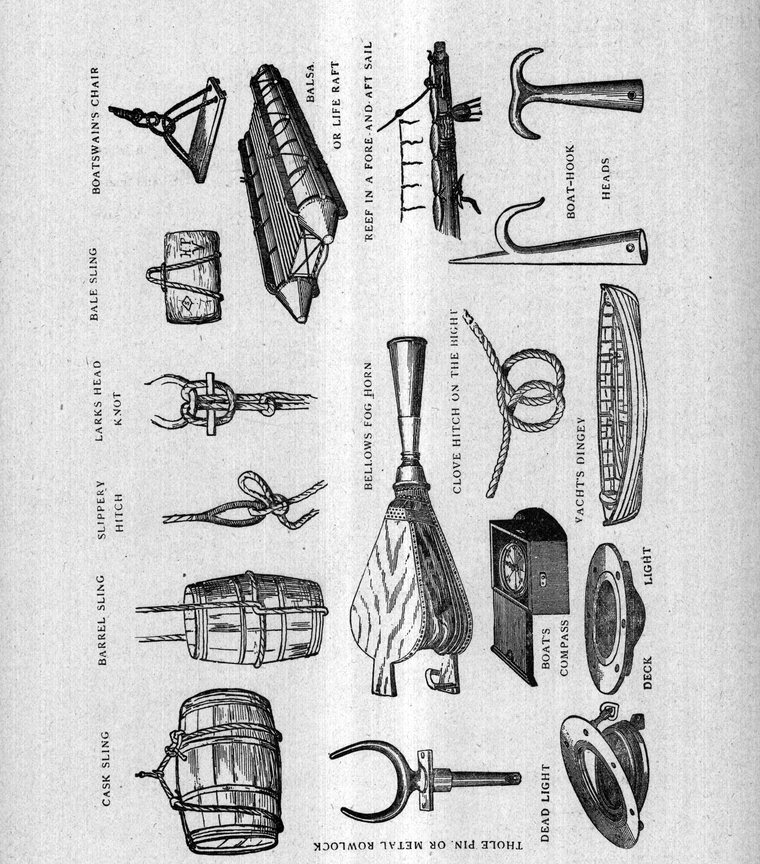
A pair of segar-shaped sheet iron cylinders connected on the same principle of a catamaran, with thwartship slats to sit on and attached thole pins in the sides for the use of oars. This contrivance is also known as a balsa.

Boat gear — balsa or life raft, boatswain's chair, bale, barrel and cask slings, lark's head, slippery hitch, bellows fog-horn, boat-hook heads, yacht's dingey, deck and dead lights, thole pin and rowlock

Life Saving StationSea Terms

Buildings erected along the coast and provided with life boats, mortar apparatus, etc., for succoring shipwrecked seamen and passengers. A station crew under an officer live in these houses during certain stormy months in the year, and patrol the beach regularly on the lookout for vessels in distress.

LiftSea Terms

A rope extending from a yard-arm to the mast to support the yard, and by means of which the yard may be topped up, etc.; when a vessel is kept so close to the wind that her sails shiver they are said to lift. Fog lifts when it rises from the surface of the sea or land. The weather lifts when it clears. (See Topping Lift; Quarter Lift.)

← page 162The A–Z indexpage 166 →