CoamingsShipbuilding
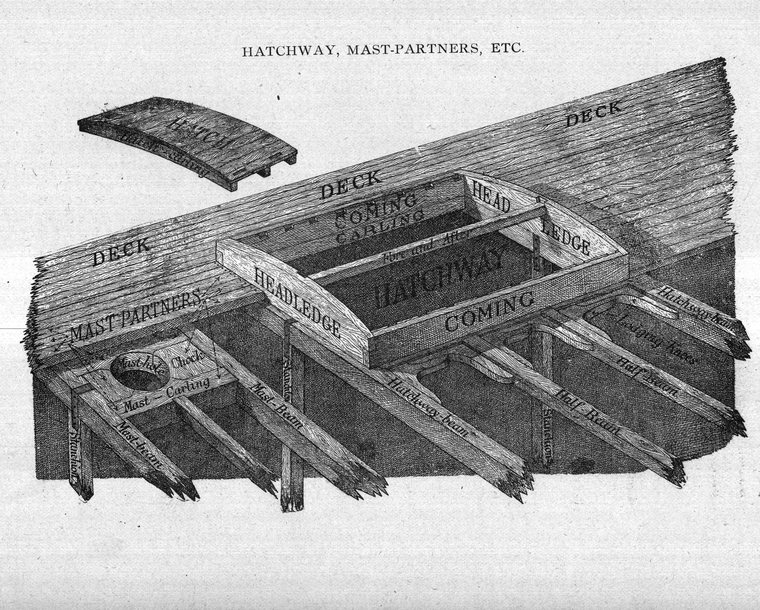
The raised borders of oak about the edge of the hatches and scuttles which prevent water from flowing down from off the deck. Their inside upper edge has a rabbet to receive the gratings.
Page 288 of Patterson’s Illustrated Nautical Encyclopedia · 17 entries
The raised borders of oak about the edge of the hatches and scuttles which prevent water from flowing down from off the deck. Their inside upper edge has a rabbet to receive the gratings.
In ships of war the framing and sash lights upon the quarter-deck or poop through which the light passes to the commander's apartments. In merchant ships it is the birthing or hood round the ladder-way leading to the master's cabin, and in small ships is chiefly for the purpose of keeping the sea from beating down.
Such as are curved or arched.
The art of lining and moulding timber, plank, etc., with the least possible waste.
Turning the ends of iron lodging-knees so as they may hook into the beams.
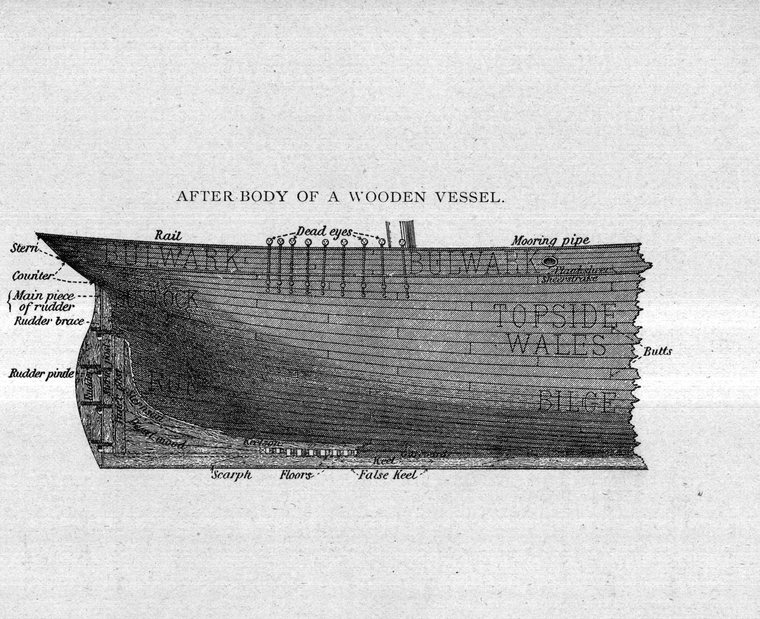
A part of the stern, the lower counter being that arched part of the stern immediately above the wing transom. Above the lower counter is the second counter, the upper part of which is the under part of the lights or windows. The counters are parted by their rails, as the lower counter springs from the tuck-rail, and is terminated on the upper part by the lower counter rail. From the upper part of the latter springs the upper or second counter, its upper part terminating in the upper counter rail, which is immediately under the lights.
The hollows in iron plates, etc., which are excavated by an instrument called a counter-sunk bitt to receive the heads of screws or nails so that they may be flush or even with the surface.
The right-aft timbers which form the stern. The longest run up and form the lights, while the shorter only run up to the under part of them, and help to strengthen the counter. The side counter timbers are mostly formed of two pieces scarphed together in consequence of their peculiar shape, as they not only form the righ-aft figure of the stern, but partake of the shape of the topside also.
The arch moulding sunk in at the foot or lower part of the taffarel.
A sort of little capstan, formed of a kind of wooden pillar, whose lower end works in a socket whilst the middle traverses or turns round in partners which clip it in a circle. In its upper end are two holes to receive bars, which act as leavers, and by which it is turned round and serves as a capstan for raising of weights, etc. By a machine of this kind, so simple in its construction, may be hove up the frame timbers, etc., of vessels when building. For this purpose it is placed between two floor timbers, while the partners which clip it in the middle may be of four or five-inch plank fastened on the same floors. A block is fastened beneath in the slip, with a central hole for its lower end to work in. Besides the crab here described there is another sort which is shorter and portable. The latter is fitted in a frame composed of cheeks, across which are the partners, and at the bottom a little platform to receive the spindle.
A strong frame of timber, etc., placed under the bottom of a ship in order to conduct her steadily in her ways till she is safely launched into water sufficient to float her.
A term applied to ships built too deep in proportion to their breadth, and from which they are in danger of over-setting.
A term applied to plank when it curves or compasses much in short lengths.
Pieces of timber fayed across the dead-wood amidships to make good the deficiency of the heels of the lower futtocks.
Pieces of timber that keep a vessel together while in frame.
A piece of timber connecting two bitts.
Deals or fir plank nailed in a temporary manner to the frames of the ship at a certain height, and by which the frames are kept to their proper breadths until the deck-knees are fastened. The main and top-timber breadths are the heights mostly taken for spalling the frames, but the height of the ports is much better; yet this may be thought too high if the ship is long in building.