PinkShipbuilding
A ship with a very narrow round stern; whence all vessels, however small, having their stern fashioned in this manner, are said to be pink-sterned.
Page 316 of Patterson’s Illustrated Nautical Encyclopedia · 30 entries
A ship with a very narrow round stern; whence all vessels, however small, having their stern fashioned in this manner, are said to be pink-sterned.
Straps of mixed metal, or of iron, fastened on the rudder, in the same manner as the braces on the stern post, having a stout pin or hook at the ends, with the points downwards to enter in and rest upon the braces on which the rudder traverses or turns, as upon hinges, from side to side. Sometimes one or two are shorter than the rest, and work in a socket brace, whereby the rudder turns easier. The latter are called dumb-pintles. Some are bushed.
Tar, boiled to a harder and more tenacious substance.
The inclination or vibration of the ship lenghtwise about her centre of gravity; or the motion by which she plunges her head and after-part alternately into the hollow of the sea. This is a very dangerous motion, and when considerable, not only retards the ship's way, but endangers the mast, and strains the vessel.
Covering the outside of the timbers with plank sometimes quaintly called skinning, the plank being the outer coating, when the vessel is not sheathed.
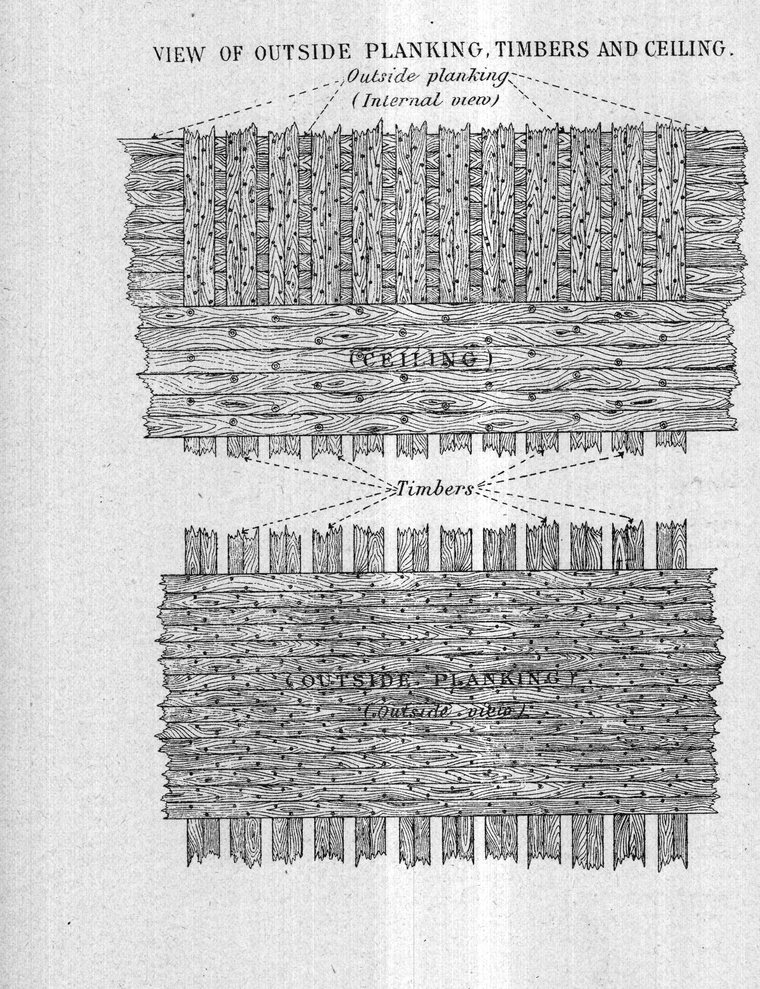
The pieces of plank laid horizontally over the timber-heads for the purpose of covering the top of the side, hence sometimes called covering-boards.
That point where, in a direct course, the centre of effort of all the sails should be found.
Those pieces (mostly fir) which are fixed perpendicularly between the ship's bottom and the bilgeways, at the fore and aftermost parts of the ship, to support her in launching.
The machine, fitted in the wells of ships, to draw water out of the hold.
Cisterns fixed over the heads of the pumps, to receive the water until it is conveyed through the sides of the ship by the pump-dales.
Pipes fitted to the cisterns, to convey the water from them through the ship's sides.
The projections from the quarters abaft, fitted with sashes and ballusters, and intended both for convenience, and ornament to the aft part of the ship.
That part of a vessel's sides which is above the chain-wales and decks--so called in ship-building. Also the term applied to that part of a vessel that is under water when she is laden.
To give anything a greater curve. For instance, "to quicken the sheer" is to shorten the radius by which the curve is struck. This term is therefore opposed to straightening the sheer.
A joint made by a groove, or channel, in a piece of timber cut for the purpose of receiving and securing the edge or ends of the planks, as the planks of the bottom into the keel, stem, or stern post, or the edge of the one plank into another.
A sort of bolt having its point jagged or barbed to make it hold the more securely.
The overhanging of the stem or stern beyond a perpendicular with the keel, or any part or thing that forms an obtuse angle with the horizon.
A small rope or line sometimes used for the purpose of forming the sheer or hang of the decks, for setting the beams fair, etc.
The act of marking by a mould on a piece of timber; or any marks made by a tool called a rasing-knife.
To make one piece of work answer fair with the moulding or shape of the adjoining piece; and, more particularly, in the reversion of curves.
A term used by caulkers for opening the seams of the planks, that the oakum may be more readily admitted.
The large irons used by caulkers in opening the seams.
Large open splits or shakes in timbers; particularly in plank, occasioned by its being exposed to the wind or sun, etc.
The longitudinal pieces of fir, about five inches square, nailed to the timbers of the square body (those of the same description in the cant body being shaped by a mould and called harpins) to keep the body of the ship together, and in its proper shape, until the plank is brought on. The shores are placed beneath them. They are removed entirely when the planking comes on. The difference between the cant ribbands and square or horizontal ribbands is, that the latter are only ideal, and used in laying-off.
The same with diagonal lines.
Interior timbers placed occasionally opposite to the principal ones, to which they are bolted, reaching from the keelson to the beams of the lower deck.
A term derived from the shape of a ship's bottom in general, which gradually narrows or becomes sharper towards the stem and the stern-post. On this account it is that the floor, towards the extremities of the ship, is raised or lifted above the keel; otherwise, the ship would be so very acute as not to be provided from timber with sufficient strength in the middle, or cutting-down. The floor timbers forward and abaft, with regard to their general form and arrangement, are therefore gradually lifted or raised upon a solid body of wood called the dead or rising wood, which must, of course, have more or less rising as the body of the ship assumes more or less fullness or capacity. (See Dead-Rising.)
Rising of Boats is a narrow strake of board fastened within side to support the thwarts.
The floors forward and abaft, which on account of the rising of the body, are the most difficult to be obtained, as they must be deeper in the throat or at the cutting-down to preserve strength.
An elliptical line, drawn on the plan of elevation, to determine the sweep of the floor-heads throughout the ship's length, which accordingly as certains the shape of the bottom with regard to its being full or sharp.
That motion by which a ship vibrates from side to side. Rolling is therefore a sort of revolution about an imaginary axis passing through the centre of gravity of the ship; so that the nearer the centre of gravity is to the keel, the more violent will be the roll, because the centre about which the vibrations are made is placed so low in the bottom, that the resistance made by the keel to the volume of water which it displaces in rolling, bears very little proportion to the force of the vibration above the centre of gravity, the radius of which extends as high as the mast-heads. But, if the centre of gravity is placed higher above the keel, the radius of the vibration will not only be diminished, but such an additional force to oppose the motion of rolling will be communicated to that part of the ship's bottom as may contribute to diminish this movement considerably. It may be observed that, with respect to the formation of a ship's body, that shape which approaches nearest to a circle is the most liable to roll; as it is evident that, if this be agitated in the water, it will have nothing to restrain it; because the rolling or rotation about its centre displaces no more water than when it remains upright; and, hence, it becomes necessary to increase the depth of the keel, the rising of the floors, and the dead-wood afore and abaft.