Shaken, or ShakyShipbuilding
A natural defect in plank or timber when it is full of splits or clefts, and will not bear fastening or caulking.
Page 322 of Patterson’s Illustrated Nautical Encyclopedia · 16 entries
A natural defect in plank or timber when it is full of splits or clefts, and will not bear fastening or caulking.
A thin sort of doubling, or casing, of fir-board or sheet copper, and sometimes of both, over the ship's bottom, to protect the plank from worms, etc. Tar and hair, or brown paper dipped in tar and oil, is laid between the sheathing and the bottom.
The longitudinal curve or hanging of a ship's side in a fore-and-aft direction.
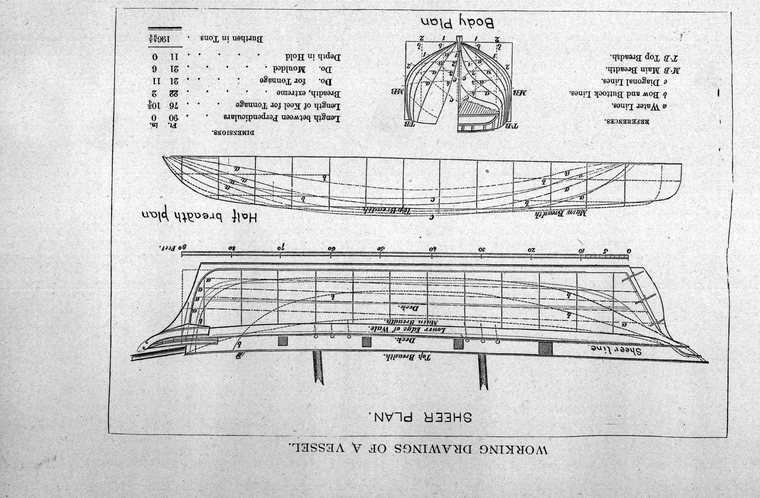
The plan of elevation of a ship whereon is described the outborad works, as the wales, sheer-rails, ports, drifts, head, quarters, post, and stem, etc., the hang of each deck inside, the height of the water lines, etc.
A ship-construction drawing which show the side elevation, rail, planksheer, outlines of stem, stern, keel, and overhang. The water lines appear in this plan as straight lines, as do also the frame lines.
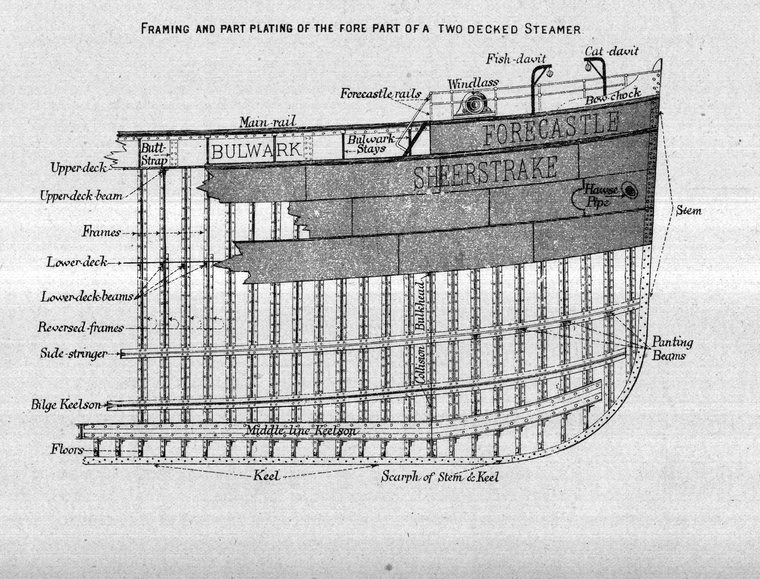
The strake or strakes wrought in the topside, of which the upper edge is wrought well with the top-timber line, or top of the side, and the lower edge kept well with the upper part of the upper deck ports in midships, so as to be continued whole all fore-and-aft and not cut by the ports. It forms the chief strength of the upper part of the topside, and is therefore always worked thicker than the other strakes, and scarphed with hook and butt between the drifts.
The size or dimensions of timber the contrary way to the moulding or moulded side.
The different places marked upon the moulds where the respective bevelings are to be applied, as the lower sirmark, floor sirmark, etc.
Pieces of wood fitted between the whelps.
The knees that connect the transoms to the after-timbers of the ship's quarters.
Are the planks upon which the bilgeways slide in launching.
The foundation laid for the purpose of building the ship upon, and launching her.
To hance or bevel the end of anything so as to fay upon an inclined plane.
A term applied to planks when their edges round or curve upwards. The great any occasioned in full bows or buttocks is only to be prevented by introducing steelers.
The comparative difference in the weight or gravity of two bodies of equal bulk; hence called, also, relative or comparative gravity, because we judge of it by comparing one body with another.