CompressionEngineering
The result of confining a small portion of steam in a cylinder by closing the exhaust valve before the piston reaches the end of its stroke.
Page 424 of Patterson’s Illustrated Nautical Encyclopedia · 21 entries
The result of confining a small portion of steam in a cylinder by closing the exhaust valve before the piston reaches the end of its stroke.
That line traced on an indicator diagram from the time the exhaust valve closes until either the steam valve opens or the piston reaches the end of its stroke.
The closed vessel in which steam discharged from the engine cylinder is reduced to water by coming in direct or indirect contact with the cold injection water.
Jet Condenser. The water is brought in direct contact with the steam.
Surface Condenser. The water and steam are separated by thin metal, usually in shape of tubes.
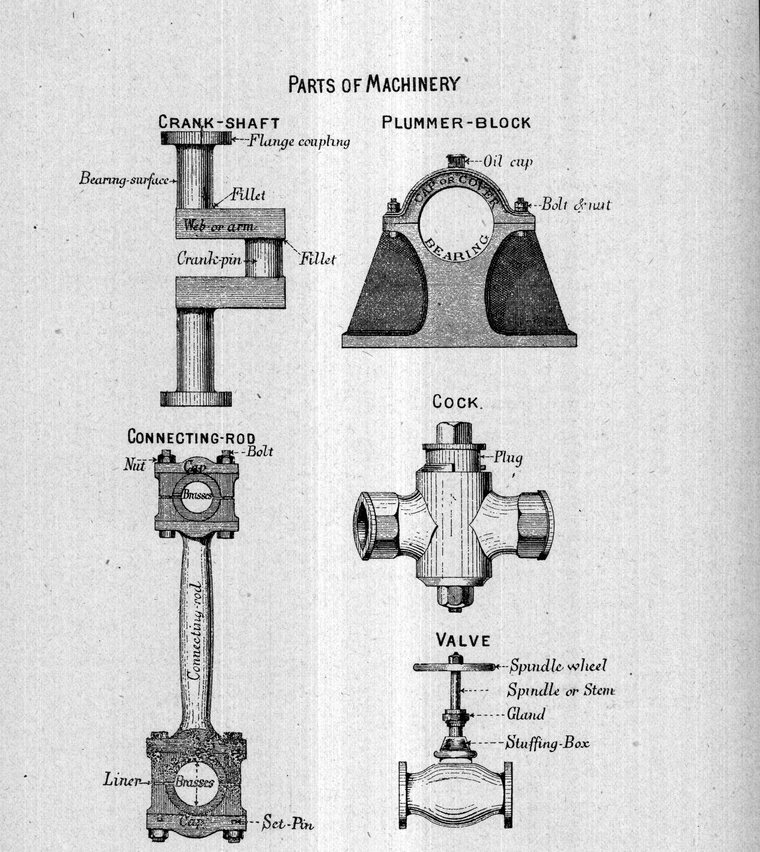
The long rod, one end of which takes hold of the wrist-pin in cross-head and the other end takes the crank-pin.
A piece of metal screwed in to stop the holes left in hollow castings by the core supports, and through which the core sand is afterward removed.
A mechanism for registering the number of revolutions or strokes made by an engine.
A bore of slightly increased diameter at each end of a cylinder bore.
A device for securing together the adjacent ends of two pieces of shaft.
A lever attached to the end of a shaft. Rectilinear motion applied to its outer extremity causes it and the shaft to revolve.
(See Disc Crank.)
The cylindrical pin near the outer end of a crank, whose axis is parallel to axis of shaft and a certain distance from it called the throw.
The space in the engine-bed through which the crank revolves.
That part of the main shaft which is contained in the enginebed and has the crank attached.
The sliding block attached to the exposed end of piston-rod.
A wearing piece, usually of composition, in contact with the guides, held in the jaws of the crosshead.
The end of a boiler brace divided and spread, forming feet, each secured to shell. Also the piece spanning a man or hand-hole which holds the plate in position.
The sheet forming the top of a furnace.
The compressed steam in a cylinder, at or near the end of the stroke, which takes up gradually the momentum of the reciprocating parts.
The gear for stopping the admission of steam to the cylinder before the piston has reached the end of its stroke.
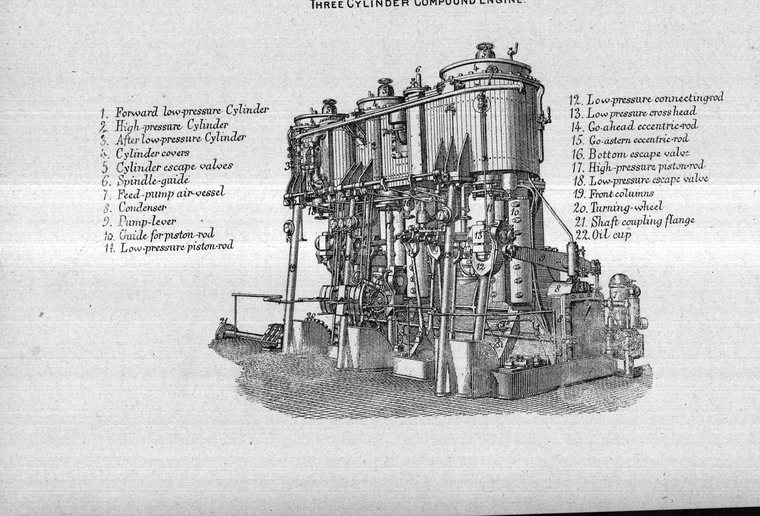
The vessel in which the steam is brought in contact with the piston to perform useful work.
(See Cylinder Head.)