BreakwaterSea Terms
A natural or artificial barrier across the mouth of a harbor which prevents the seas outside from rolling into it.
Page 66 of Patterson’s Illustrated Nautical Encyclopedia · 22 entries
A natural or artificial barrier across the mouth of a harbor which prevents the seas outside from rolling into it.
Burning off the marine growth from a vessel's bottom.
(obsolete). They were set up in the channels to support the mast when on the wind.
A band of canvas passing across the breast of the leadsman to prevent him from falling overboard.
A rope used for securing a vessel's side to a wharf or to another vessel.
The knees placed across the stem and apron for the purpose of uniting the bows.
The rail that runs across the forward part of the poop deck.
A rope pasing across the leadsman's breast to prevent him from falling overboard while sounding.
To meet the sea bows on.
The outer angle of a knee timber; the bottom of a block, where the standing part of the tackle is made fast to the block; the after-end of a gun.
A life-saving contrivance for getting people ashore from a wreck. It is in the shape of the ring life-buoys which are generally carried at the stern of steamships and large sailing vessels with the addition of a canvas shape suspended to the ring like the upper part of a pair of breeches--hence the name.
The rope passing through the cascabel of a gun and employed to prevent the recoil beyond a certain limit--the ends of the breeching have eyes and are secured by pins (called breeching bolts) in the ship's side.
(See Land Breeze and Sea Breeze.)
A platform which extends across the deck on steam vessels, and which is raised considerably above the rail of the ship. It is for the convenience of the officer of the watch, from which altitude he superintends and manages the vessel.
The Steering Bridge has reference to the bridge on which is placed the steering wheel. Some steamships are provided with two bridges, one above the other, and when this is the case the lower bridge is made the steering bridge.
(See Bowline Bridle.) A span of chain or rope, formed by having the ends secured. The hauling power is applied to the bight of the bridle.
The foremast ports on the gun deck of a man-o'-war.
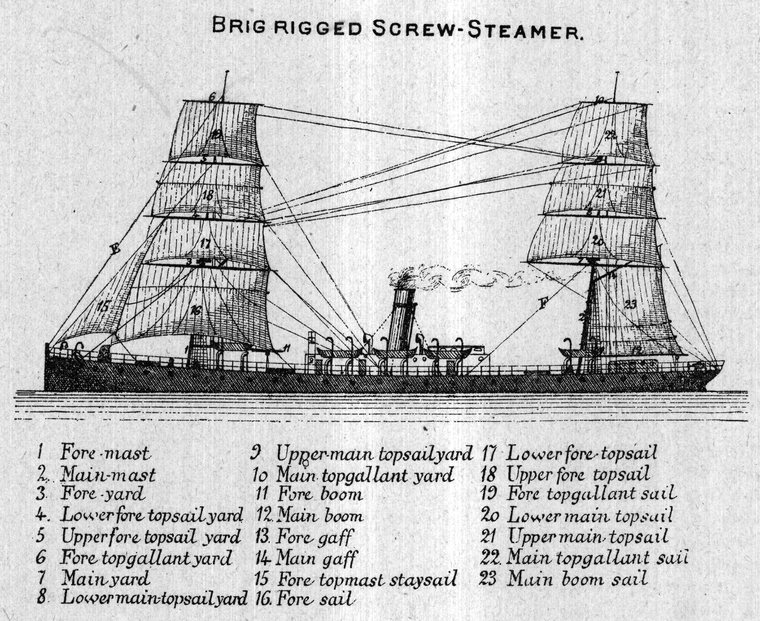
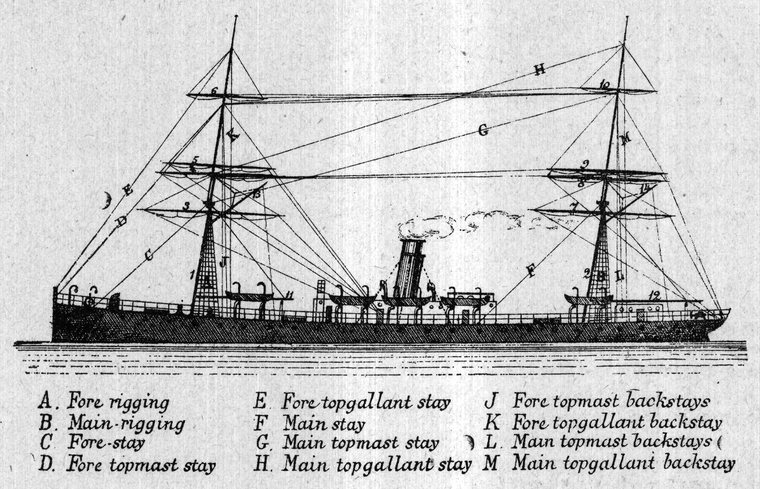
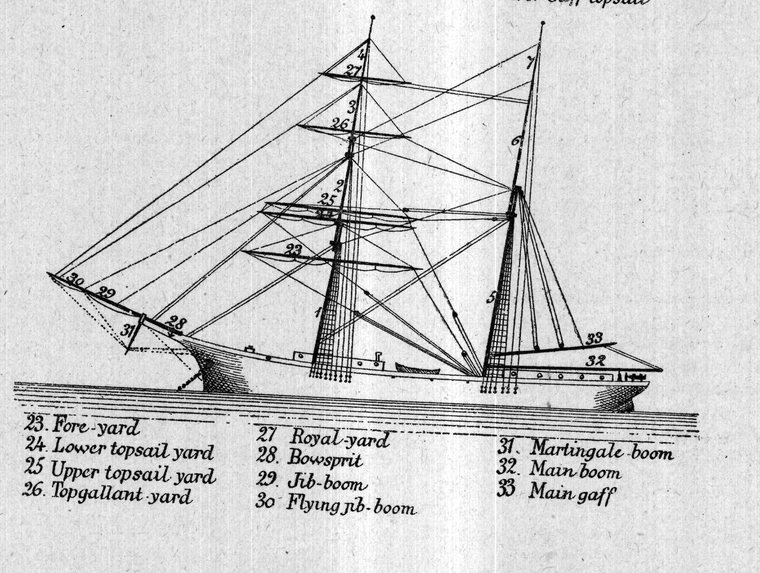
A vessel with two masts, both of them square-rigged. (See Brigantine, Hermaphrodite Brig, Jackass Brig.) The cage or prison below decks in which offenders are confined.
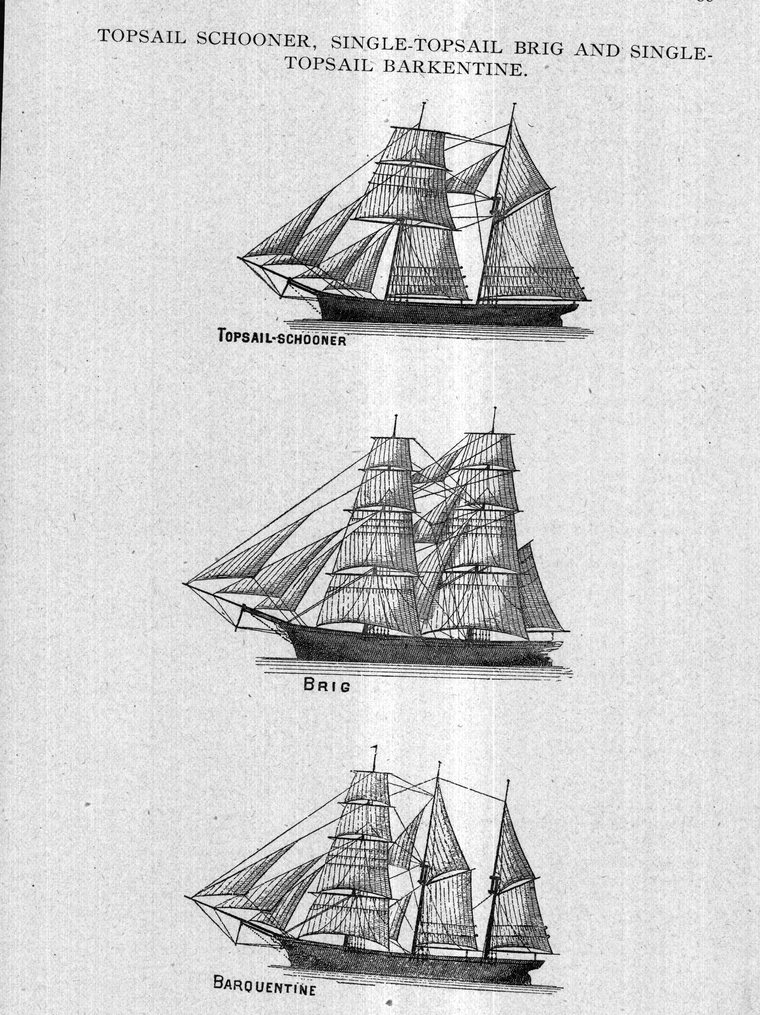
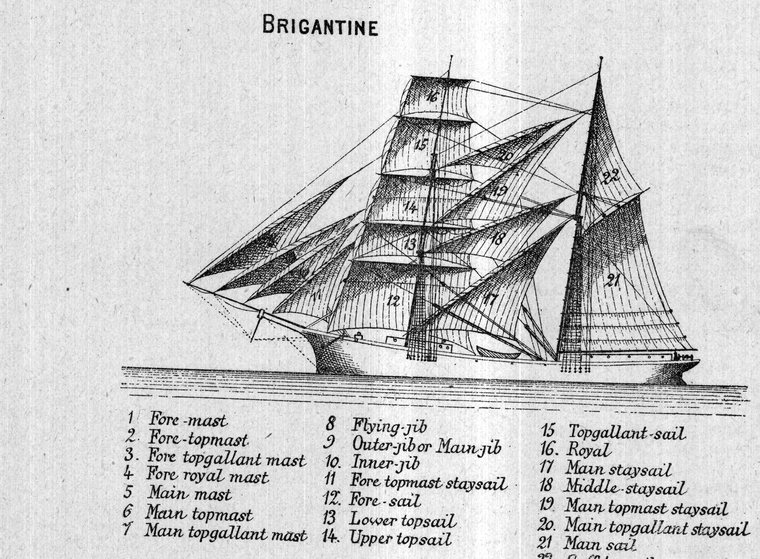
In olden times a brigantine was a two-masted vessel, square-rigged on the fore, and schooner-rigged on the main, with this addition, that she carried a light square topsail on the mainmast. In these days a brigantine dispenses with the square main topsail so that no difference exists between the rigs of a brigantine and an hermaphrodite brig. (See Hermaphrodite Brig.)
An expression used in reference to the brass fixings about decks, such as binnacles, belaying pins, capstan heads, etc.
Bright work also refers to the woodwork which is kept scraped instead of being painted over.
To fall off so much when running free as to bring the wind around on what was a moment before the lee quarter. In the position the sails will be aback, and the vessel, if a square-rigger, will be in great danger. On a fore-and-after it would be jibing the vessel.
To lie-to; to heave-to; to come to an anchorage.
A vessel is said to bring up when she casts anchor.
Bring up all Standing. When a vessel comes to anchor suddenly without first taking in her sails.