CreeperSea Terms
An iron instrument having four claws like a grapnel and used for dragging over the bottom in search of lost cables, anchors, etc.
Page 90 of Patterson’s Illustrated Nautical Encyclopedia · 15 entries
An iron instrument having four claws like a grapnel and used for dragging over the bottom in search of lost cables, anchors, etc.
Before sailing on a foreign voyage, or on a whaling voyage, the master of a vessel must make a list of the names of the officers and crew composing the ship's company; this list to specify also the respective place s of birth and residence, and to give a description of the men individually.
A term applied to a well-known individual who plies seamen with liquor until they are intoxicated, then ships them on some vessel and robs them of their advance money through false claims.
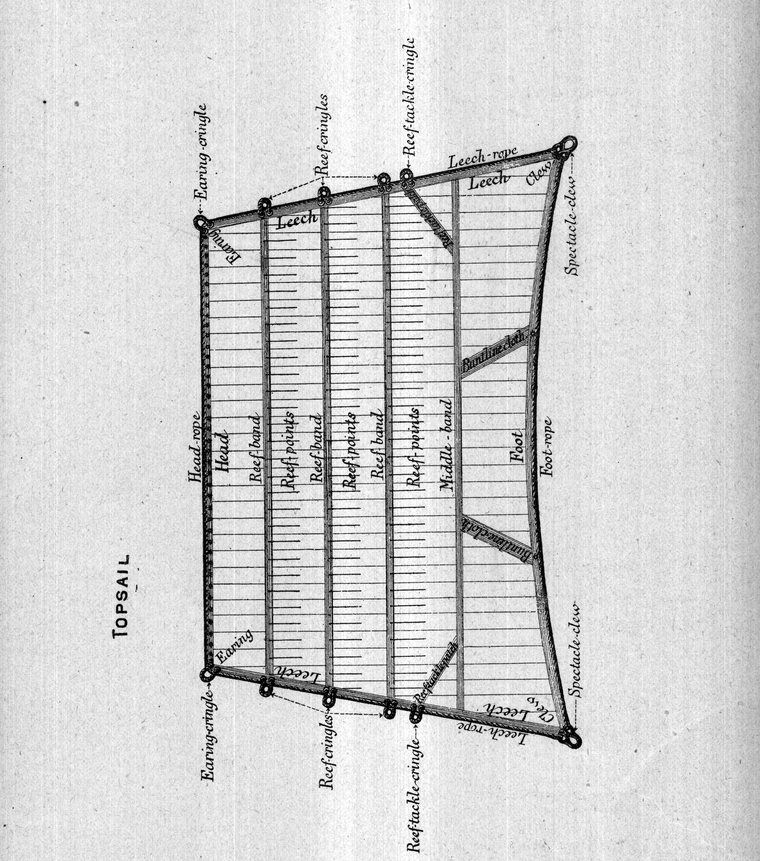
A short piece of rope spliced into and forming an eye on the bolt rope on the luff, head, tack, clew, and leach of gaff sails, into the head, foot, and leaches of square sails, and into the head, tack, and clew of jib-headed sails. An iron ring, called a thimble, is contained within the eye to prevent chafing. See Reef Cringles.)
Bars of iron bent at each end; they are used to turn the shank of an anchor.
The lower yard on the mizzen mast of a ship. It is pronounced as though spelled crog-ic. Some merchant ships carry a sail on the cross-jack, but on men of war such a sail is never found.
The cross-jack braces are the braces not only which are employed to swing the cross-jack yard, but the name refers collectively to the braces of all the mizzen yards.
A sea that runs contrary to the direction of the wind; a confused, ugly sea, very dangerous for low-sided vessels. This kind of a sea is very trying to a ship as it makes her labor heavily.
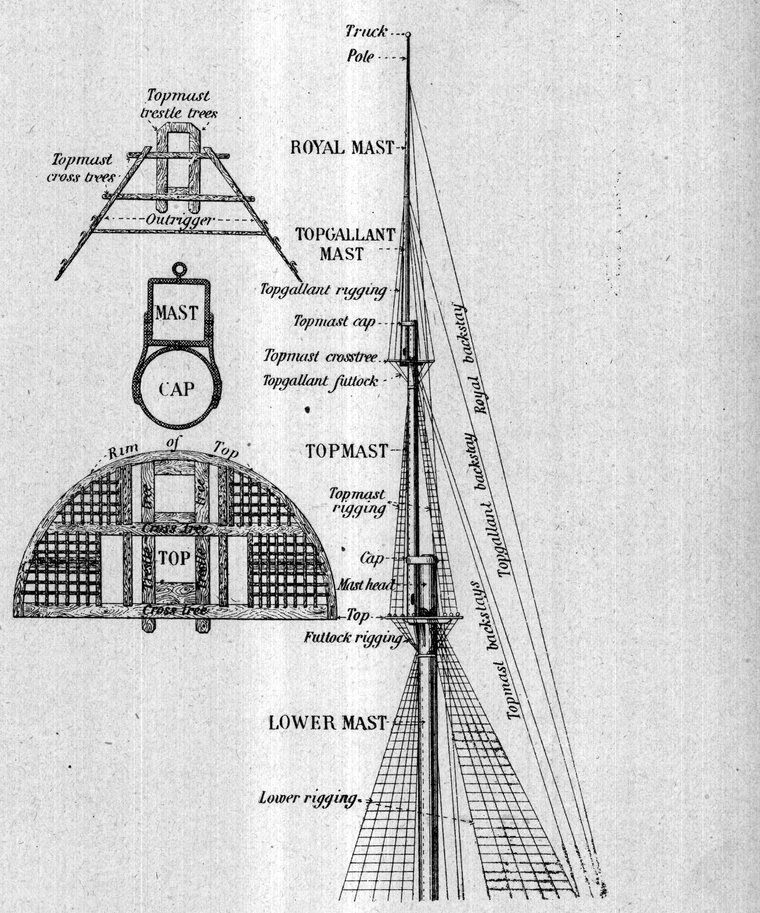
Pieces of oak running thwartships which are supported by the cheeks and trestle trees, and on which the tops on the lower masts rest; they spread the topgallant rigging at the topmast head.
To send yards aloft and drop them to the horizontal, and secure them with their gear.
When a ship sails over the equator she is said to cross the line. (See Neptune.)
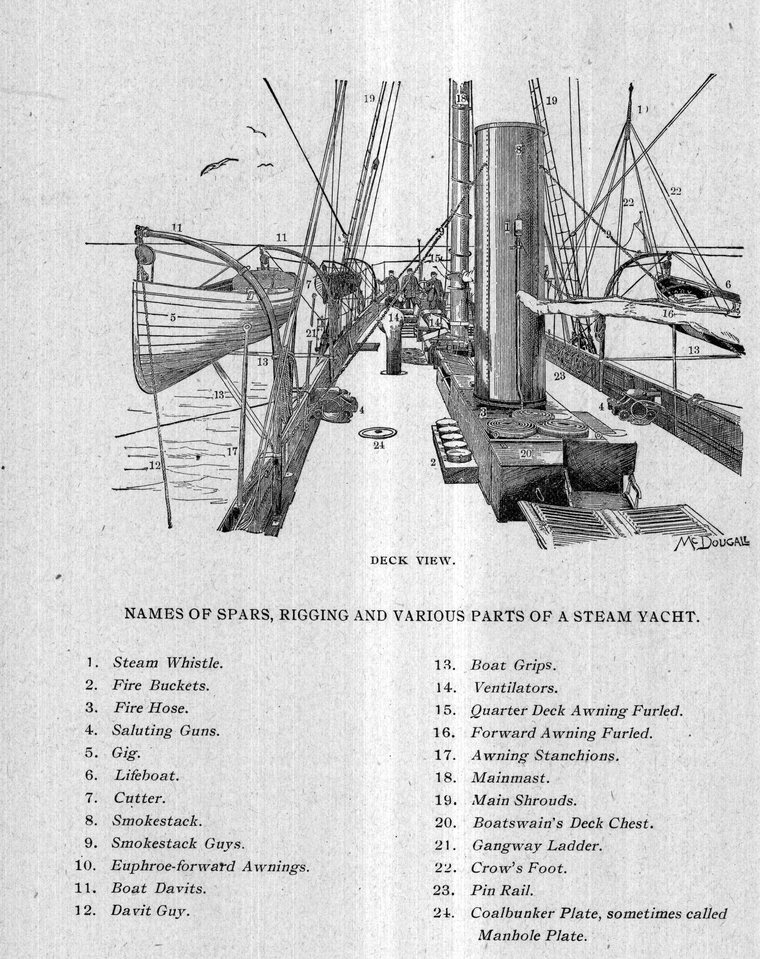
A number of small lines suspending an awning, and which are either spliced into or hooked to little thimbles on the awning backbone; these lines reeve through an euphroe, to which is bent or hooked the awning halliards, by which the canopy is triced up.
To crowd sail upon a vessel is to set everything the ship can stagger under; or, all the sail that the vessel has.
When one vessel interferes with another's course by luffing or by bearing away, the former is said to crowd upon the other's course.
The crown of an anchor is the lowest part directly beneath the shank, or where the arms are welded to that portion of the anchor.
To single crown a knot is to lay the ends of the strands over and then under each other above the knot.
To double crown a knot is to repeat the process of single crowning, following the parts of the latter with the strands of the rope.
A look-out perch at the mast-head of whalers. It is made of a barrel minus the head, so rigged as not to interfere with the sails, and provided with a telescope for the use of the seamen who occupy it. A crow's nest is also carried by arctic exploring vessels.