CordageSea Terms
A term applied in a general way to all the standing and running rigging.
Page 88 of Patterson’s Illustrated Nautical Encyclopedia · 30 entries
A term applied in a general way to all the standing and running rigging.
A term used to designate an amateur patron of yachting.
When the owner or some other amateur seaman acts as sailing master, the crew also, in whole or in part, being amateurs.
(See Drag.)
A volatile meteor sometimes seen about the masts and yards of a vessel just before and during storms. Sailors are very superstitious, concerning these electrical quantities, believing them to be spirits, and that to be aloft when one of these fireballs is playing around is very unlucky, and to be touched by one a sign that the man's life is of short duration. Seamen have other names for this phenomena, among which are, St. Elmo's Light. St. Elmo's Fire, Compreesent, Compressant, Furole, and Jack o' Lantern.
The figures obtained after applying the time allowance to the actual time made in sailing over the course. (See Time Allowance.)
A piratical vessel of Algiers, Tripoli and Tunis.
(See Part V.)
Colored fireworks of private patterns used for various signaling on board vessels at sea.
A Scotch fishing boat.
To brace the head-yards one way and the after-yards another.
A sea which runs in a contrary direction to which the wind is blowing.
The concave in the after-body of a vessel which forms the run.
A small yawl of the Garonne.
That point of the compass toward which the vessel's head is pointed when under way.
The blasts blown on the whistle by steam vessels to indicate to one another the respective courses to be pursued.
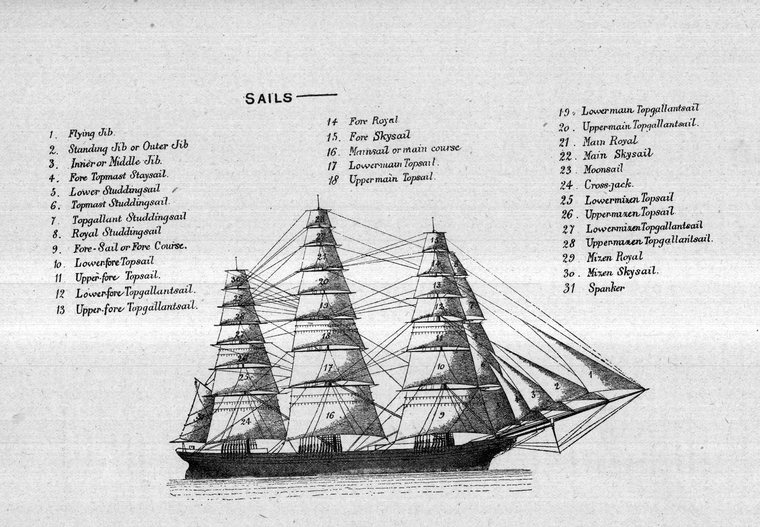
The sails upon the lower yards of a vessel, thus the foresail is the fore course, the mainsail the main course, and the cross-jack the mizzen course.
Same as plank shear.
The person who steers the boat and is in charge of same in the absence of an officer.
The space between the backboard of the boat and the stern.
A wooden machine with three claws, used in launching ships.
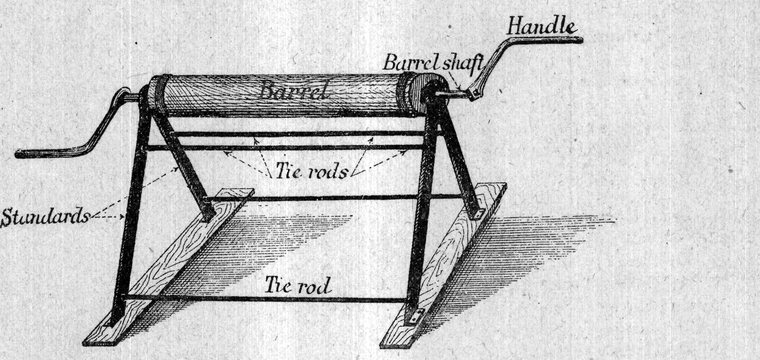
A small winch resting on light iron standards. (See engraving.)
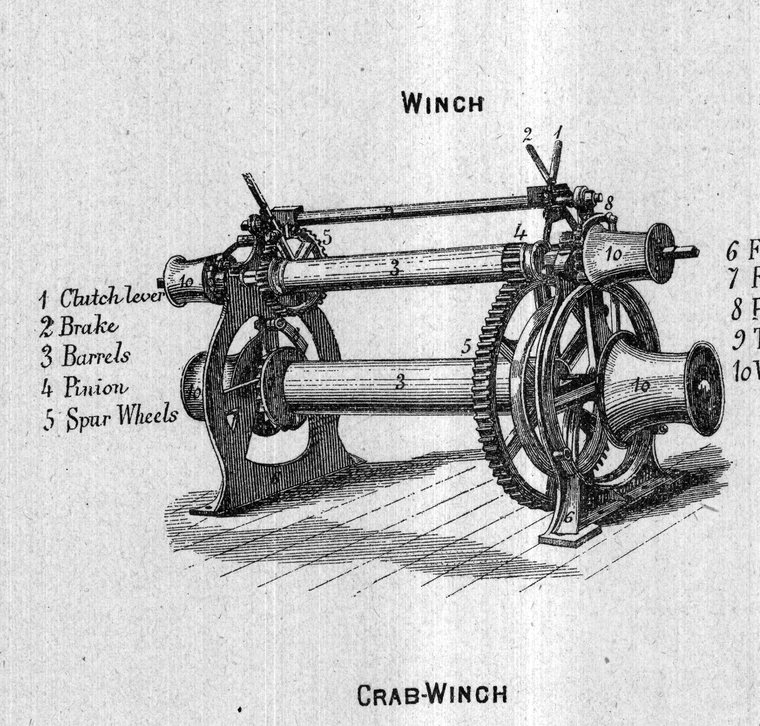
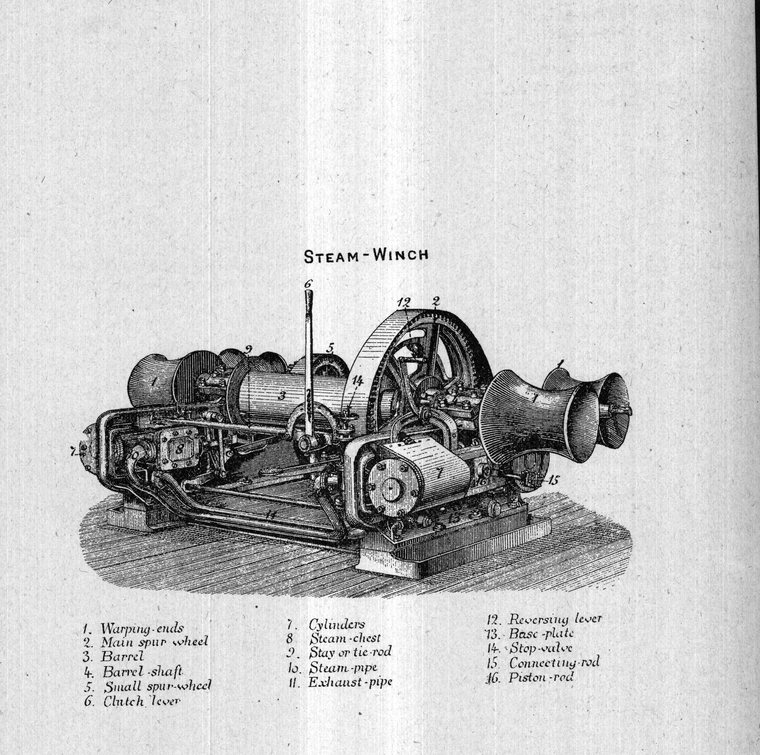
Made by breaking up a quantity of sea biscuit, soaking them in water until soft, then spreading some slush (grease obtained from the skimmings of the cook's coppers) over the mess and baking it in the oven--a great breakfast dish on board a man-o'-war.
A framing built upon launching ways and in which the ship rests while she is being launched.
A general term for all kinds of vessels, independent of size or rig.
(See Cranze Iron.)
A flat, broad barge fitted with a crane for lifting heavy weights.
A machine used in raising or lowering great weights; a derrick. (See Cat Crane.)
A vessel is said to be crank or tender when she heels over unduly under sail so as to be in danger of capsizing. This may arise from insufficient contructural stability or to the manner in which the cargo or ballast is stowed.
The iron band on the bowsprit end to which the bowsprit shrouds and bobstays are shackled.