Deep WaistedSea Terms
A vessel is so called when she has a poop and topgallant forecastle.
Page 96 of Patterson’s Illustrated Nautical Encyclopedia · 22 entries
A vessel is so called when she has a poop and topgallant forecastle.
Meaning the same as blue water.
A seaman of the long voyage.
When a vessel is detained in port in loading or unloading beyond a limit specified in her charter party she is allowed so much demurrage money per day--such detention, however, being the delay for which the charterer or his agent is responsible.
A vessel abandoned at sea.
A spar supported by guys, with a block at its upper end forming part of a tackle by which cargo is loaded and unloaded.
In signing a charter party it is customary for a clause to be inserted to the effect that the vessel is to be loaded or discharged with despatch, the same being governed by the custom of the port where she may be. In some countries it also means the facility afforded at the custom houses in clearing a vessel with more than customary promptness, and for which an additional fee is sometimes charged.
A voluntary departure without necessity from the regular and usual course of the specific voyage for which the vessel is insured. In such a case the responsibility of the underwriters terminates with the commencement of the act.
A strong iron hook used as a stopper for the cable.
The white fleecy cloud which often settles over Table Mountain at the Cape of Good Hope; it is the forerunner of a gale from the southeast.
A flat-bottom trading craft of India, of about 100 tons.
An Arab vessel of 150 to 250 tons.
A manner of building boats in which the planking runs diagonally, the inside planks running in a contrary direction to the outside planks, their edges meeting.
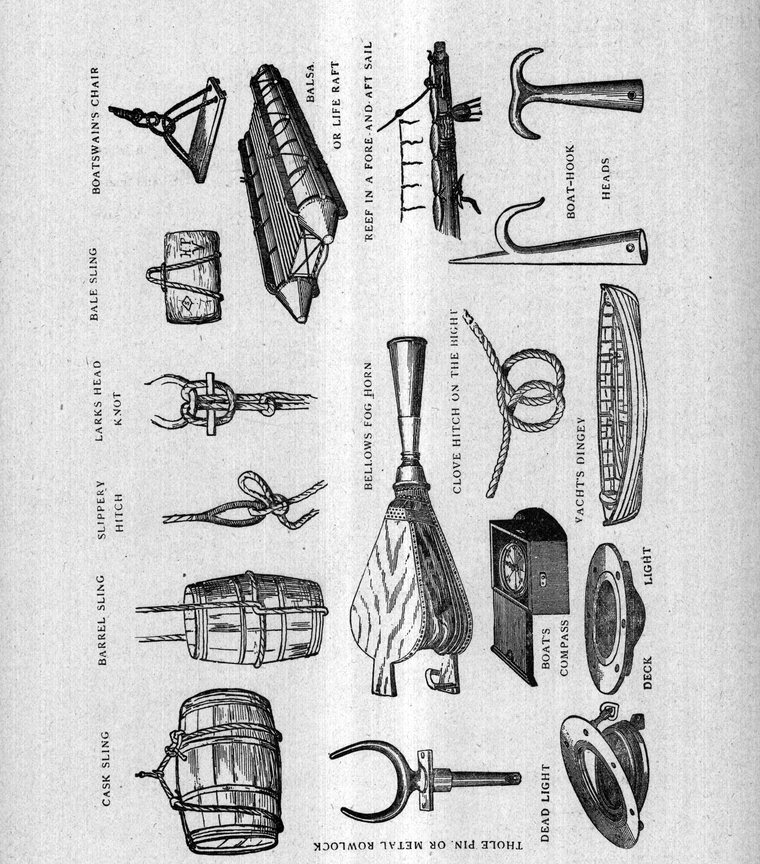
An ornamental knot made with the strands of a rope and used on man-ropes, etc. Diamond knots are made both single and double. (See engraving.)
The smallest boat carried by a vessel, and is used for all kinds of rough and dirty work.
A small fishing boat of Ireland.
One which has to be shifted to leeward of the mast each time the vessel is tacked.
The act of lowering the national ensign (which is flown at the stern) and hoisting it again as a salute, or in return for a salute received.
When a vessel is unrigged--stripped of her spars and upper masts.
The state of a vessel when her masts have been carried away--gone over the side.
A fast steaming vessel used in the navy for carrying dispatches to and from the commanding officer of a vessel or fleet.
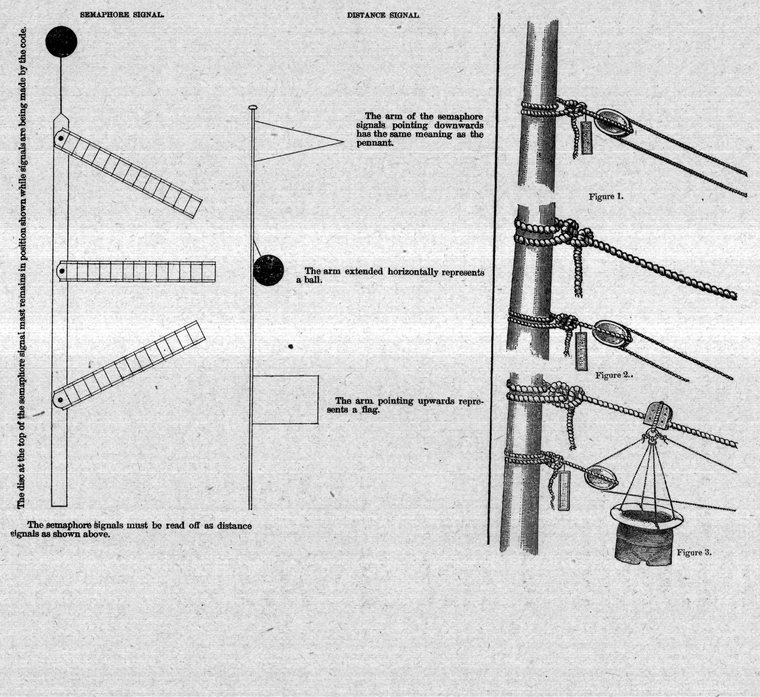
Distance Signals are sometimes used when it is impossible to distinguish the Code flags. The characteristic of this signal is the black ball, one ball at least appearing in every hoist of the Distance code, the other symbols being pennants or square flags of any color. (See engravings).