Hawse BlockSea Terms
A block of wood made to fit into a hawse pipe from inboard, and which is shipped at sea in order to prevent water from coming on board through the hawse holes.
Page 136 of Patterson’s Illustrated Nautical Encyclopedia · 25 entries
A block of wood made to fit into a hawse pipe from inboard, and which is shipped at sea in order to prevent water from coming on board through the hawse holes.
Pieces of oak plank bolted under the hawse holes in order to prevent the cables from chafing.
The woodwork to be seen just outside of the hawse pipe on a wooden vessel.
An iron plate to cover the hawse hole, taking the place of hawse blocks and jackasses.
The holes in the bows of a vessel through which the cables pass.
The timbers in the bows of a vessel through which the hawse holes are cut.
An iron pipe in a vessel's bows through which the cable runs.
A block of wood made to fit into a hawse pipe from the outside so as to prevent water from getting into the manger. (See Manger.)
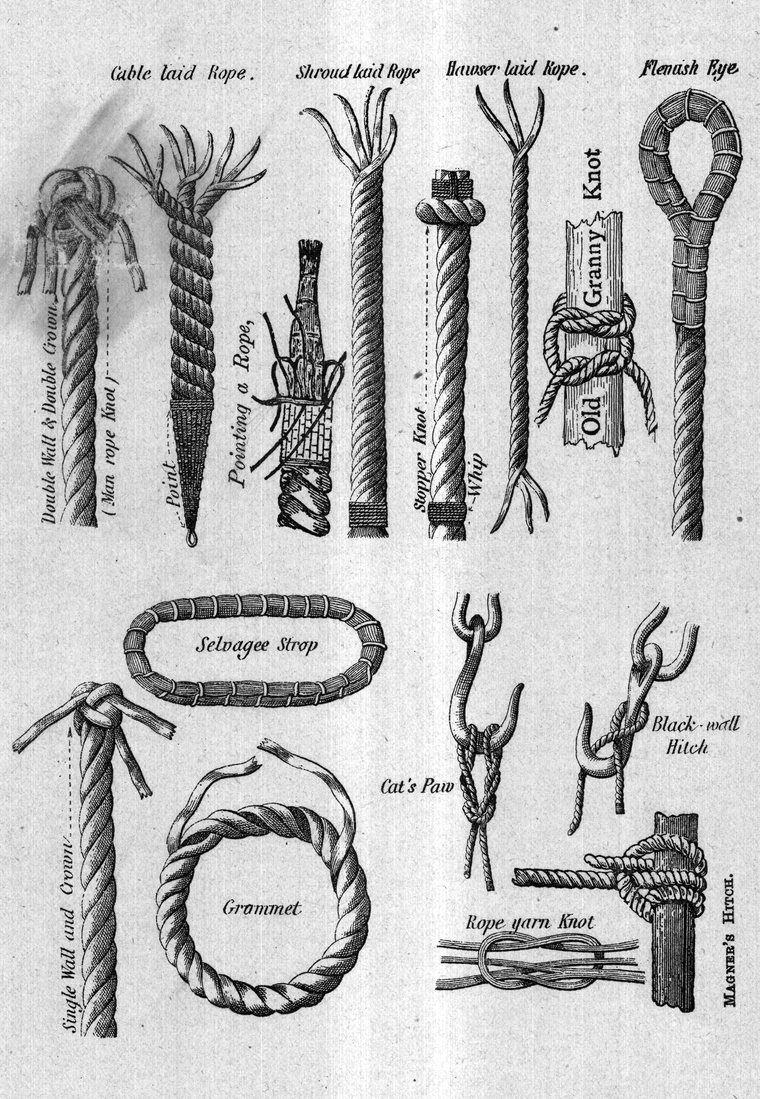
A large rope used for towing, warping, etc.
Same as cable-laid rope--see the latter.
Punishing a man by keeping him at work upon dirty and unnecessary jobs. (See Ride Down a Man.)
The head of anvthing, as mast-head, timber-head, capstan-head, head of a sail, etc. Also the carved figure under the bowsprit is called a figure-head, a carved scroll a billet-head, a carved board that turns in at the end like the head of a violin a fiddle-head.
The boards placed inside the hammock nettings at the forward and after ends.
The iron ring or shape spliced into the bolt rope at the junction of the leach and head of a fore-and-aft sail; but at the two upper corners of square sails.
The ropes which secure the two upper corners of a square sail to the yard-arms by alternate passings of the line through the head cringles and the spar.
(See Coamings.)
A mooring rope leading ahead of the vessel.
The farthest in advance.
Short low rails extending from the stem to the bows.
The forging or progress ahead of a vessel when lying to. (See Fore Reach.)
The height of the cabin from the floor to the roof; the height of any place, such as the hold, the forecastle, the caboose. The cabin has seven feet of head room when it measures seven feet from the floor to the underneath part of the roof.
The rope to which the tabring on the upper edge of a sail is sewn.
All the sails forward of the foremast. These are named differently on vessels of various rigs. They are known as forestaysails, fore-topmast-staysails, jibs, flying jibs. jib-o-jibs, inner-jibs, main-jibs, outer-jibs, jib-topsails, middle-jibs and standing-jibs. (See engravngs of various rigs.)
A sea coming from the same point of the compass that the vessel is directed toward.
The sheets of all the head sails.