HandySea Terms
A vessel is said to be handy if she is quick in stays and always answers her helm quickly.
Page 134 of Patterson’s Illustrated Nautical Encyclopedia · 31 entries
A vessel is said to be handy if she is quick in stays and always answers her helm quickly.
A watch tackle; a name for the forecastle boy.
Blocks used at the mastheads for the halliards of the head sails.
A plank hung horizontally over the ship's side for men to stand or sit on while painting ship, etc.
The rings of wood, rope or iron round a stay, and to which the luff of the head sails is secured by robands.
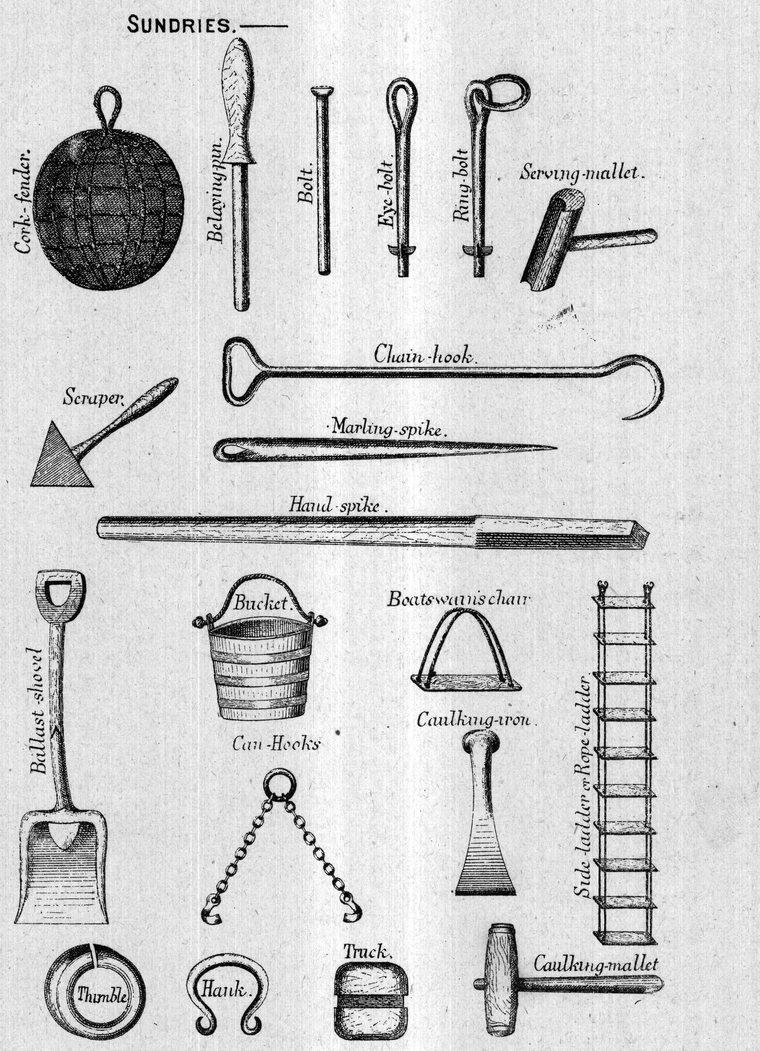
(See Port Charges.)
(See Gasket.)
An officer whose duty it is to inspect the moorings of the harbor, to observe that ships are properly berthed, and to enforce the regulations provided for the shipping in the harbor. (See Port Warden.)
Same as River Pirate--see latter.
(See Anchor Watch.)
To put the tiller all the way over towards the windward side of the vessel.
The helm is said to be hard down when it is put over to leeward as far as it can go.
The helm is hard over when it is moved to its extreme limit.
A name for the rigging on a vessel.
A conical barrel, having a locked lid and kept on deck, containing a quantity of salt pork and salt beef for daily consumption.
A spear-shaped iron used for burying in the bodies of large fish.
(See Primage.)
An iron bar which crosses the hatches and keeps them down by having both of its ends secured to the hatch coamings.
(See Coamings.)
The iron rings in the corners of hatches for lifting the latter.
An ordinary luff tackle, composed of a double and single block, and used for hoisting or lowering stuff through the hatches.
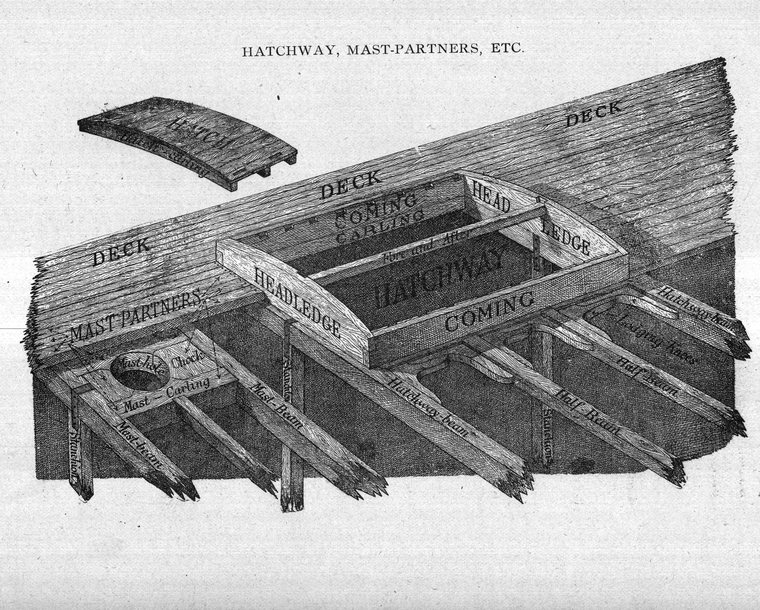
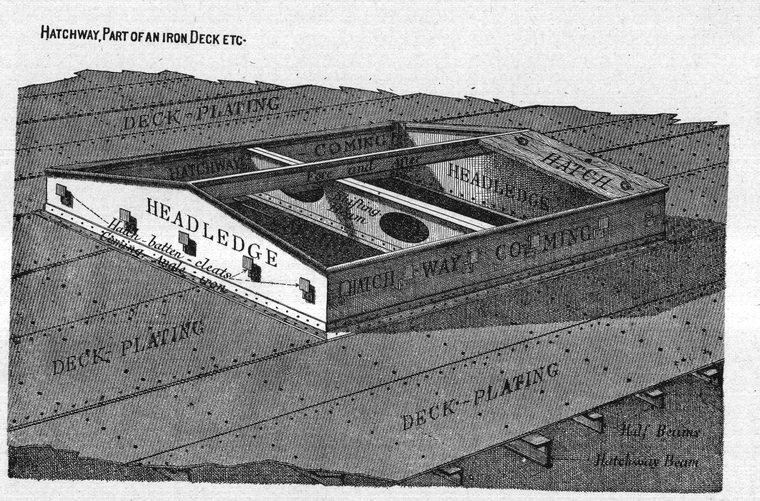
The covers for the hatchways.
The openings in the deck to afford passage up and down for the cargo.
To pull. The wind is said to haul when it ships around the compass with the sun, i. e., in the same way that the hands of a watch revolve.
An order given to bring the weather clew of a course to the tack block when setting the sail.
The order given to haul the bunting down from aloft, and from the truck of the flag-pole at the stern.
Swinging all the yards at once.
A vessel is said to be hauled up when her course is changed so that she will lie closer to the wind.
A line sent down from aloft to bend on to any article required for use, and by which the article is hauled up.
Hauls her Wind. Said of a vessel when she is brought by the wind after sailing with the wind free.
A vessel rides to a hawse when she has her two bow anchors down; the surface of the water just ahead of the vessel; clear hawse or open hawse means that there is no cross in the cables; athwart hawse means across the line of the vessel's keel just in advance of the vessel; to freshen the hawse is to veer out or heave in a little cable so as to bring the strain or chafe an another part. (See Mooring Swivel.)
(See Jackass.)