BalconyShipbuilding
The projecting open galleries to be seen at the stern of old men-of-war of the line of battle ship class.
Page 276 of Patterson’s Illustrated Nautical Encyclopedia · 12 entries
The projecting open galleries to be seen at the stern of old men-of-war of the line of battle ship class.
In general, light scantlings of wood. In ship-building, long, narrow laths of fir, their ends corresponding and fitted into each other with mortice and tenon, used in setting fair the sheer-lines on a ship. They are painted black in order to be the more conspicuous. Battens used on the mold-loft floor are narrow laths, of which some are accurately graduated and marked with feet, inches and quarters for setting off distances. Battens for gratings are narrow, thin laths of oak.
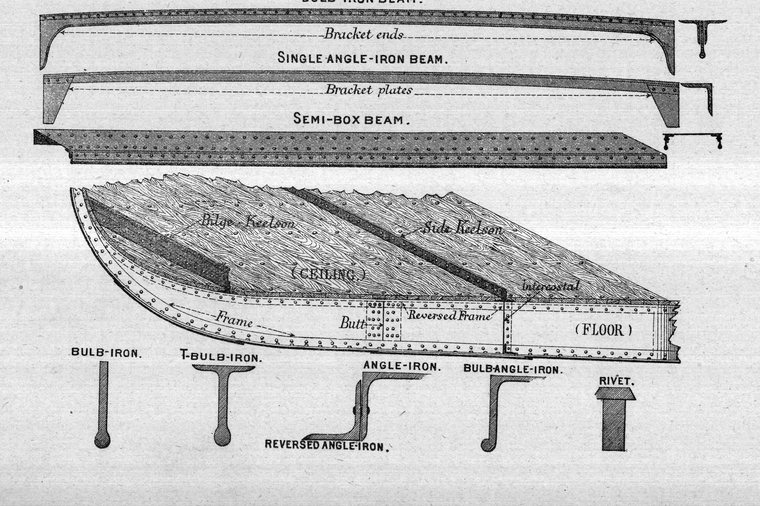
The substantial pieces of timber which stretch across the ship from side to side to support the decks and keep the ship together by means of the knees, etc., their ends being lodged on the clamps, keeping the ship to her breadth.
Beam Arm, or Fork Beam, is a curved piece of timber, nearly of the depth of the beam, scarphed, tabled and bolted for additional security to the sides of beams athwart large openings in the decks, as the main hatchway and the mast-rooms.
Breast Beams are those beams at the forepart of the quarter deck and poop, and afterpart of the forecastle. They are sided larger than the rest, as they have an ornamental rail in the front, formed from the solid, and a rabbet one inch broader than its depth, which must be sufficient to bury the deals of the deck, and one inch above for a spurn-water. To prevent splitting the beam in the rabbet the nails of the deck should be crossed, or so placed, alternately, as to form a sort of zigzag line.
Half-Beams are short beams introduced to support the deck where there is no framing, as in those places where the beams are kept asunder by hatchways, ladder-ways, etc. They are let down on the clamp at the side, and near midships, into fore-and-aft carlings. On some decks they are abaft the mizzen-mast, generally of fir, let into the side tier of carlings.
The Midship Beam is the longest beam of the ship, lodged in the midship-frame or between the widest frame of timbers.
The diminishing of the edge or surface of a piece of timber, etc., from a given line, as on the dead-wood, clamps, plank-sheers, fife-rails, etc.
A curved line occasioned by bearding the dead-wood to the form of the body; the former being sided sufficiently, this line is carried high enough to prevent the heels of timbers from running to a sharp edge, and forms a rabbet for the timbers to step on; hence it is often called the stepping-line.
The widest part of a vessel below the plank-sheer or deck line, or the "line of flotation," so called when the vessel is properly ballasted and trimmed.
A solid framing of timber to receive and to support the mortar in a bomb vessel.
A large mallet used by caulkers for driving in their reeming irons to open the seams in order for caulking.
The inside or hollow part of compass or curved timber, the outside of which is called the back.
A term applied to the top of a quarter galley when the upper stool is hollowed away, or made like a rim, to give more height, as in the quarter galleries of small vessels, and the stool of the upper finishing comes home to the side, to complete overhead.
Bend-mould, in whole moulding. A mould made to form the futtocks in the square body, assisted by the rising-square, and floor-hollow.
The frames or ribs that form the ship's body from the keel to the top of the side at any particular station. They are first put together on the ground. That at the broadest part of the ship is denominated the midship-bend or dead-flat. The foreparts of the wales are commonly called bends.
The space contained between any two decks of a ship.