Between PerpendicularsShipbuilding
The length on deck from the forepart of the stem to the afterpart of the stern post.
Page 278 of Patterson’s Illustrated Nautical Encyclopedia · 14 entries
The length on deck from the forepart of the stem to the afterpart of the stern post.
A well-known instrument, composed of a stock and a movable tongue, for taking of angles on wood, etc., by shipwrights, called bevelings.
A piece of deal on which the bevelings or angles of the timbers, etc., are described.
The windings or angles of the timbers, etc., a term applied to any deviation from a square or right angle. Of beveling there are two sorts, denominated standing bevelings and under bevelings. By the former is meant an obtuse angle, or that which is without a square; and by the latter is understood an acute angle, or that which is within a square.
That part of a ship's floor, on either side of the keel, which has more of a horizontal than of a perpendicular direction, and on which the ship would rest if laid on the ground; or, more particularly, those projecting parts of the bottom which are opposite to the heads of the floor-timbers amidships, on each side of the keel.
Bilge Trees, or Bilge Pieces, or Bilge Keels. The pieces of timber fastened under the bilge of boats or other vessels to keep them upright when on shore, or to prevent their falling to leeward when sailing.
A square bed of timber placed under the bilge of the ship to support her while launching.
The iron links which surround the dead-eyes, a general term for clamps, knees, transoms, etc., for connecting parts of a vessel.
Two strakes of oak plank, worked all the way fore-and-aft upon the beams of each deck, within one strake of the coamings of the main hatchway, in order to strengthen the deck, as that strake and the midship strakes are cut off by the pumps, etc.
A sort of large chests, or erections in store-rooms, in which the stores are deposited. They are generally 3 or 4 feet deep and nearly of the same breadth.
A term generally used for working up a topside or bulkhead with board or thin plank.
A broad strake, which is parallel to and worked upon the upper edge of the wales in order to strengthen the ship. It derives its name from being paid with pitch, and is the boundary for the painting of the topsides. Ships having no ports near the wales have generally two black strakes.
A design of a vessel whittled from a block of wood, instead of being drawn on paper. (See Designing.)
Blocks, for Building the Ship Upon, are those solid pieces of oak timber fixed under a ship's keel upon the groundways.
Timber sawed to a less thickness than plank; all broad stuff of, or under, one inch and a half in thickness.
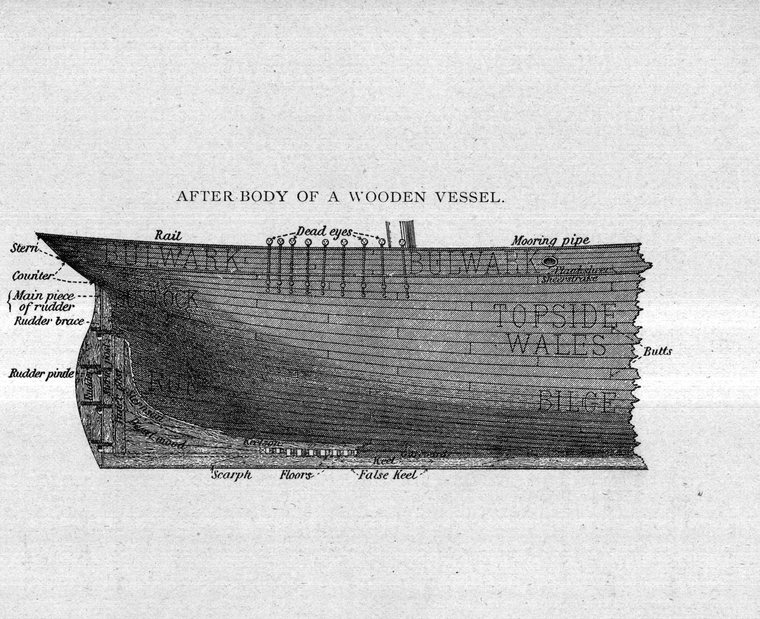
The figure of a ship, abstractedly considered, is supposed to be divided into different parts, or figures, to each of which is given the appellation of body. Hence, we have the terms fore body, after body, cant bodies, and square body. Thus the fore body is the figure, or imaginary figure, of that part of the ship afore the midships, or dead-flat, as seen from ahead. The after body, in like manner, is the figure of that part of the ship abaft the midships, or dead-flat, as seen from astern. The cant bodies are distinguished into fore and after, and signify the figure of that part of a ship's body, or timbers, as seen from either side, which form the shape forward and aft, and whose planes makes obtuse angles with the midship line of the ship; those in the fore cant-body being inclined to the stem, as those in the after one are to the stern-post. The square body comprehends all the timbers whose areas or planes are perpendicular to the keel, and square with the middle line of the ship; which is all that portion of a ship between the cant bodies.