Body PlanShipbuilding
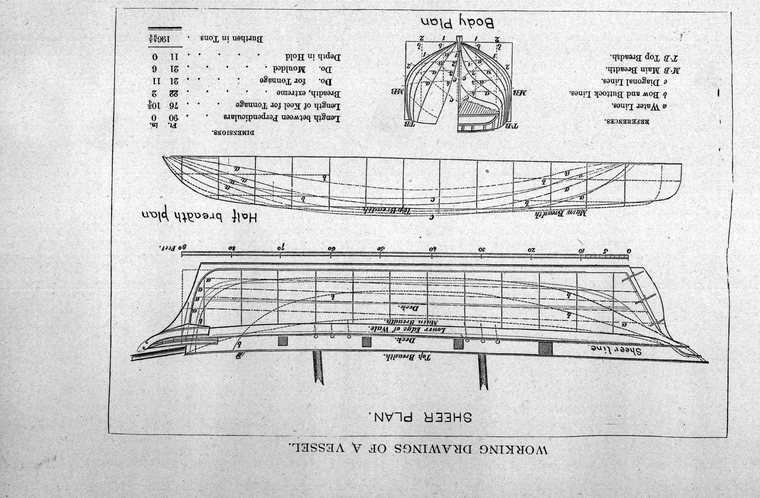
A ship construction drawing showing the frames as curved lines. The forward body, or bow, is shown on the right of the center line, and the after body, or stern, is shown on the left of the center line.
Page 280 of Patterson’s Illustrated Nautical Encyclopedia · 11 entries
A ship construction drawing showing the frames as curved lines. The forward body, or bow, is shown on the right of the center line, and the after body, or stern, is shown on the left of the center line.
(See Knight Heads.)
Pieces of oak timber fayed to the curvature of the bow, under the hawse-holes, and down upon the upper or lower cheek, to prevent the cable from rubbing against the cheek.
Bolsters, for the Anchor Lining, are solid pieces of oak, bolted to the ship's side, at the fore-part of the fore-chains, on which the stanchions are fixed that receive the anchor lining. The fore end of the bolster should extend two feet or more before the lining, for the convenience of a man standing to assist in fishing the anchor.
Bolsters for Sheets, Tacks, etc., are small pieces of fir, or oak, fayed under the gunwale, etc., with the outer surface rounded to prevent the sheets and other rigging from chafing.
Cylindrical or square pins of iron or copper, of various forms, for fastening and securing the different parts of the ship, the guns, etc. The figure of those for fastening the timbers, planks, hooks, knees, crutches, and other articles of a similar nature, is cylindrical, and their sizes are adapted to the respective objects which they are intended to secure. They have round or saucer heads, according to the purposes for which they may be intended; and the points are fore-locked or clinched on rings to prevent their drawing. Those for bolting the frames or beams together are generally square.
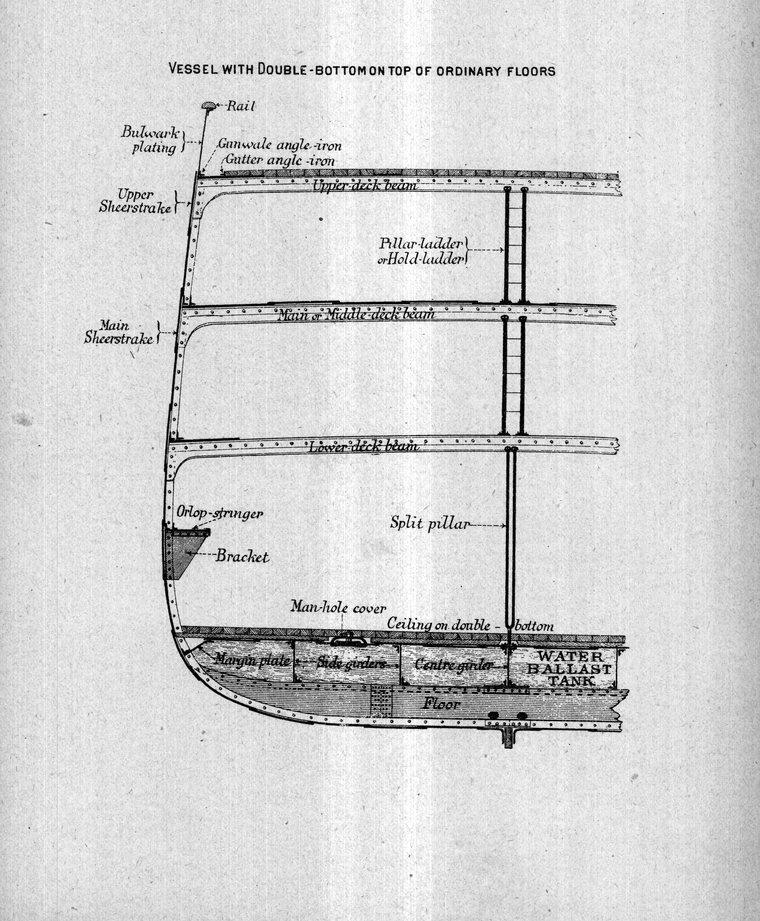
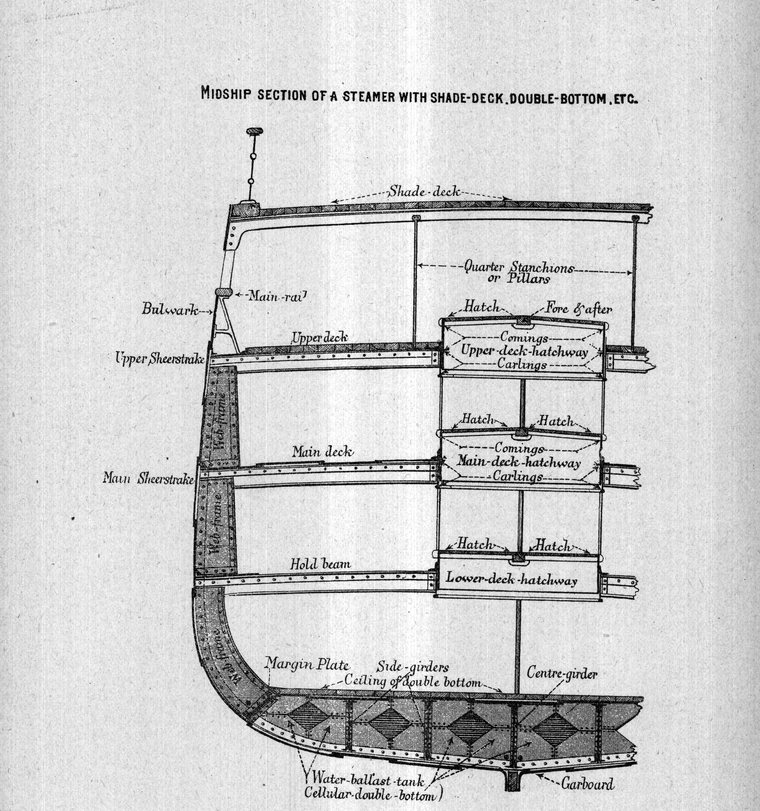
All that part of a ship or vessel that is below the wales. Hence, we use the epithet sharp-bottomed for vessels intended for quick sailing, and full-bottomed for such as are designed to carry large cargoes.
The circular part of the ship forward, terminated at the rabbet of the stem.
Straps of iron, copper or mixed metals, secured with bolts and screws in the stern-post and bottom planks. In their after-ends are holes to receive the pintles by which the rudder is hung.
A term more particularly applied to some essential dimensions of the extent of a ship or vessel athwartships, as the breadth-extreme, and the breadthmoulded, which are two of the principal dimensions given in the building of the ship. The extreme breadth is the extent of the midships, or dead-flat, with the thickness of the bottom plank included. The breadth-moulded is the same extent, without the thickness of the plank.
A curved line of the ship lengthwise, intersecting the timbers at their respective broadest parts.
The sudden termination or rise in the decks of some merchcant ships, where the aft, and sometimes the fore, part of the deck is kept up to give more height between decks, as likewise at the drifts.
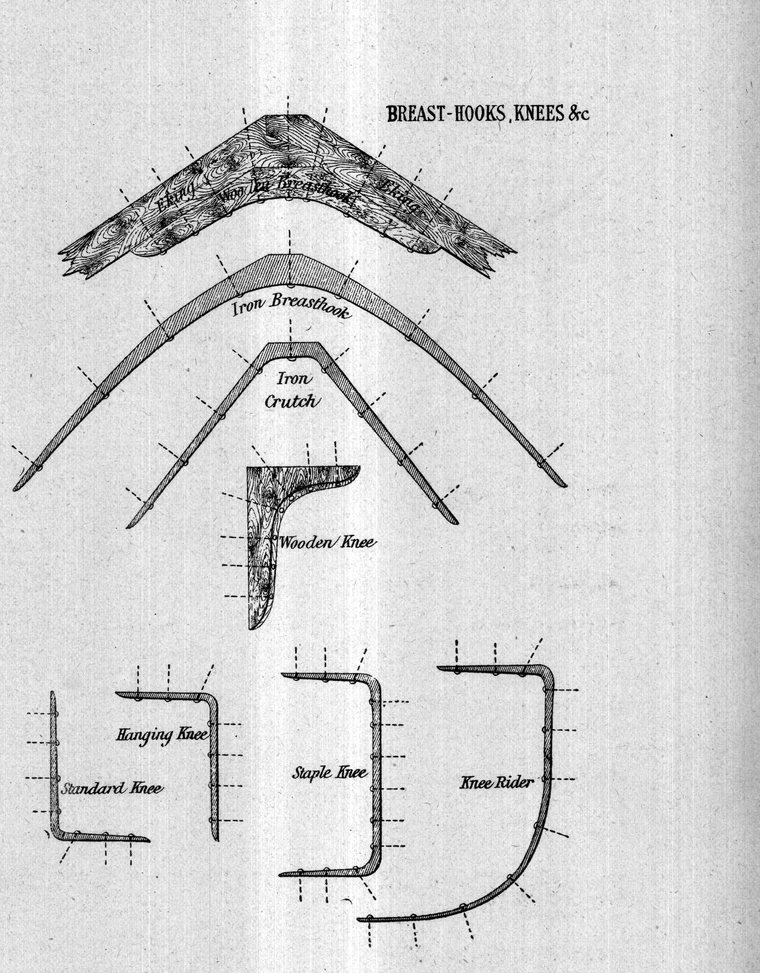
Large pieces of compass timber fixed within and athwart the bows of the ship, of which they are the principal security, and through which they are well bolted. There is generally one between each deck, and three or four below the lower deck, fayed upon the plank. Those below are placed square to the shape of the ship at their respective places. The breast-hooks that receive the ends of the deck-planks are also called deck-hooks, and are fayed close home to the timbers in the direction of the decks.