The Nautical Encyclopedia
Patterson’s Illustrated Nautical Encyclopedia — Howard Patterson, 1891

Carlings to Chain-Bolt

Page 284 of Patterson’s Illustrated Nautical Encyclopedia · 12 entries

CarlingsShipbuilding

Long pieces of timber, above four inches square, which lie fore-and-aft, in tiers, from beam to beam, into which their ends are scored. They receive the ends of the ledges for framing the decks. The carlings by the side of, and for the support of the mast, which receive the framing round the mast, called the partners, are much larger than the rest, and are named the mast carlings. Besides these there are others, as the pump carlings, which go next without the mast carlings, and between which the pumps pass into the well; and also the fire-hearth carlings, that let up under the beam on which the galley stands, with pillars underneath, and chocks upon it, fayed up to the ledges for support.
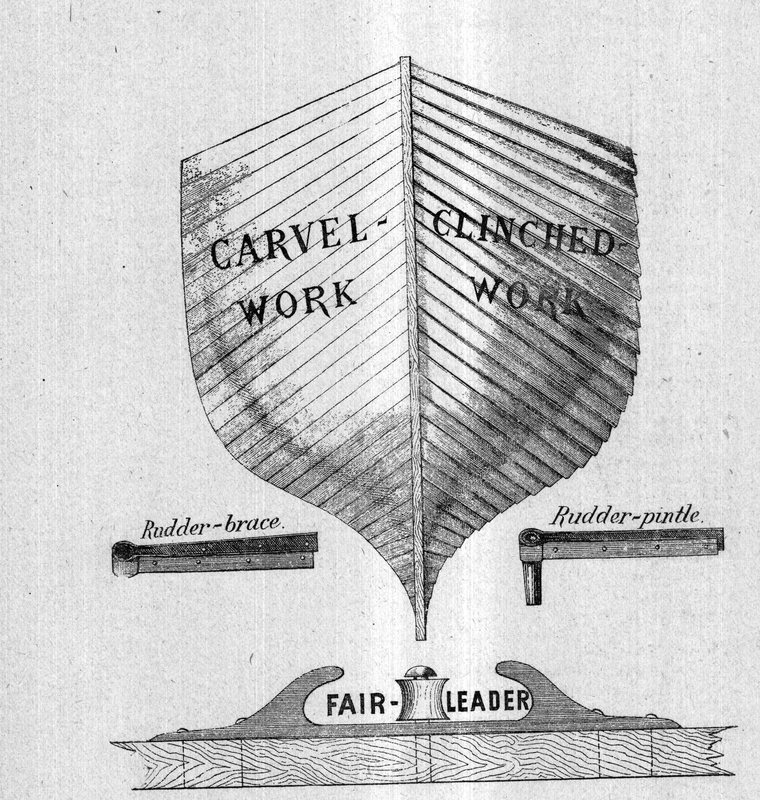
Carvel WorkShipbuilding

A term applied to cutters and boats, signifying that the seams of the bottom-planking are square, and to be tight by caulking as those of ships. It is opposed to the phrase clincher-built, which see.

Carvel-work and clinched-work, rudder-brace and rudder-pintle, and the fair-leader

CaulkingShipbuilding

Forcing oakum into the seams and between the butts of the plank, etc., with iron instruments, in order to prevent the water penetrating into the ship.

Ceiling or Foot-walingShipbuilding

The inside planks of the bottom of the ship.

Centre of Cavity, or of DisplacementShipbuilding

The centre of that part of the ship's body which is immersed in the water, and which is also the centre of the vertical force that the water exerts to support the vessel.

Centre of GravityShipbuilding

That point about which all the parts of a body do, in any situation, exactly balance each other. Hence, I. If a body be suspended by this point as the centre of motion it will remain at rest in any position indifferently. 2. If a body be suspended in any other point, it can rest only in two positions, viz.: when the centre of gravity is exactly above or below the point of suspension. 3. When the centre of gravity is supported the whole body is kept from falling. 4. Because this point has a constant tendency to descend to the centre of the earth, therefore--5. When the point is at liberty to descend, the whole body must also descend, either by sliding, rolling or tumbling over.

Centre of Lateral ResistanceShipbuilding

(See Lateral Resistance.)

Centre of MotionShipbuilding

That point of a body which remains at rest whilst all the other parts are in motion about it; and this is the same, in bodies of one uniform density throughout, as the centre of gravity.

Centre of OscillationShipbuilding

That point in the axis or line of suspension of a vibrating body, or system of bodies, in which, if the whole matter or weight be collected, the vibrations will still be performed in the same time, and with the same angular velocity, as before.

Centre of Percussion, in a moving body, is that point where the percussion or stroke is the greatest, and in which the whole percutient force of the body is supposed to be collected. Percussion is the impression a body makes in falling or striking upon another, or the shock of bodies in motion striking against each other. It is either direct or oblique; direct when the impulse is given in a line perpendicular to the point of contact; and oblique when it is given in a line oblique to the point of contact.

Centre of Resistance to a FluidShipbuilding

That point in a plane to which, if a contrary force be applied, it shall just sustain the resistance.

Chain or ChainsShipbuilding

The links of iron which are connected to the binding that surround the dead-eyes of the channels. They are secured to the ship's side by a bolt through the toe-link called a chain-bolt.

Chain-BoltShipbuilding

A large bolt to secure the chains of the dead-eyes, for the purpose of securing the masts by the shrouds.

← page 282The A–Z indexpage 286 →