HoldShipbuilding
That part of the ship below the lower deck, between the bulkheads, which is reserved for the stowage of ballast, water and provisions in ships of war, and for that of the cargo in merchant vessels.
Page 302 of Patterson’s Illustrated Nautical Encyclopedia · 18 entries
That part of the ship below the lower deck, between the bulkheads, which is reserved for the stowage of ballast, water and provisions in ships of war, and for that of the cargo in merchant vessels.
Those ends of the planks which bury in the rabbets of the stem and stern post.
The scarphing or laying the ends of timbers over each other.
An iron fixed in a handle, and used with a beetle by caulkers, to horse-up or harden in the oakum.
Large straps of iron or copper shaped like a horse-shoe and let into the stem and gripe on opposite sides, through which they are bolted together to secure the gripe to the stem.
The whole frame or body of a ship, exclusive of the masts, yards, sails and rigging.
A term sometimes used for the scantling of the timbers the moulding way, but more particularly applied to those bolts in the knees, riders, etc., which are driven through the ship's sides, or athwarthships, and therefore called in-and-out bolts.
A piece of oak timber, brought on and fayed to the foreside of the main stern-post, for the purpose of seating the transoms upon it. It is a great security to the ends of the planks, as the main post is seldom sufficiently afore the rabbet for that purpose, and is also a great strengthener to that part of the ship.
The main and lower timber of a ship, extending longitudinally from the stem to the stern-post. It is formed of several pieces, which are scarphed together endways, and form the basis of the whole structure. Of course it is usually the first thing laid down upon the block for the construction of the ship.
Keelson, or, more commonly, Kelson. The timber, formed of long square pieces of oak, fixed within the ship exactly over the keel (and which may, therefore, be considered as the counterpart of the latter) for binding and strengthening the lower part of the ship, for which purpose it is fitted to and laid upon, the middle of the floor timbers and bolted through the floors and keel.
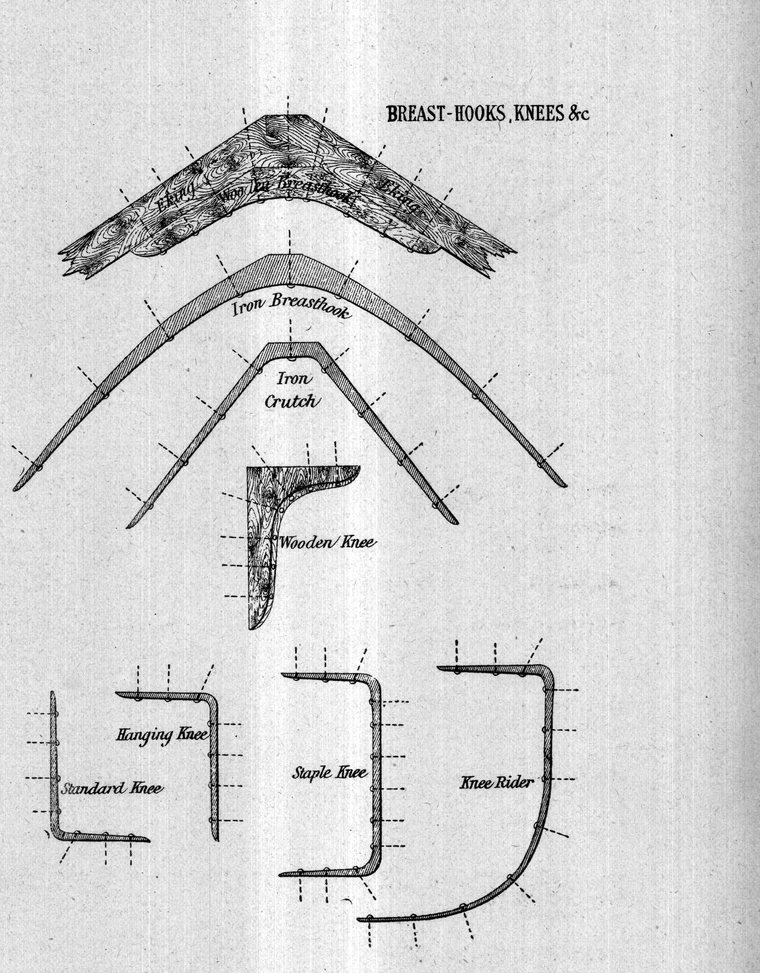
The crooked pieces of oak timber by which the ends of the beams are secured to the sides of the ship. Of these such as are fayed vertically to the sides are called hanging-knees, and such as are fixed parallel to, or with the hang of, the deck, are called lodging-knees.
The large flat timber fayed edgeways upon the fore-part of the stem. It is formed by an assemblage of pieces of oak coaked or tabled together edgewise, by reason of its breadth, and it projects the length of the head. Its forepart should form a handsome serpentine line, or inflected curve. The principal pieces are named the mainpiece and lacing.
The timbers next the stem on each side, and continued high enough to form a support for the bowsprit.
Subject to labor, or to pitch and roll violently in a heavy sea, by which the masts, and even the hull, may be endangered. For, by a series of heavy rolls the rigging becomes loosened, and the masts at the same time may strain upon the shrouds with an effort which they will be unable to resist, to which may be added that the continual agitation of the vessel loosens her joints and makes her extremely leaky.
A piece of compass or knee timber fayed to the back of the figure-head and the knee of the head, and bolted to each.
The mast carlings are said to lap upon the beams by reason of their great depth, and head-ledges at the ends lap over the coamings.
A term expressive of the condition of a vessel when she will not swim upright, owing to her sides being unequal.
The resistance of the water against the sides of a vessel in a direction perpendicular to her length.
A set of planks mostly used to form the platform on each side of the ship, whereon the bilgeways slide for the purpose of launching.