Stopping-upShipbuilding
The poppets, timber, etc., used to fill up the vacancy between the upper side of the bilgeways and the ship's bottom, for supporting her when launching.
Page 331 of Patterson’s Illustrated Nautical Encyclopedia · 15 entries
The poppets, timber, etc., used to fill up the vacancy between the upper side of the bilgeways and the ship's bottom, for supporting her when launching.
A treenail through the stern and keel at their joining; also through the joining of the stern-post and keel.
The space before and abaft dead-flat, in which the ship is the same uniform breadth, or of the same breadth as at X or dead-flat. (See Dead-Flat.)
One breadth of plank wrought from one end of the ship to the other, either within or without board.
Strakes of plank round the inside of a vessel close to the under side of the beams.
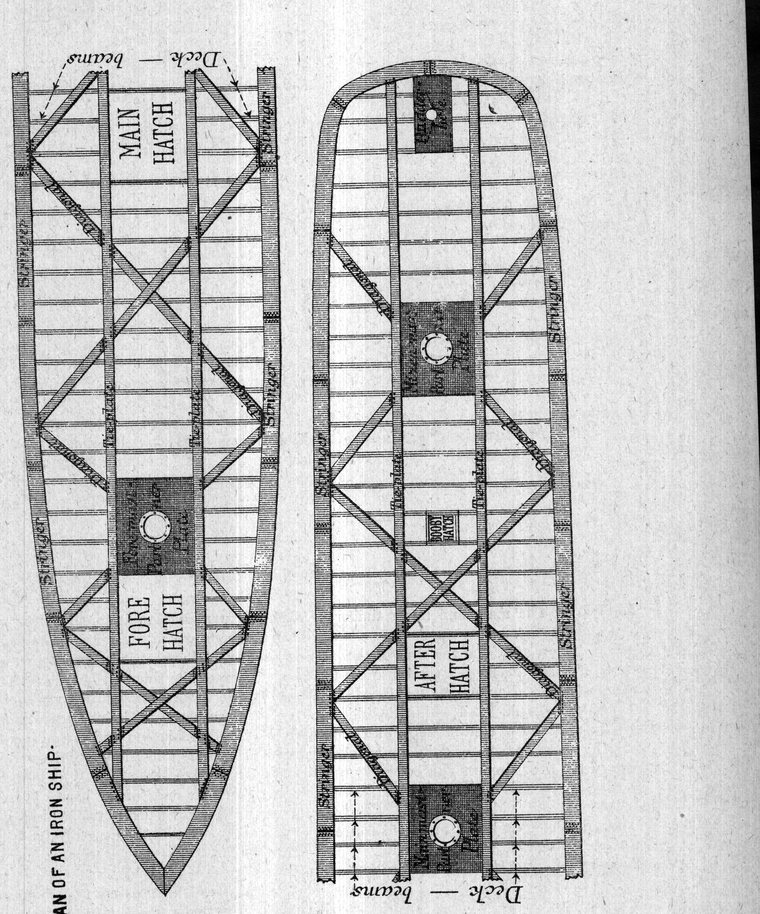
The knee timbers under the cat-heads.
Lapping the edges of planks over each other for a bulkhead.
Letting one piece of timber into another by alternate scores of projections from the middle, so that it cannot be drawn asunder either lengthwise or sidewise.
The upper part of the ship's stern, usually ornamented with carved work or mouldings, the ends of which unite to the quarter-pieces.
Chipping it with an adze, or boring it with a small auger, for the purpose of ascertaining its quality or defects.
A term applied to the direction that any line, etc., seems to point out--Thus we say, "Let the line or mould teach fair to such a spot, raise," etc.
The square part at the end of one piece of timber diminished so as to fix in a hole of another piece, called a mortise, for joining or fastening the two pieces together.
A name for sided timber exceeding four inches; but not being more than twelve inches, in thickness.
The inside of knee timber at the middle or turn of the arms. Also the midship part of the floor timbers.
A method of working English plank so as to make good conversion. As the plank runs very narrow at the top clear of sap, this is done by disposing the top end of every plank within six feet of the butt end of the plank above or below it, letting every plank work as broad as it will hold clear of sap, by which method only can every other seam produce a fair edge.