Below the PoleNavigation
When the north star (or other circumpolar body) is so situated that the pole is intercepted between the observer and the star it is said to be below the pole.
Page 340 of Patterson’s Illustrated Nautical Encyclopedia · 30 entries
When the north star (or other circumpolar body) is so situated that the pole is intercepted between the observer and the star it is said to be below the pole.
A zone, as the belt of calms; a girdle.
The area contained between the limits of the south-east and north-east winds near the equator.
Fixed points for reference left on a line of survey, indicating a series of levels at different elevations.
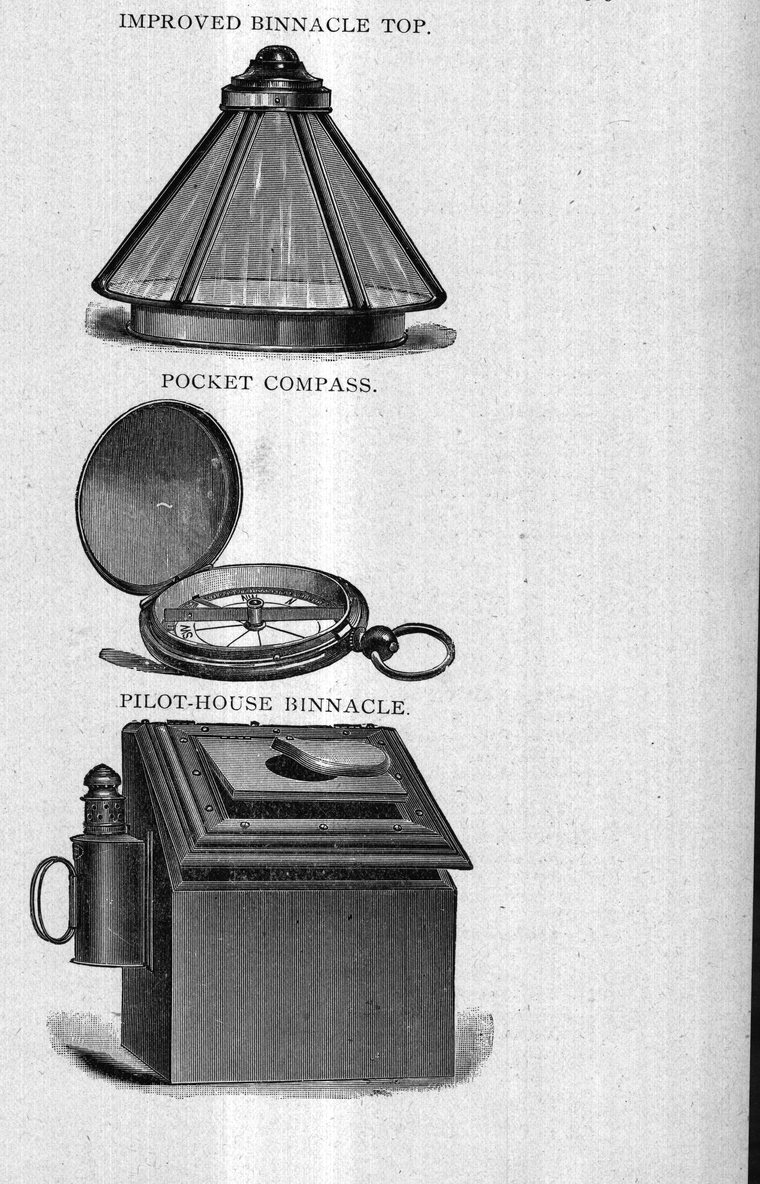
A case in which the compass is enclosed.
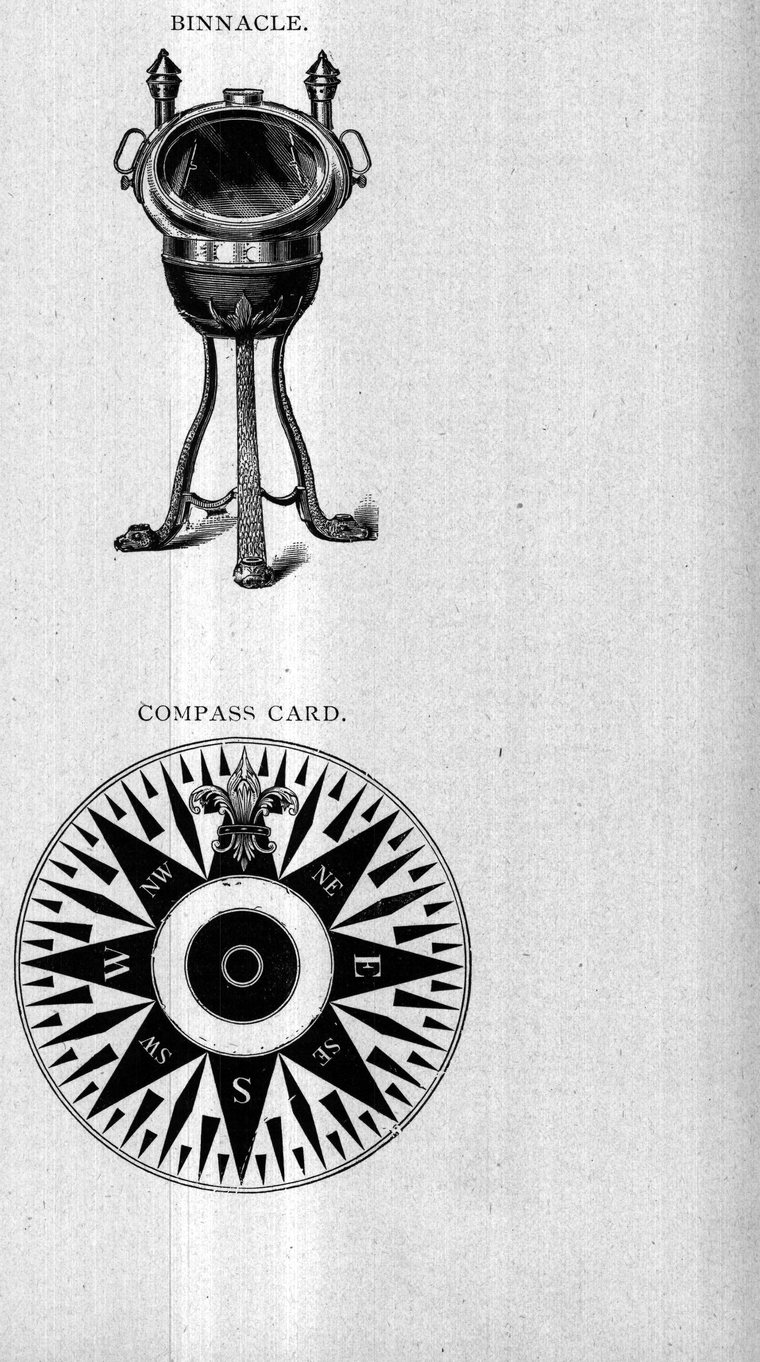
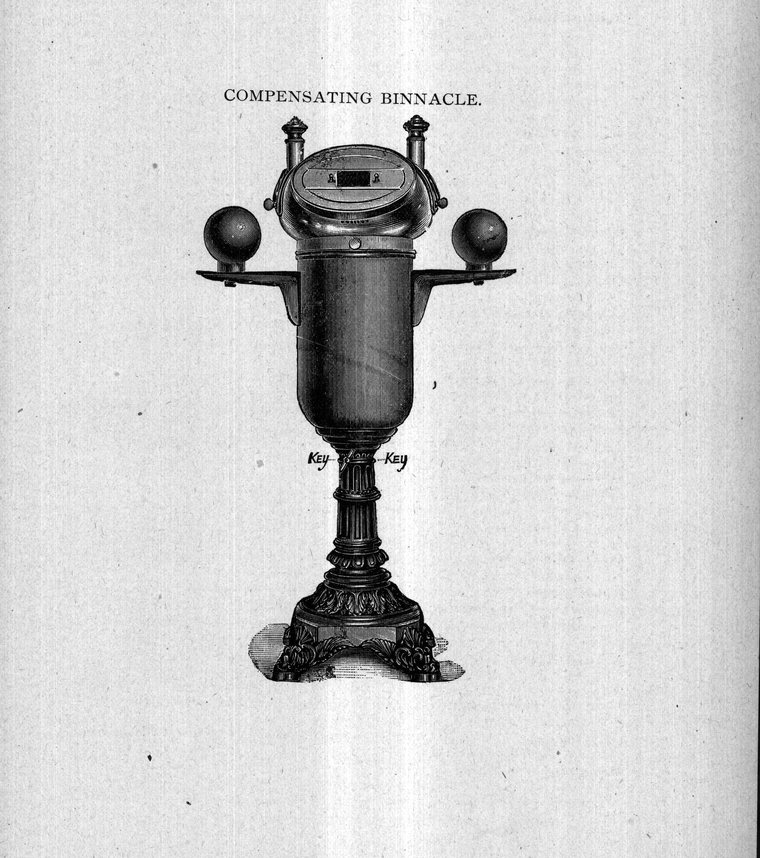
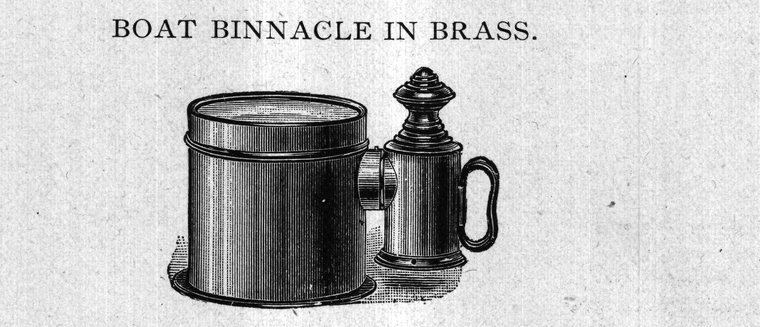
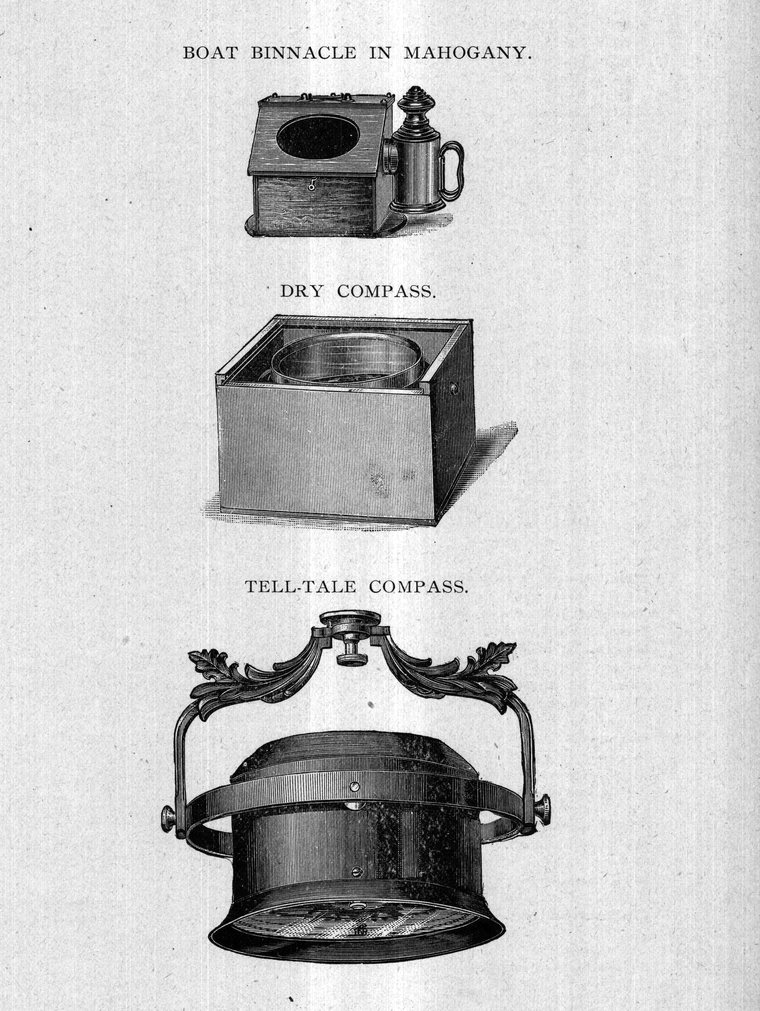
The dome of the binnacle.
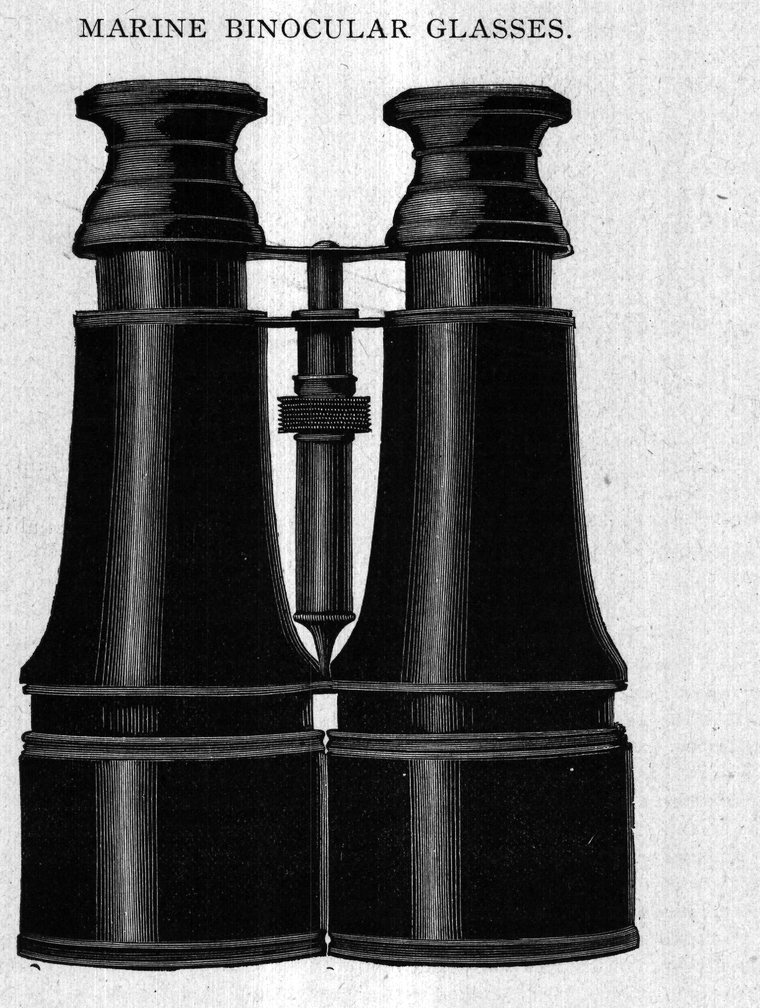
A double, or as it is sometimes termed, a two-barreled telescope.
A year introduced into the calendar by Julius Caesar, and is known as the Julian Correction. The next correction was made by Pope Gregory XIII in 1582, and adopted in England in 1752, when the 3rd day of September was, by Act of Parliament, called the 14th to compensate for the eleven days of error that had accumulated in the calendar since the correction by Caesar.
A short-lived but violent wind experienced in the northern part of the Adriatic Sea.
An old navigating instrument, employed for measuring angles. It consisted of a graduated arc of 90 deg., three vanes and a staff.
Nathaniel Bowditch, LL.D., F.R.S., a celebrated mathematician, astronomer, navigator and shipmaster; born in Salem, Mass., in 1773; died 1838; published in 1800 the first edition of the great work which bears his name.
A device for recording the height of tides, consisting of a long, vertical box, closed at the bottom, and having a sufficient number of small gimlet holes near the lower part to allow access of water, so that a copper float with a graduated rod contained within the box may be moved up and down with the tide.
Rehearsing the thirty-two points of the compass in order, commencing at north, and going around the circle by the way of east, or with the hands of a watch.
The steering compass on the bridge of a steamship.
A prismatic instrument, being a combination of zenith telescope and transit.
Floating beacons for the guidance of vessels. (See Part I.)
A period of from 28 to 31 days, derived from the synodical revolution of the moon.
Same as Common Year, containing 365 days.
The four cardinal points of the horizon, or of the compass, are the North, South, East and West. The inter-cardinals are the North-east, South-east South-west and North-west.
1. Mirror.
2. Telescope.
3. Handle.
4. Shade Glasses.
5. Horizon Glass.
6. Adjusting Screws.
7. Back Shade Glasses.
8. Arc.
9. Index Tangent Screw.
10. Sliding Limb.
11. Reading Glass.
12. Vernier Shade.
13. Vernier.
14. Mirror Adjusting Screw.
Winds blowing from any one of the cardinal points, such as a North, South, East or a West wind.
Opposed to terrestrial. The heavens.
The sun, moon, stars and planets.
The heavens. The terrestrial sphere is convex, while the sphere of the heavens appears to the observer on the earth's surface as concave.
The imaginary great line in the heavens over the earth's equator, from which the declination (latitude) of heavenly bodies is reckoned as high as 90 deg. north and south.
The declination of a heavenly body, or its distance north and south of the celestial equator.
The term sometimes applied to the right ascension of a heavenly body, which is reckoned from the first point of Aries eastward from 0 deg. to 360 deg., or from 0 hour to 24 hours.
The view of a spectator on the earth is bounded by the heavens and the horizon and this is known as the visible hemisphere. This together with the invisible hemisphere below the horizon, constitutes what is variously called the heavens, the celestial sphere, and the celestial concave.
The retard or acceleration in the running of a chronometer in relation to the rate previously calculated.
The turn of the tide.
The seven stars of the "Dipper."