The Nautical Encyclopedia
Patterson’s Illustrated Nautical Encyclopedia — Howard Patterson, 1891

Astronomical Time to Bearing of Storm Centre

Page 338 of Patterson’s Illustrated Nautical Encyclopedia · 23 entries

Astronomical TimeNavigation

The civil day begins twelve hours before the astronomical day, and the rule for transforming civil time into astronomical time is as follows: If the civil time is A. M., take one from the date and add twelve to the hours; if the civil time is P. M., take away the designation P. M. and the answer will be the astronomical time.
AstronomyNavigation

The science which treats of the heavenly bodies.

AtlasNavigation

A book of maps or charts.

AugmentationNavigation

Increase.

Augmentation of the moon is the apparent increase of the moon's diameter.

Aurora AustralisNavigation

The Southern lights. A luminous phenomenon attributed to electrical origin.

Aurora BorealisNavigation

The Northern lights.

Autumnal EquinoxNavigation

The period when the sun crosses the equator on its way into southern declinations.

AxisNavigation

An imaginary line passing through the centre of a body, and on which it is considered to revolve, also known as Axis of Rotation.

Axis of CollimationNavigation

Also known as line of collimation. The axial line of a telescope; also an imaginary line passing through the optical centre of an object glass and the intersection of the focus cross-wires.

AzimuthNavigation

The bearing (never in excess of 180 deg.) of a heavenly body calculated in degrees from the north or south point. Magnetic azimuth is the observed bearing of the body by compass. True azimuth is the geographical bearing of the body calculated for its declination, the hour and the parallel of observation, and found tabulated in special works on navigation.

Azimuth AttachmentNavigation

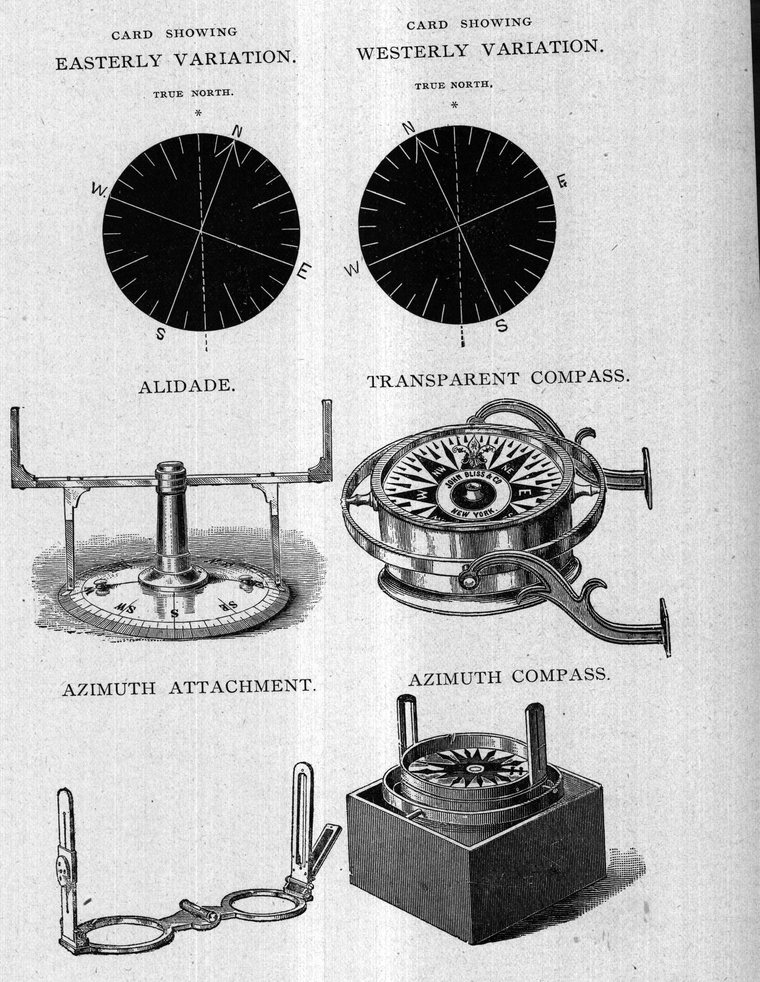
A handy little instrument composed of two upright sight arms, for centering in a "boss" in the middle of a compass glass. The limbs are revolved when taking bearings. The binnacle hood must be removed in order to use the attachment. (See engraving.)

Azimuth CircleNavigation

A great circle passing through the zenith and nadir; a vertical circle.

Azimuth CompassNavigation

A compass provided with revolving sight arms, and specially adapted for taking bearings. (See engraving.)

Cards showing easterly and westerly variation; alidade; transparent compass; azimuth attachment and azimuth compass

Azimuth DiagramNavigation

A diagram designed by one Godfray, which gives, without calculation, the true azimuth; the necessary data being the declination, apparent time, and the latitude of the observer.

Azimuth MotionNavigation

An instrument is said to "move in azimuth" when it turns on a vertical axis.

Azimuth TablesNavigation

Published tables giving the true bearing of the sun, calculated for various declinations, parallels and time.

Back ObservationNavigation

An altitude measured on a back observation quadrant, which requires the observer to turn his back to the body observed. The instrument is an ordinary quadrant with the addition of a second horizon glass below the regular one, and the former one is looked into while measuring the altitude--the instrument being held backwards, so that the observer faces the mirror, and pulls the sliding limb towards him. This instrument is used for measuring the altitude of a heavenly body from its farthest horizon by throwing it across the observers, zenith. This process is only employed when the intervention of the land does not admit of a regular fore observation.

BalestilhaNavigation

The cross-staff of the early Portuguese navigators.

BarometerNavigation

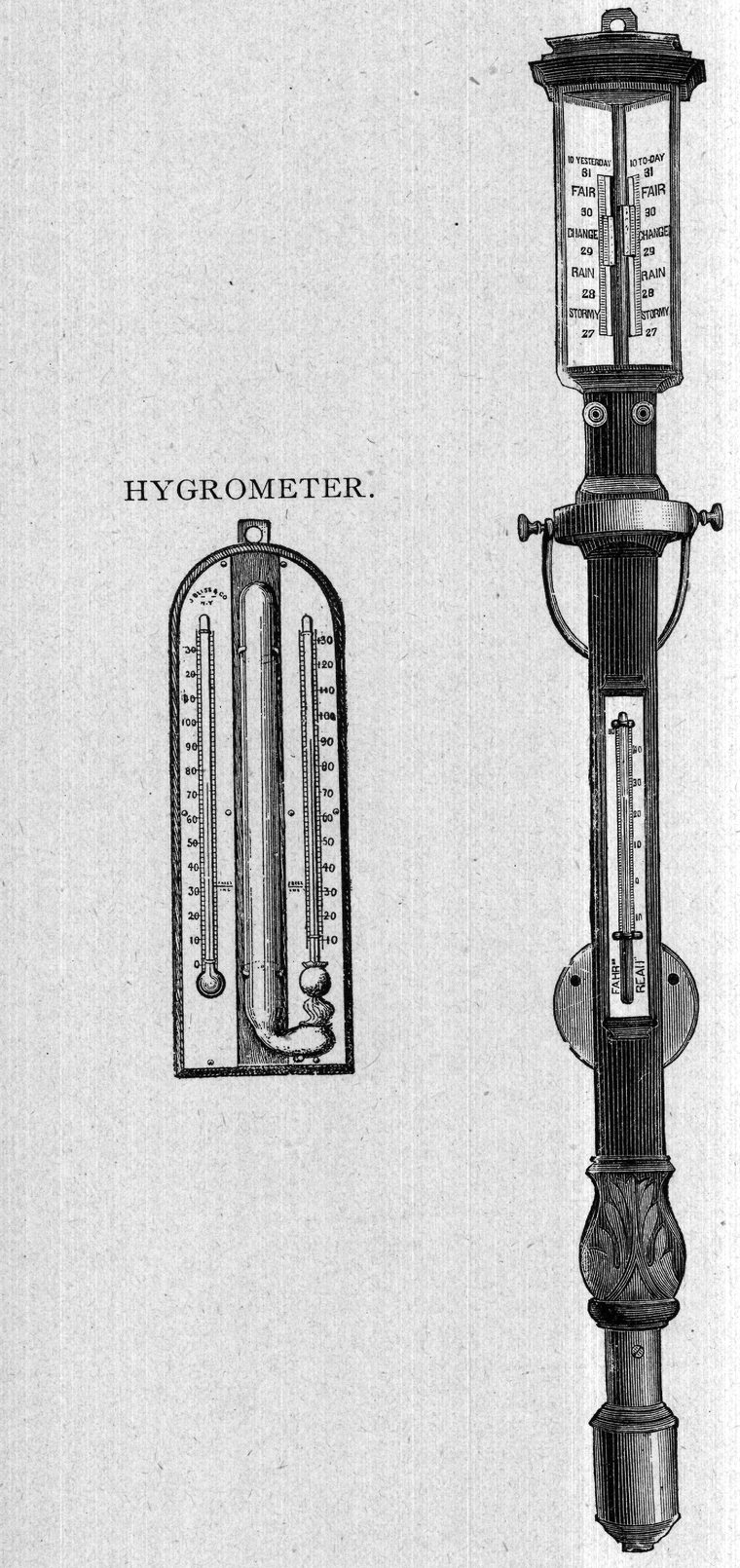
An instrument which records the weight or pressure of the atmosphere. The mercurial barometer consists of a glass tube 34 inches long, closed at the top, and exhausted of air. The lower end of the tube is immersed in a cup of mercury (quicksilver), which the pressure of the atmosphere causes to rise in the tube, on one side of which, on the frame, a graduated scale is found, embracing the range of oscillations. (See Aneroid Barometer.)

THE QUADRANT OF REFLECTION

1. Sliding Limb.

2. Mirror.

3. Horizon Glass.

4. Sight Vane.

5. Shade Glasses.

6. Adjusting Screw.

7. Adjusting Screw on Mirror.

8. Index Tangent Screw.

9. Arc.

0. Frame.

The vernier is set on the sliding limb against the arc of the instrument

Hygrometer and mercurial barometer
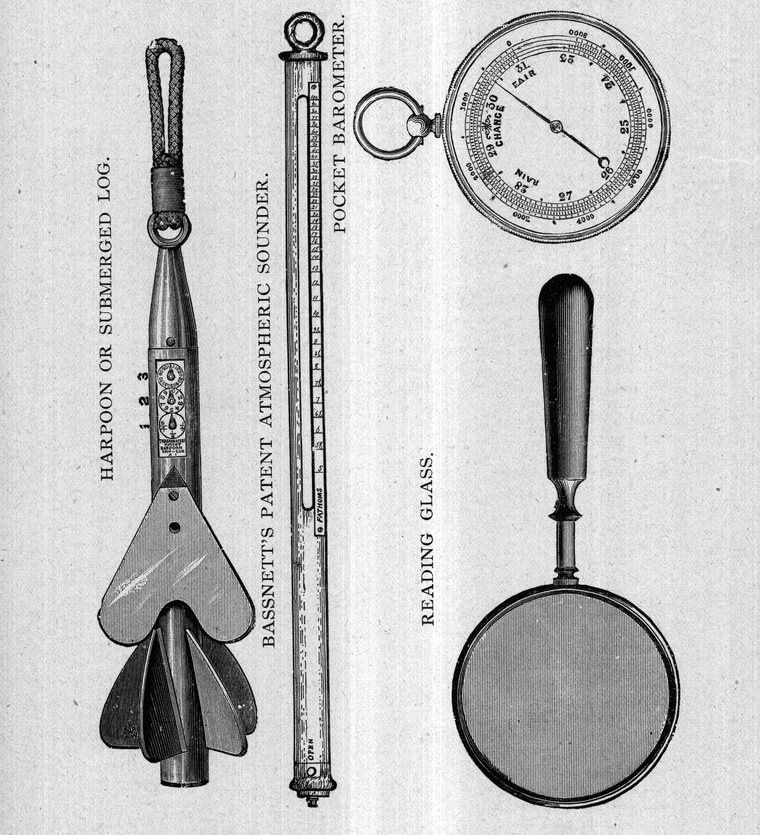
Harpoon or submerged log, Bassnett's patent atmospheric sounder, pocket barometer and reading glass

Base LineNavigation

The geometrical plane; the base on which the triangulation is founded; the lowest side of a figure, as that of a cone, etc.

Beam CompassNavigation

A drawing instrument used in surveying.

BearingNavigation

The direction of one thing from another by the points of the compass.

Bearing of Storm CentreNavigation

Eight points to the right of the wind's eye in the northern hemisphere, but eight points to the left of the wind's eye in the northern hemisphere, according to the Circular theory, but about ten points by the Indraught theory.

← page 334The A–Z indexpage 340 →