Chart CompassNavigation
The diagram compass (either true or magnetic) printed on charts.
Page 344 of Patterson’s Illustrated Nautical Encyclopedia · 16 entries
The diagram compass (either true or magnetic) printed on charts.
Shaping the course of the ship from point to point, and finding the distance contained between them, by aid of the parallel rules and dividers.
A process for finding the time.
(See Log Chip.)
A marine timepiece of superior construction and accuracy.
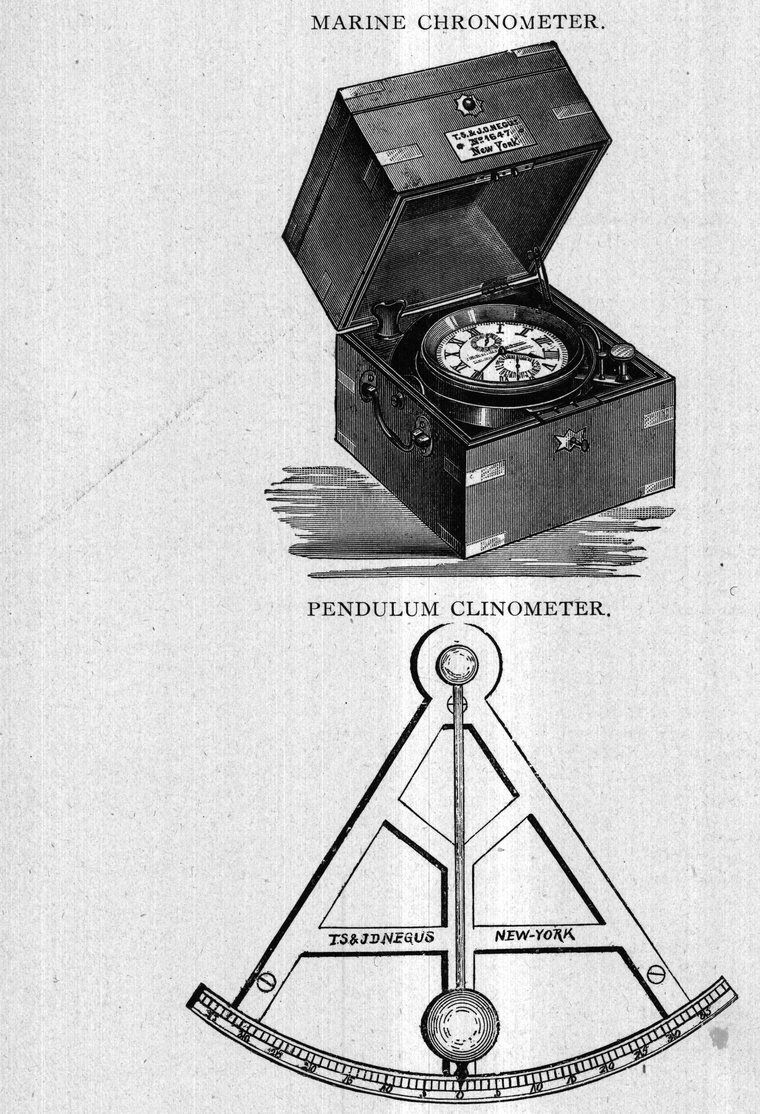
The operation of determining the error of a chronometer by means of time-balls, observatory clocks, or by the employment of an artificial horizon sight.
The aggregate amount of time the chronometer is either in advance of or behind the mean time of the Greenwich or other meridian which the instrument represents.
The daily loss or gain in time of a chronometer in comparison with the mean time of the meridian which the instrument represents.
A ring; a circumference; the line that bounds a circle; a round body; a globe.
Altitude Circles. Great circles upon which altitudes of heavenly bodies are measured.
Astronomical Circle. An instrument of reflection for measuring angles, the limb being a complete circle.
Great circles passing through the poles of the horizon.
A circle whose plane passes through a sphere and is bounded by its surface. When the plane of the circle passes through the centre of the sphere it is called a great circle; but in all other cases it is known as a small circle.
One-half of the earth's surface is illuminated by the sun when the other half is in the shadow, and the great circle which marks the boundary of light and darkness is termed the circle of illumination.
Great circles passing through the poles of the ecliptic.
The circum-polar stars included within this circle never rise.
The circum-polar stars included within this circle never set.
An instrument for measuring the angular distance of the moon from the sun or a star, and much superior for this purpose to a sextant.
ABC. The Earth
ZAK. Vertical plane passing through D, the moon, or d, a planet
ed GEDF. Circular arcs about C as a centre
C. The Earth's centre.
A. The Observer
KZ. Starry heavens
If at any time the moon be at D, she will be referred to the point H, by a spectator supposed to be placed at the centre of the earth, and this is called the true place of the moon; but the spectator at A will refer the moon to the place b, and this is called the apparent place of the moon; the difference Hb, or the angle HDb=ADC, is called the moon's parallax in altitude, which is evidently greatest when the moon is in the horizon at E, being then equal to the arc KI. When the moon is at Z (the zenith) there will be no parallax, the body being observed on the same line from the centre of the earth as from the earth's surface.
1. Altitude of the sun's lower limb--semi-diameter added gives central altitude.
2. Altitude of the sun's upper limb--semi-diameter subtracted gives central altitude.
3. Altitude of the sun's middle--semi-diameter not considered.
4. Altitude of the moon's lower limb--semi-diameter added gives central altitude.
5. Altitude of the moon's upper limb--semi-diameter subtracted gives central altitude
6. Altitude of a star--possesses no apparent diameter.