Line of Sines, Tangents and SecantsNavigation
Scales of several radii.
Page 376 of Patterson’s Illustrated Nautical Encyclopedia · 21 entries
Scales of several radii.
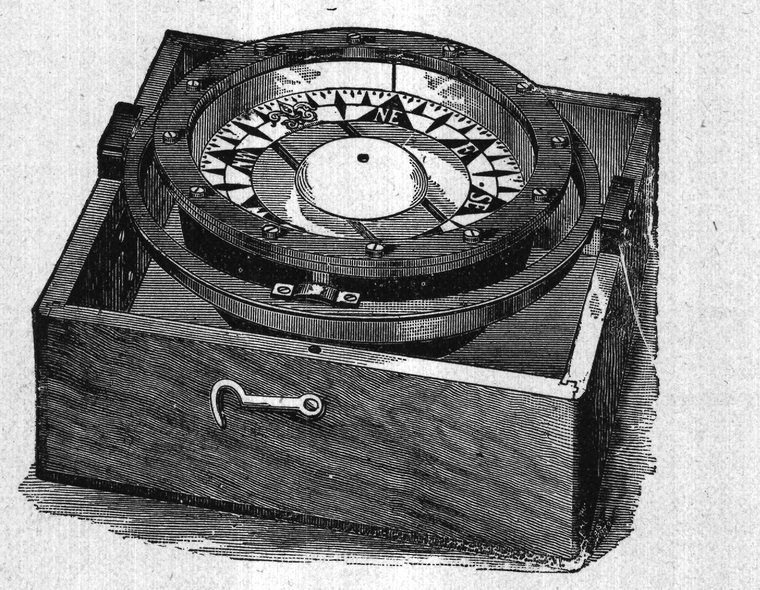
(See Compass.)
A certain rule, named after the inventor, for determining the longitude by observation by employing circum-meridian altitudes.
Magnetic elements outside the ship, affecting the pointing of the compass on board.
The time confined or limited to a place; time calculated by the passage of the mean sun over the meridian.
(See Apparent Time.)
The crossing or passage of a heavenly body over the meridian of the observer.
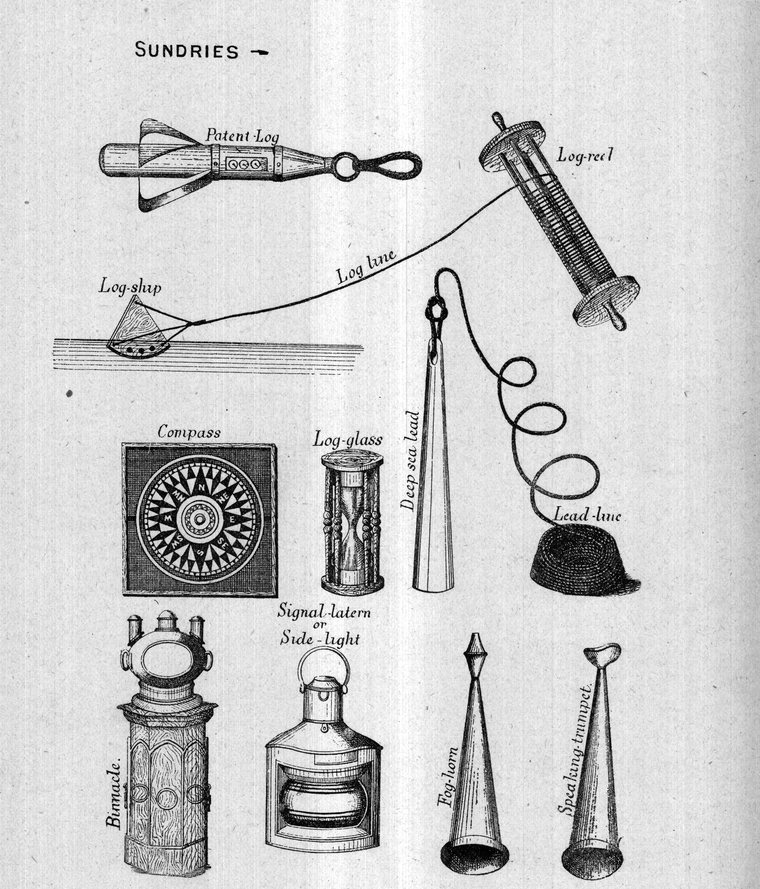
An instrument used for measuring the rate of a vessel's speed through the water. There are many kinds, the most ancient being known as the "old-fashioned chip log," and the patent logs (working by a series of cog wheels) are known respectively as the "Bliss American Taffrail Log," the "Walker Taffrail Log," the "Massey Harpoon Log," the "Cherub Log," and the spring log, known as the "Clark Russell Log." (See Current Log and Ground Log.)
(See Part I.)
(See Part I.)
A flat piece of board in the shape of a quadrant--a part of the old-fashioned log.
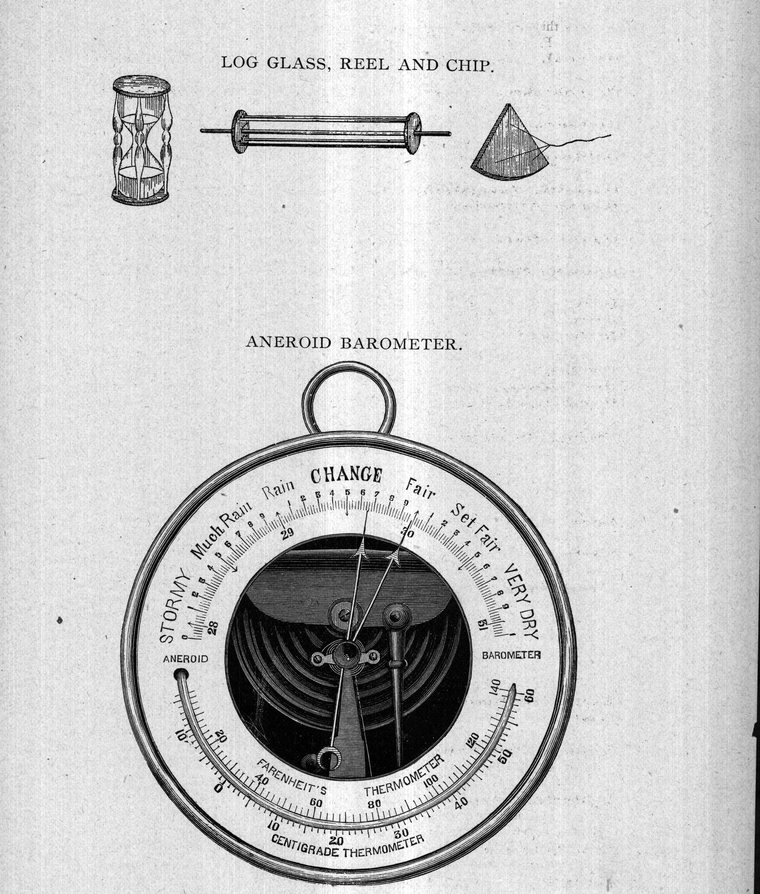
The register of a taffrail log.
The sand-glass belonging to the chip log.
Recorded in the log-book.
The line belonging to the chip log, or the line which connects the propeller of a taffrail log with the register.
The reel on which the log-line is wound.
Same as log chip.
(See Part I.)
The exponent of the power to which a fixed number, called the base, must be raised to produce a certain other number. Logarithms were invented by Lord Napier, a Scottish baron. They abridge greatly the labor of trigonometrical calculation, multiplication, division, involution and evolution of natural numbers being performed respectively by the addition, subtraction, multiplication and division of the corresponding logarithms. Lord Napier's base is 2,71828, and the common, constructed by Prof. Henry Briggs, is 10.
The logarithm of the number of seconds in an hour (3,600) diminished by the log of the number of seconds less than an hour.
The distance, expressed in degrees, or hours, east or west of a given meridian.
Celestial Longitude. The distance of a heavenly body from the vernal equinox, reckoned on the ecliptic. Celestial Longitude is reckoned from the first point of Aries, eastward, from o deg. to 360 deg. and from 0 h. to 24 h.
Difference of Longitude. The difference in degrees, minutes and seconds of arc, or the difference in hours, minutes and seconds of time between two meridians.
Geocentric Longitude. The longitude of a heavenly body as viewed from the earth.
Heliocentric Longitude. The longitude of a heavenly body as viewed from the sun.
Terrestrial Longitude. The distance of any place on the earth's surface, east or west of a given meridian, expressed in arc or time.