Diagram CompassNavigation
The figure of a compass printed on charts.
Page 356 of Patterson’s Illustrated Nautical Encyclopedia · 13 entries
The figure of a compass printed on charts.
The distance through the centre of any object, from one circumference to another.
The arc of a meridian included between two parallels.
The arc of the equator included between two meridians.
When a heavenly body disappears below the horizon it is said to dip. Also after a heavenly body has passed over the meridian it is said to dip.
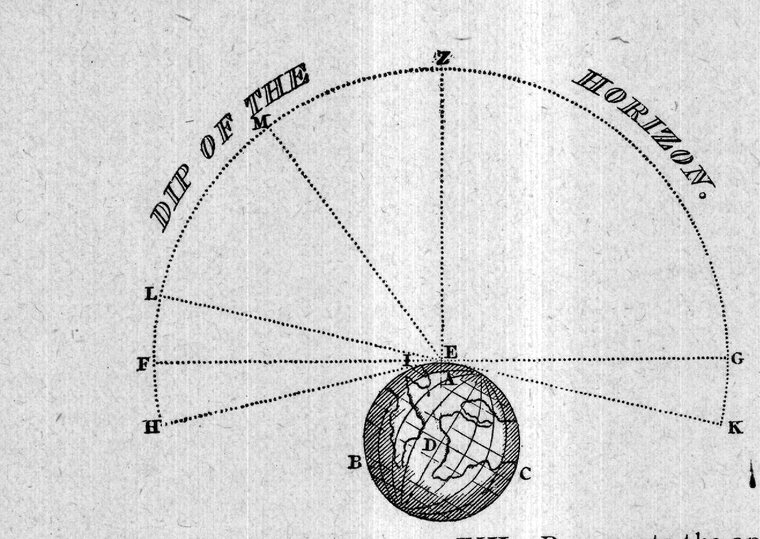
Owing to the elevation of the eye of the observer above the surface of the earth the visible horizon is depressed below the sensible horizon, and this is known as the dip of the horizon.
The angle formed with the horizontal by the dipping needle.
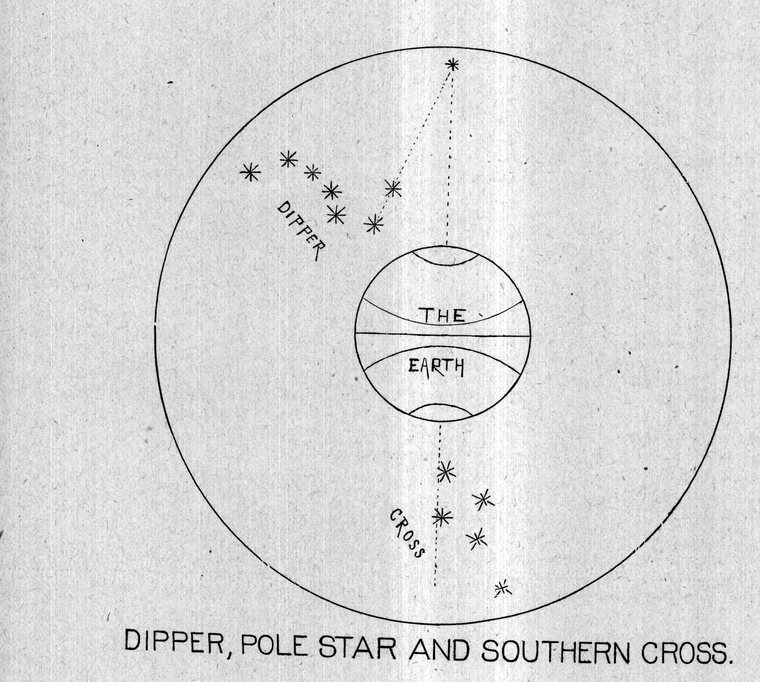
The seven stars in the constellation of the Great Bear, and by means of which the location of the Pole Star is readily determined.
An instrument which shows the direction in a verti a plane of the magnetic force of the earth. The contrivance consists of a magnetic needle suspended at its centre of gravity so as to move freely in the plane of the magnetic meridian. A graduated circle surrounds the needle.
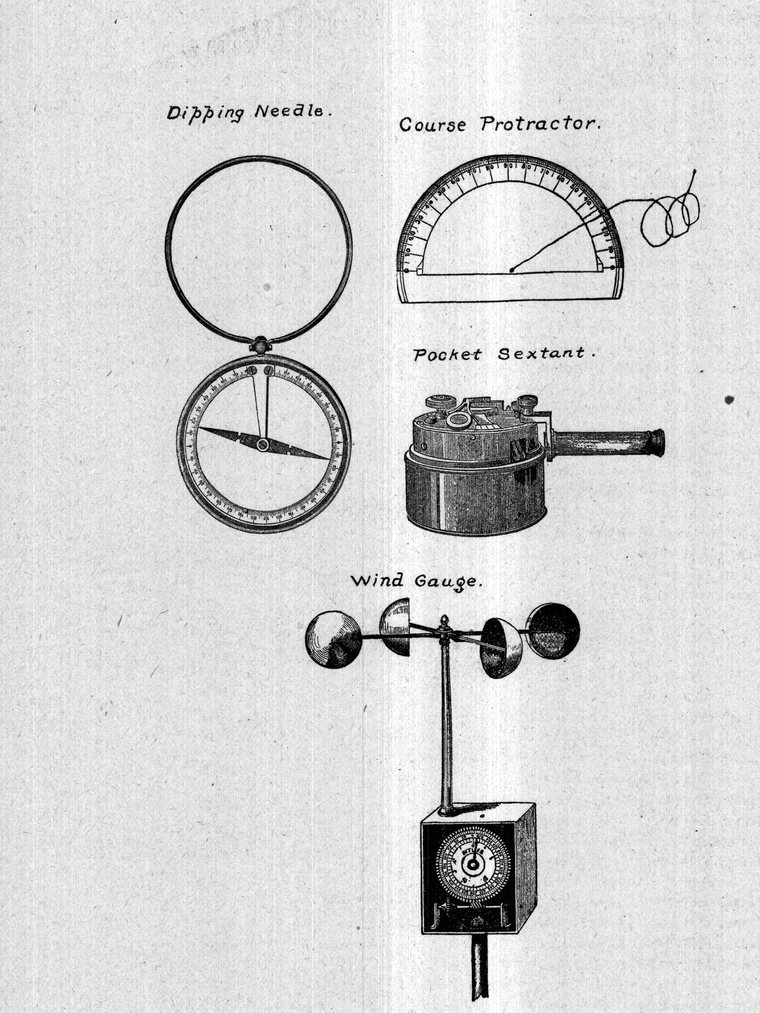
An instrument for measuring the true dip of the horizon.
Also disk. The face of the sun, moon, or planet.
The distance between any two points on the surface of a sphere is measured by an arc of a great circle.
The distance of the stars is a subject which has naturally engaged the close attention of astronomers, ancient and modern, but all their efforts to arrive at anything like a satisfactory conclusion have failed until within a very recent period. The stars appear in precisely the same positions from whatever part of the earth they are viewed, but with the hope of detecting some change of place by which to judge of their separation from us, they have been observed at points as widely distant from each other as we are able to command, viz., from opposite parts of the earth's annual orbit. With this base line of 190 millions of miles there is the most favorable chance of detecting the parallax of a star, provided the instruments employed are sufficiently accurate.
An annual parallax of one second of arc would indicate a distance of about 206,000 times the radius of the earth's orbit, that is, of 206,000 times 95 millions of miles. In only one instance has a parallax closely approaching this amount been discovered, and this in the case of the star aCentauri, which is never visible in England. It is found that the semi-diameter of the earth's orbit would subtend at the star an angle of 97-100ths of a second, whence it follows that the distance must be 211,000 times that of the sun from the earth, or twenty billions of miles. The late Professor Henderson, Astronomer Royal at Edinburgh, and formerly at the Cape of Good Hope, has the merit of having first detected the parallax of aCentauri.
The distance is so enormous that the mind is hardly able to appreciate it; light, with its astounding velocity of 191,500 miles per second, furnishes the only unit by which it can be measured and brought within small numbers. Suppose a ray to leave this star, travelling through space at the above prodigious rate, it would not reach the earth until after the expiration of 1,218 days, or 3 1-3 years. We do not see the star as it actually is, but it shines with the light emitted 3 1-3 years ago. Hence if it were obliterated from the heavens, we should continue to see it for more than three years after its destruction.
It has been considered probable, from recondite investigations, that the average distance of a star of the first magnitude from the earth is 986,000 radii of our annual orbit, a distance which light would require 15 1/2 years to traverse; and further that the average distance of a star of the sixth magnitude (the smallest distinctly seen without a telescope) is 7,600,000 times the same unit, to traverse which, light with its prodigious velocity, would occupy more than 120 years. If, then, the distances of the majority of stars visible to the naked eye are so enormously great, how are we to estimate our distance from those minute points of light discernable only in powerful telescopes? The conclusion is forced upon us that we do not see them as they appeared within a few years, or even during the life time of man, but with the rays which proceeded from them several thousands of years ago. What an idea does this consideration give us of the immensity of the stellar universe.--f. R. Hind, F. R. S.